Satan's Host - Official Website


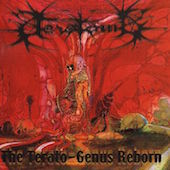
The Terato-Genus Reborn

United States Country of Origin: United States

The Terato-Genus Reborn
Send eMail
Type: Full-Length
Release Date: 2000
Label: Fleshfeast Productions
Genre: Death, Grindcore
1. By The Hands Of The Devil
2. Shades Of The Unlight
3. Demontia
4. Before The Flame
5. Bleeding Hearts Of The Damned
6. Black Hilted Knife
7. Revival
8. Fallen Angel
9. Inferior Worlds
10. Norwegian Wood (The Beatles Cover)
1. The Teratogenous Reborn
2. Pathogenous Morphology
3. Decrepit Carnage
4. Venial Conspiracy
5. Hollow Preacher
6. I Will Feed On You
7. Dimension
8. Visceral Hate
9. Christ Passion (Sodom Cover)
10. Suffering


Review by Jophelerx on August 4, 2024.

Harry Conklin is revered by fans of the traditional heavy metal/USPM scenes for his seminal, inimitable performances in groups like Jag Panzer, Titan Force, and the subject of today's review, Satan's Host. While it never had the same widespread appeal and praise as Jag Panzer's almighty Ample Destruction, largely due to its subpar production, Satan's Host's 1986 debut album Metal from Hell is still quite well-respected within the genre for bringing a darker, more occult "black metal" edge to the traditional scene, being one of the few bands to combine the occult vitriol of something like Venom to the US trad metal scene, with Exorcist's Nightmare Theatre being the other notable example. Of course, at the end of the day, Metal from Hell isn't black metal in any technical sense of the term in its modern denotation, merely dark heavy metal/USPM with occult lyrics and a ton of aggression. The same can be said of the follow-up EP Midnight Wind, the only other release from the band in its original incarnation. It was written and recorded in 1987 but wouldn't see the light of day until a limited CDR pressing in 1995 due to the original label going belly up, but Satan's Host was far from done. The passion project of Patrick Elkins, AKA Patrick Evil, the band predated Conklin's involvement and would carry on as an actual black metal band from the late 90s with vocalist L.C.F. Elixir, who brought more standard black metal shrieks to the mix and transformed the project into something that stayed more or less in the realm of extreme metal, releasing 5 full-lengths and an EP over the course of more than a decade.

Of course, we're not here to talk about any of that, but context is important, and Conklin's triumphant return to the fold with 2011's By the Hands of the Devil, his first new material with the band in 24 years, owes much to both that original 80s material as well as the black metal direction Patrick Evil and LCF Elixir took the band into in the 2000s, as this band sees a combination of the two styles that works surprisingly well, and features one of Harry Conklin's most engaging, charismatic, and technically masterful performances of his long and storied career. While his run with Jag Panzer from 1997's The Fourth Judgement to 2004's Casting the Stones is celebrated by many, there's really no album in the band's modern discography that sees Conklin as enthused and unhinged as he is here, and it's clear this more relentless, aggressive style is something he really enjoys doing and gels with quite nicely. It's really impossible to understate just how well everything comes together here, in fact, as classic USPM and black metal have never really been friendly with one another, and while the album's frenetic, intense riffs certainly take some influence from thrash metal as well, the black metal influence is undeniable, the tremolo riffing which is a staple of the genre appearing many times throughout the album's run. However, this is far from a black metal album with traditional heavy metal vocals thrown on top; there is a lot of care put into incorporating all of the seemingly disparate influences into a very cohesive whole, and while Conklin's varied and undeniably infectious performance might be the glue that holds it together - he throws out his share of growls and shrieks, though he still sticks primarily to his standard gruff tenor - the songwriting is impeccable, with the guitar work going from USPM to thrash to black metal to any combination thereof, as the mood of the song calls for it.

The drumming perhaps shows the difficulty that goes into blending these genres more than any other aspect of the album, as there are a lot of blast beats even in passages that feel much more in a heavy/power/thrash vein than a black metal one, and it's clear that the man behind the kit, Anthony "Hobbit" Lopez is much more comfortable in a black/death metal context, having cut his teeth pretty much exclusively in extreme metal, starting his stint with Satan's Host on the previous album, Power ~ Purity ~ Perfection...999 two years earlier, and while he does have some interesting drum lines in slower tracks like "Bleeding Hearts of the Damned," showing that he's definitely more than a one trick pony, he seems to revert to a more black metal style whenever the music gets faster or more intense, even if that's not generally the vibe the music is going for, and that does hurt the album's otherwise varied and organically unique blend of styles somewhat, but of course drumming isn't the main focus of the album so it's only so much of a problem, especially given that the drumming is appropriate enough probably 65-70% of the time. The real star of the show here, as I've already mentioned, is the legendary Harry Conklin, though somewhat weaker tracks like "Bleeding Hearts of the Damned" and "Inferior Worlds," whose sparse instrumentation and more repetitive ideas leave him to hold up most of the song's melody on his own, show that the riffs are definitely a hugely important element as well.

I wouldn't really say the album has pure USPM tracks or pure black metal tracks, rather the songs themselves tend to alternate between more traditional and more extreme passages when they don't combine both into a slurry of blistering yet surprisingly melodic elements almost always rooted in a traditional heavy metal sensibility. Tracks like "Black Hilted Knife" do lean more into the extreme metal side, with Conklin letting out some absolutely malevolent, growling rasps, and even the verses where he goes for his more traditional style are very black metal-inspired in the riffing, but this is easily the most extreme example on the album, and most of the tracks lean more towards the USPM side, with thrash influence thrown in for good measure. The album certainly isn't without its more measured, slow-burn epics, which shouldn't be particularly surprising given the fact that most of the tracks here are at or above the 6-minute mark, and long-time fans of the band will remember the band's penchant for this style of track with examples like "Souls in Exile" and "Witches Return" from their 80s run. The obvious pick here for a multi-part epic is "Before the Flame," an 8-minute behemoth that features tons of cool multi-tracking from Conklin, a healthy contrast between fast and slow, melodic and extreme, that really showcases everything this new iteration of the band is capable and the brilliant ways in which their dogged ambition can pay off. This is probably the best track on the album, though it is quite difficult to pick, with most of the tracks outside of the two I mentioned earlier being an immaculate 10/10.

Tracks like the opener "By the Hands of the Devil" with its relentless pace that still satisfies the USPM fan in me, "Shades of the Unlight" which shows the band's more melodic chops and ability for restraint when necessary, or "Revival," whose more complex songwriting that belies its blistering intensity and foreshadows the more sophisticated and varied songwriting which would appear on the follow-up Virgin Sails all shine very brightly, and "Fallen Angel" even shows that the band can do more subdued rockers quite well. In contrast to "Shades of the Unlight," which is more about a sinister buildup to the evil intensity of the chorus, "Fallen Angel" pretty much stays in a slower, more melodic space for the entirety of its duration. "Bleeding Hearts of the Damned" also does this, but doesn't work as well, feeling more bare bones and repetitive to me, and while that song is probably the low point of the album, "Fallen Angel" is an anthem whose simple riffing still provides a solid foundation and allows Conklin to shine not only with his commanding main vocal lines but also little accompaniments like his falsetto "Ooh"s thrown in here and there. Then two minutes into the song we suddenly change gears, with the guitars changing pace to a gallop (though one that's more in line with a faster NWOBHM track than anything thrash or extreme metal) where Conklin gets to throw out the brilliant lines "Into/through a storm, sin is born" over and over in an almost angelic refrain in a passage which could totally have fit into something from the mid-80s, before taking it up yet another notch into riffing that has some black metal inspiration and drumming that is admittedly a bit distracting but still can't take much away from Conlkin taking things up to one of his most memorable performances on the album, belting out high notes and then eventually harmonizing with himself with two totally different vocal lines (different lyrics and everything) layered on top of each other, making a unique experience that transcends genre and makes it one of the greatest tracks here that really only this band could have pulled off in 2011.

"Inferior Worlds" is still a very solid track but I feel does the worst job of incorporating all the black and USPM-styled elements together, feeling more like what you would expect from such a combo, black metal riffing and drumming followed by more traditional sections that don't always feel put together organically. It still has some great ideas and doesn't feel totally disjointed, but doesn't close out the album on the highest note. Actually, most versions of the album include the bonus track "Norwegian Wood," and yes, this is a Beatles cover, though the lyrics are changed so that Conklin describes the very black-metal-approved subject of church/priest burning rather than the Beatles' original more peaceful lyrics. However, the music hasn't changed enough for this to feel like a real Satan's Host track, and it feels more like a joke inclusion if anything, with the weird '60s pop-rock riffing feeling totally out of place, though the addition of some tremolo and blast beats are interesting in that they make me think of the popular idea that black metal is just surf rock with distortion. Either way, this is pretty skippable after the novelty wears off, unless you're the one person who's a fan of The Beatles and black metal and really resonates with this combo. Overall, though, this is an incredible album that's not quite a return to form, instead becoming something even better that wouldn't have been possible without the band's unique history and boasts a production that makes full use of all the tools available in the 2010s without any of the shortcomings that plagued Conklin's original stint with the band. If you're a fan of the darker side of USPM or just enjoy Harry Conklin in any of his many projects, I highly recommend at least giving this a chance, as it really offers something unique and kicked off a run of several albums which few 80s bands on this style would rival in this era.

Rating: 9.2 out of 10

   799

Review by Carl on October 15, 2024.

Old school brutal death metal, completely done in the glorious tradition of the late 90's and early 00's. It's a style I do miss, quite honestly, because I don't seem to encounter it a lot anymore. Maybe I'm looking in all the wrong places? Could very well be, who'll say?

What Teratoma offers up on their first full-length sounds wonderfully familiar. The band is heavily reliant on down-tuned riffing, blubbering, and pulsing through a set of tracks that go full blasting speed ahead for the most part, with at times some room built in for a dose of pulsing midtempo stomp as well. As this tradition dictates, the total picture is held together by a deep and hoarse grunt, occasionally alternated by some larynx-shredding screams, upping the intensity factor with a few notches more. Melody is a concept totally unknown to Teratoma, with the band rather choosing the blunt approach to their craft, relying mostly on brute force to get the message across. In tracks like "Hollow Preacher" and "Visceral Hate", we get a few guitar leads shoved into our earholes, and while I find these to be cool additions to the overall sound, honesty also dictates me to say that these are perhaps not their strongest suit. These leads sound a bit flat and uninspired as if they were improvised on the spot. In its totality, it certainly is a straight-forward approach to the music, and for the majority of the album it works exquisitely, aided in no small part by the heavy and sturdy production job.

There aren't a whole lot of things that rub me the wrong way on this album, but I also have to admit that towards the end, a feeling of uniformity sets in. That the music is played at high speed for a big part is responsible for this, but the band also has some tendency to repeat their ideas throughout. When coupled with the dense and heavy production, it does bring on a bit of a 'one long song' feel towards the end. Not really that big of a problem for me personally, but for some others, it could be, I imagine. Perhaps also not really a problem, but kinda redundant in my book, is the cover of Sodom's "Christ Passion", which is one that wasn't really necessary for me.

This is a heavy and intense offering of 90's brutality, a release that fits in snugly with the early works of bands such as Aborted, Kadath, Sintury, Fleshgrind, and of course Suffocation and Dying Fetus, but in a somewhat simpler way. Far from overcomplicated, Teratoma let their music royally hit the spot through sheer force and intensity, and I like it all the better for it. A good album, that certainly deserves more appreciation, I say.

Rating: 8 out of 10

   799