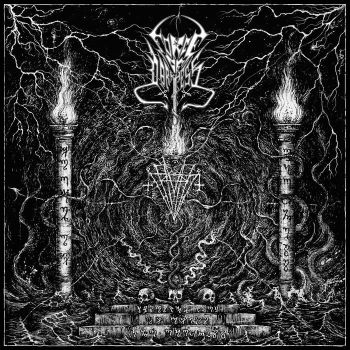
Gorgoroth - Official Website
Twilight Of The Idols - In Conspiracy With Satan |
Norway
![]() |
|---|
Review by HanSathanas on May 10, 2026.
It took me a while to finally sit down and review this album. The first three records are without a doubt my all-time favorites. But Twilight of the Idols is something else altogether. In retrospect, this full-length seems to hint at things to come, which is the eventual removal of both Gaahl and King from the equation and the rise of rather short-lived God Seed. Despite all the nonsense surrounding the band’s career, this album stands the test of time, a prime example of how deviation from the planned work program based on the existing blueprint can sometimes mean a good thing.
Some of the things that are immediately noticeable are the abundance of death metal-influenced galloping palm-muted chugs on the majority of the songs. Although at first listen, such adventurous side quests feel rather at odds with Infernus’s trademark riffing style, a few albums ago. The sound engineering on this album is also top-notch, eschewing lo-fi aesthetics that could have interfered with the blazing wall of guitars that are thankfully emulsified by the active bass guitar from start to finish. Procreating Satan is the best example of this; an avalanche of decadent grotesquery comes crashing down from the get-go. Sinister tremolo picked disharmony and solid blast beats are made in hell, and Gaahl preaches his distorted dissent with vitriolic inebriation, which is made famous thanks to the clustering of chants “Our master’s returned, praise Satan!”. Replete with hostility, this opening track sets the stage for what the entire album is generally focused on: pummeling black metal aggression where it needs to be, rhetorically delivered with full force, as evident with Kvitrafn’s grueling double bass assault – not the fastest, but certainly impactful. He is not Frost, obviously. However, Kvitrafn’s limbs somehow suited this album quite well, especially on slower, more atmospheric offerings. He is, after all, the one who penned the songwriting on the opening track.
The riffs are a lot less complex and may even be predictable at times. For example, Proclaiming Mercy shares its genetic materials with Exit, thus creating a sense of consistency, especially in the former, where it features a rhythmically barbaric galloping riff on the verse section. Such a mid-paced track signals not only a shift in atmospheric intensity but will also save whoever is the drummer during any live show, as the pace allows for a brief reprieve. With that being said, by now it is already common knowledge that Gorgoroth likes to write a drum part that is reminiscent of Diamond Head’s Am I Evil. First heard in Revelation of Doom, this pattern is again used in the opening of Exit – Through Carved Stone, albeit slower in tempo this time around. The exchange between hefty, lumbering slithers and vicious ferocity is neatly incorporated in Teeth Grinding, too. Galloping chords are complemented with evocatively atmospheric notes that are sustained at every turn before shifting up the pace toward the second half of the song. Tempo-wise, Exit is more upbeat than, say, Sorg. On its own, the grim aesthetic is amplified during the break after the church bell tolls, giving enough room for melancholic indulgence reminiscent of Sorg. However, instead of dwelling on plodding nostalgia, the death metal element seeps in while Gaahl nonchalantly delivers his sermon: “See me rising!”
One of the highlights on this album is definitely Forces of Satan Storms as it weaves the brutality of death metal into the abrasive seams of black metal nihilism. Here, Kvitrafn cleverly uses the hi-hat to mesmerize the listener with a mirage of speed when he is actually not playing any faster than what is heard. The breakdown prior to the chugging riffs altogether makes this song worthy of repeated listens. Not to mention the slow, textured jangling chords are effectively done prior to the second half of the song. It is not until Of Ice and Movement that the riffs are echoing hypnotically across the verse section, featuring a steady pace of blast beat and mind-numbing basslines. The tone then changes to consistent double pedals up until the atmospheric breaks in the middle that eventually bring the song to its tormented conclusion.
Controversy and imagery aside, the lineup of this album has collectively delivered some of the best and uniquely memorable black metal tracks in the band’s history. It’s thicker-sounding than most of the band’s previous albums, which shows that Gorgoroth can make things work even more with good production while still adhering to the black metal ethos. Twilight is certainly an enjoyable album from start to finish. It is properly written, performed, and produced, and is generally treated like actual music as opposed to leftovers of some failed experiments; the latter was the case in Destroyer. Momentum is present throughout, especially in slower songs, but it is rather diffused; each bar moves forward through a luminous blur but with clear intent. Again, the songwriting is different as Infernus took a backseat while letting King ov Hell and Kvitrafn embellish upon their contributions, throwing in ideas that seemingly border on blackened death metal. Despite its effectiveness, I do believe that this type of performance should not be replicated again by Gorgoroth. That is, if Infernus and co. decided to drop another new record somewhere in the distant future. The intensity of this full-length did somehow live up to the band’s commanding presence on stage, and the Black Mass Ritual in Krakow is a testament to that. For a more immersive experience, Twilight of the Idols should be bought together with said live DVD. What the band intended to deliver through the album is available on full display during the live show, and, personally, it does not disappoint. The songs are cohesive and very well put together, which certainly captured the band’s ascent to inglorious notoriety that only happened during the time this album was released. As a vocalist, Gaahl also took the liberty to experiment with different styles apart from the required shrieks. Grim spoken parts, whispers, and howls; dude has multiple tricks up his sleeve. While I don’t easily consider him the best vocalist for Gorgoroth, he certainly brings something fresh to the table. Guitar-wise, palm-muted chugging is perhaps the most outstanding feature of this album. When mated to tremolo pickings, the chord progresses with even more genocidal barbarism as can be heard in the second half of Blod og Minne. The only thing that feels unnecessary and out of place is the outro. I think the album would best be concluded with Of Ice and Movement.
A good, almost great album deserving of its praises. Dare I say this album is better than Ad Majorem Sathanas Gloriam? Why? Because all the songs here are a hell of a lot more memorable compared to those in the latter. Other than Wound Upon Wound, Carving a Giant, Prosperity, and Beauty, I could hardly recall the other songs despite having that album in my collection. Twilight, on the other hand, is enjoyable through and through. Of course, minus the outro. Despite what people have to say against this record, I stand firm with my belief that this is one of the better Gorgoroth albums.
Rating: 9.2 out of 10
1.69kReview by Joshua on February 23, 2004.
Gorgoroth's latest album captured my interest from the very start. It alternated equally between fast and mid-tempo black metal, heavily emphasizing treble distortion and blast beats, with bass that was either non-existent or inaudible. That's nothing new, but their arrangements and presentation were both so enjoyable that I kept this album on repeat for half a transatlantic flight.
Unlike many black metal impersonators, Gorgoroth create a grim, foreboding atmosphere without either drowning in keyboards or playing indiscriminately fast. Their production is deliberately poor: treble distortion and midrange static predominate. The raw, unpolished atmosphere sounds as if the band intentionally rejects a refined sound in favor of something more primitive. Gorgoroth incorporate it perfectly, using the static to add atmosphere, while never allowing their production to completely obfuscate any more technical riffs.
The songs on this album are generally short, especially for this genre, ranging from three to six minutes, but each incorporates numerous time changes, and occasional atmospheric interludes. Because of this, each song seems longer, but retains enough cohesiveness not to lose the listener. Most importantly, every song is unique, a quality that separates them from countless interchangeable black metal bands: Not only are the songs not formulaic, but they're clearly distinguishable.
One can hear some similarities to Dissection, Aeternus, or Immortal. Of course, that means there are some generic elements, but those rarely detract from the album as a whole. The emphasis on Satanic imagery can become a little silly, though: Chanting "praise Satan" over and over, to the accompaniment of long, dissonant blast beats, is something middle school children do to scare their English teacher.
Do not listen to the last track on this CD. I don't know what they were thinking, but Gorgoroth chose to end the album with one of the most irritating keyboard pieces that I've heard in many years. Fischer-Price keyboards sound neither ominous nor very grim. In fact, it sounds like Depeche Mode hijacked the studio and recorded the world's most pointless epilogue.
Bottom Line: Aggressive to mid-tempo, Satanic black metal, very competently played, with deliberately raw production. Parts of this album have been done before, but Gorgoroth do a good enough job to deserve a listen. Skip the keyboard outro, and the disc is great.
Categorical Rating Breakdown:
Musicianship: 8
Atmosphere: 8
Production: 7
Originality: 6
Overall: 7.5
Rating 7.3 out of 10