
Black Sabbath - Official Website
TYR |
United Kingdom
 |
|---|
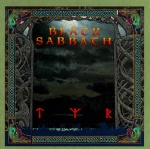

Type: Full-Length
Release Date: August 20th, 1990
Label: I.R.S. Records
Genre: Classic, Doom, Heavy, Rock
1.
Anno Mundi (The Vision)
2.
The Law Maker
3.
Jerusalem
4.
The Sabbath Stones
5.
The Battle Of Tyr
6.
Odin's Court
7.
Valhalla
8.
Feels Good To Me
9.
Heaven In Black
Review by Mandeep Arora on June 28, 2025.
With the nineties looming, the popularity of traditional heavy metal was gradually on the decline. The dominant, most prominent of bands were having a bit of an identity crisis, having to reinvent and soften their sound as a riposte to the unforeseen and unabated pounding they were receiving at the hands of their grunge and hard rock counterparts. Some bands absolutely thrived in this pursuit, churning out their career-best works, whereas some weren't as fortunate and started losing their identity and appeal. Some, on the other hand, completely shunned their roots in favour of far milder dispositions (read Metallica), thereby losing the hardcore section of the fans but also bringing in newer ones in ever greater numbers, lighting up the controversy wick and forever basking in its vexed glimmer. The additional emergence of the limitless incarnations of extreme metal and the fans' shifting loyalties towards these belligerent soundscapes cannot be discounted either.
In a similar vein, to an extent, even the mighty Black Sabbath found itself tramping down this path; to these ears at least, this is one of Sabbath's more accessible and catchier albums, made all the more apparent by its upstaged vocals, simple speed metal riffs, and uproarious choruses. Despite some slightly iffy albums that plagued their mid-eighties and an ever-changing lineup of some of the genre's titan musicians, they were, by this point, more than just a pioneer heavy metal band, having had some of the most original, acclaimed, and iconic albums under their belt. We all witnessed them recouping lost ground with 'The Eternal Idol', a certainly fine and even underrated record, but it was their descent into darkness on 'Headless Cross' that truly announced Sabbath was alive and kicking. It's arguably their most wicked album till date and anything but conforming to the masses. In comparison, 'Tyr' seems like a joyously lurid sunny day, exploring, surprisingly, the themes of Norse mythology and the like. A recent hour-long interview with Tony Iommi and Tony Martin explains why they exercised this buoyant shift in their approach.
Personally speaking, I'm all for a band or musician to venture into distinct, uncharted territories regardless of whether the eventual output strikes a chord with the audience or not. It facilitates a healthy development of ideas and gives something new for the audience to sink their teeth into. 'Tyr', in that essence, is a rather successful attempt. It feels freshly wrought, effortless in its execution, with hints galore of Sabbath's past - 'Anno Mundi' and its badass main riff warbling elegantly throughout the song's length is old-school Sabbath-cool. It was actually my first ever experience of Tony Martin's vocals and Cozy Powell’s drumming patterns, his exhilarating moments of frenzy on the song's outro vividly and perpetually seared into my sequence of thoughts. Truly, and I say this with utmost sorrow, his unfortunate and such an early demise has been a crushing blow to the metal community.
The lineup is more or less the same, even this time around, except Neil Murray replaces Laurence Cottle on bass. He's palpable on the slower sections and shines most resolutely on the acoustic passages of 'The Sabbath Stones', which, in my opinion, is the most impactful song on the album. Tony Martin's vocals are, understandably, often compared to Dio's, with some even throwing shade at him as being a knockoff of the latter. I personally don't support this argument, but understand where it stems from. And truth be told, he does actually remind me of Dio here, especially on uptempo songs like 'The Law Maker' and 'Heaven In Black'. Is it a bad thing that he does? I don’t think so. How many instances have there been in music when something or the other reminds you of a matching harmony or instrumentation,n or vocal style? It's the very essence of art to be inspired, whether furtively or conspicuously. Besides, Martin has his own thing going on where he can sound a bit grandiose but also majestic when called for - the prowess of his high notes can be felt on the choruses of 'Valhalla' and 'Jerusalem'. One of the primary reasons why they adopted such an extravagant sound is that he wrote the lyrics and hooks a certain way, and somehow, if not outright, the way they've been written reminds me of the Dio years too.
The latest remasters have given the sound a new lease of life, as I've already explicitly talked about in my previous review of 'Headless Cross'. A strong emphasis on melodies and harmonies seems to permeate the album, percolating every song, and the dynamism of the compositional structure is kept simple in general; you cannot not get the impression that this seems like a speed metal album at times. A tiny wee bit like Bathory's Viking metal era, too, if you especially focus on how they end certain songs with added emphasis on melodism. 'The Battle of Tyr', a teeny instrumental at barely a minute long, has got to be the most non-Sabbath tune of them all, seeming perhaps a more congruous fit for settings like Skyrim or Middle-earth. But unlike Sabbath's pointless previous instrumentals like 'FX' or 'Don't Start (Too Late)', it actually serves a purpose as being the precursor to tracks 6 and 7, which basically are fragments of one very long song. After you revel in the terrific and resounding choruses of 'Valhalla' where I think the album peaks, it's a bit of a downward spiral from there. It's nothing too bad, for the final two songs are decent and serviceable, but they conclude the album on a humdrum note. What's appreciable though, is that it does not deviate from its straightforward and linear flow, which I'll wholly attribute to the combined and coherent efforts of the band members playing their part to near-perfection and with a direction in sight.
The vast majority of 'Tyr' is full of solid and amazing moments that showcase the best of traditional heavy metal, speed metal, some power metal, and even a sparse bit of doom. The continuous streak of fantastic songs from track 1 through to track 7 is too good to resist, and the lukewarm ones that follow aren't too shabby either. It's Sabbath's resounding entry into the nineties with an ebullient sound that, for obvious reasons, did not stick, for the 'Mob Rules' lineup was back to produce the very nasty-sounding 'Dehumanizer' with its insanely wicked album cover. Then again, that's the beauty of Sabbath's vast discography and numerous eras - there's always something for everyone. And as it went with this album, each passing listen revealed new highlights or recast old ones in new ways. I'm sure I've said this countless times, annoyingly so at this point, but these handful of years from Sabbath's prodigious history are glorious, underrated, and as good as any other period. Let's cherish and celebrate them now that we have the opportunity to do so.
Rating: 8 out of 10
1.93k