
Megadeth - Official Website
Cryptic Writings |
United States
 |
|---|
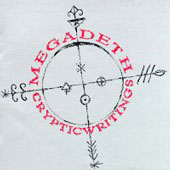

Type: Full-Length
Release Date: July 10th, 2015
Label: Go Fuck Yourself Productions
Genre: Classic, Heavy, Thrash
1.
Intro
1.
Trust
2.
Tormented
2.
Almost Honest
3.
The Power Of Lust
4.
The Great Deceiver
5.
The Rejection
6.
Maniacs
3.
Use The Man
7.
Italian Bastards
4.
Mastermind
8.
Schizophrenic Paranoic
5.
The Disintegrators
9.
Sign Of The Cut
6.
I'll Get Even
10.
Cunts Must Die
7.
Sin
8.
A Secret Place
9.
Have Cool, Will Travel
10.
She-Wolf
11.
Vortex
12.
FFF
Review by Denis on May 9, 2003.
Starting in 1998, Sinister welcomed their first day as a death metal band. Signed to Nuclear Blast in 1991, the first of quite a few albums came out in 1992. Having a new record deal and CD in 2001, Sinister got a new singer: Rachel; but one thing remained: their faithfulness to what they do best; death metal.
Sinister delivers a death metal syringe that sticks to its original basics: heavy, raw, and brutal with the usual lethal weapons. Their music could be described as head banging, hectic and fast brutality. Don't let the first song 'Relic of Possession' throws you off by its ambient and acoustic melodic darkness because it's only an introduction to a very beastie and meaty death metal. Don't think either that the fact that the lead vocalist is named Rachel, will give a sweet or romantic feel to the compositions, because her voice is as deep and rough as any guy on the market. What you get is simply called good death metal done by excellent musicians. But simple music it is not. Fast, in constant evolution yes. Slow, doomier passages are also found on songs like 'Bleeding Towards the Wendigo' and 'Reviving the Dead.' Besides the usual great riffs, you'll get to hear some very weird ones on 'Early Gothic Horror.' For me the best song is the closing number 'Storm in my Mind.' Just the great solo of the intro is a real jaw dropper but they also added a frequent mode shifting in the progressive structure and a very scary vocal part, to close the opus.
Bottom Line: An intricate and devastating primal Death metal recording.
Categorical Rating Breakdown
Musicianship: 8.5
Atmosphere: 7.5
Originality: 7
Production: 8.5
Overall: 7.5
Rating: 7.8 out of 10
Review by Krys on December 7, 2001.
Most of you are probably very familiar with one of the Holland’s most brutal death metal formation - Sinister. For some fans they are a cult band, one of the best of its kind. For others, it’s always a little short of getting to the top of the class and, with a little disappointment, I have to say that “Creative Killings” won’t help us break out from this deadlock one way or another.
In one sentence, their latest epic is a very, I repeat, very solid death metal album but something is missing here to make it great. To further explain my point, consider the fact that throughout the whole 36 minutes of fast and brutal music only one track, the title track, stuck in my head (can sing it in the shower).
I’m not saying that the rest of it was bad, but I have the feeling that there is too much of a good thing here. I never thought I would say something like that; I must be overworked! Each song has its moments, great riffs, drumming or interesting arrangements but in the end it all seems to melt together without leaving a lasting impression. If I listen to each song separately most of the time they just blow my mind off but as a whole, shoot me and I still won’t be able to tell you which track is which. All tracks seem to be written using a standard, good old template that doesn’t allow for any experiments or innovations and that’s probably the biggest flaw of this release.
Or maybe I’m concentrating too much on their new vocalist, Rachel; a female that can overshadow a good percentage of today’s growlers on death metal scene. Holy shit, you have to hear this to believe it. Where is she getting it from? And if that wasn’t enough I can see most of the male crowd holding their ‘jewels’ during the concert while having filthy thoughts rather than listening to the music. If she’s a death angel, I’m ready to go.
Bottom Line: Pure in-your-face death metal that will satisfy most of the fans of this genre. I’m just not sure if it’ll bring any new ones.
Categorical Rating Breakdown
Musicianship: 8
Atmosphere: 7
Production: 8
Originality: 6
Overall: 7
Rating: 7.2 out of 10
Review by Luka on March 8, 2002.
There has never been an album that so finely and clearly sums up the evolution of a band's sound. After three strong, distinct works with their most successful line-up ever, it was a real challenge for Megadeth to choose where to go next. For the last seven years they walked a tightrope of thrash, heavy, and melodic metal that had just the right chemistry to keep the fans interested. So what's next, the lightning fast thrash sound of "Rust and Peace", the heavy, face-pounding approach of "Countdown to Extinction", or the moderate, melodic sound of "Youthanasia". The answer is simple, three equal parts of each!
Let's start with the real stuff, who would have ever thought Dave Mustaine would go back to the "Rust in Peace" sound after seven years. 'FFF', 'Vortex', the Maiden-esque 'She-Wolf', and 'The Disintegrators' are the choice tracks on "Cryptic Writings" that are worth the whole album! Speed and energy returning to Megadeth was like the pull of the massive switch that brought Frankenstein back to life: Megadeth's resurrection! Generally placed near the end of the album, these songs unleash their pent-up fury once the listener has already been half tranquilized by the mellow tracks, giving the best effect.
Now to skip forward in time to "Countdown to Extinction", probably Megadeth's most popular and memorable album. Borrowing its sound are 'Mastermind', 'Sin', 'Secret Place', 'Have Cool Will Travel', and are, much like most of "Countdown...", mediocre songs at best. There is the groove, the flow, the heaviness, sure, but not much more. Closely eluding the mediocrity is the complicated and interesting song 'Sin', one of my favorites on the album.
On to the melodic era of Megadeth with the four tunes from the "Youthanasia" breed. It's not surprising that, along with 'Use the Man' and 'I'll Get Even', it's from this batch they plucked the singles 'Trust' and 'Almost Honest'-which I can confidently label as the worst song in Megadeth's history. The most mainstream and radio-friendly, I can't help but cringe at these songs that don't even stand up to the quality of "Youthanasia". Below par, very bad.
Bottom Line: A cohesive summary of "Rust in Peace", "Countdown to Extinction", and "Youthanasia". A solid album from a band that seems to have forgotten the word original.
Originality: 5
Musicianship: 9
Atmosphere: 8
Production: 9
Overall: 8
Rating: 7.8 out of 10
Review by Luka on March 8, 2002.
There has never been an album that so finely and clearly sums up the evolution of a band's sound. After three strong, distinct works with their most successful line-up ever, it was a real challenge for Megadeth to choose where to go next. For the last seven years they walked a tightrope of thrash, heavy, and melodic metal that had just the right chemistry to keep the fans interested. So what's next, the lightning fast thrash sound of "Rust and Peace", the heavy, face-pounding approach of "Countdown to Extinction", or the moderate, melodic sound of "Youthanasia". The answer is simple, three equal parts of each!
Let's start with the real stuff, who would have ever thought Dave Mustaine would go back to the "Rust in Peace" sound after seven years. 'FFF', 'Vortex', the Maiden-esque 'She-Wolf', and 'The Disintegrators' are the choice tracks on "Cryptic Writings" that are worth the whole album! Speed and energy returning to Megadeth was like the pull of the massive switch that brought Frankenstein back to life: Megadeth's resurrection! Generally placed near the end of the album, these songs unleash their pent-up fury once the listener has already been half tranquilized by the mellow tracks, giving the best effect.
Now to skip forward in time to "Countdown to Extinction", probably Megadeth's most popular and memorable album. Borrowing its sound are 'Mastermind', 'Sin', 'Secret Place', 'Have Cool Will Travel', and are, much like most of "Countdown...", mediocre songs at best. There is the groove, the flow, the heaviness, sure, but not much more. Closely eluding the mediocrity is the complicated and interesting song 'Sin', one of my favorites on the album.
On to the melodic era of Megadeth with the four tunes from the "Youthanasia" breed. It's not surprising that, along with 'Use the Man' and 'I'll Get Even', it's from this batch they plucked the singles 'Trust' and 'Almost Honest'-which I can confidently label as the worst song in Megadeth's history. The most mainstream and radio-friendly, I can't help but cringe at these songs that don't even stand up to the quality of "Youthanasia". Below par, very bad.
Bottom Line: A cohesive summary of "Rust in Peace", "Countdown to Extinction", and "Youthanasia". A solid album from a band that seems to have forgotten the word original.
Originality: 5
Musicianship: 9
Atmosphere: 8
Production: 9
Overall: 8
Rating: 7.8 out of 10