
Darkthrone - Official Website
Under A Funeral Moon |
Norway
 |
|---|
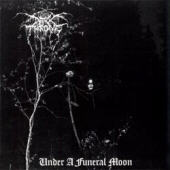

Type: Full-Length
Release Date: February 15th, 1993
Label: Peaceville Records
Genre: Black
1.
Natassia in Eternal Sleep
2.
Summer of the Diabolical Holocaust
3.
The Dance of Eternal Shadows
4.
Unholy Black Metal
5.
To Walk the Infernal Fields
6.
Under a Funeral Moon
7.
Inn I de Dype Skogers Faun
8.
Crossing the Triangle of Flames
Review by HanSathanas on July 15, 2026.
Everyone should know who Darkthrone are by now. As one of the bands that stood guilty of further spreading dark whispers of diabolical temptation to the far reaches of the planet, their role remains monumentally influential in shaping a niche sound within a subgenre already that can sometimes take itself way too seriously. Fans like me readily sang in praise of this album, while others chose to embrace a contrarian outlook. With all due respect to the critics, there are a lot of reasons as to why we love this masterpiece of a record. Its significance transcends mere musical expression of darkness, hate, and the occult. Black Sabbath dabbled with the occult, as did countless bands that followed. What Darkthrone did on this album was something else altogether. It was considered groundbreaking for its time, spawning countless imitators the world over, including from within Southeast Asia. Songs like Tinggam and Thy Creator of Life, for example, all trace their roots back to this album. Another better example is the debut record 666, which was released by Katharsis, which, in my opinion, is one of the more successful attempts at replicating what the mighty Norsemen had conjured in 1993. All this would not have been possible had the album not existed at all in the first place.
Understandably, the album opens not so much with a bang, but there is no intro either. Natassja in Eternal Sleep revels in structured simplicity, with riffs flowing down like a waterfall, hypnotic and trance-inducing. Nocturno Culto’s vocals are a lot less human than in the previous masterpiece. Instead of relying on full-on screams, he exercised restraint, letting it all out only when required. Does that mean the vocals are a letdown? I beg to differ. This type of approach yet again befits the established concept tailored for this album. The vocals are just as cavernous as the floor tom, echoing perfectly in harmony with the buzzing, running chords. They are not the least bit ominous, but they do reflect the blasphemous messages the band tried to convey. Then again, the blasphemy is nowhere near excessive when sung in different parts of each song, and it is performed with such style that builds upon the dissonant anticipation, creating even darker mental imagery without having to spit out unending profanities Deicide style. Speaking of blasphemy, I remember reading an article on the internet that linked the Norwegian black metal scene with white supremacism and antisemitism. The author supposedly highlighted some of the lyrics from Unholy Black Metal, citing the emphasis here goes way beyond merely articulating darkness and the occult in the most obsidian fervor possible, but whose peripheral glimmers are radiating hate in ways so unsubtle to those in the know; beliefs of the eastern lands are raped and raped again. But hey, who am I to judge, right? After all, this is the movement that altogether weaponizes blasphemy and despicable ideals to confront the corruptive nature of organized religions and to free people’s minds from so-called unintellectual subjugation. Cool. To each his own, of course. What’s written here lyrically embodies that warring conviction using an occultic approach that, by now, is nothing new in 2026. In retrospect, both Fenriz and Nocturno have admirable lyrical skills in a way that they are not necessarily rhythmic in nature, as they often do not structurally conform to the accepted norms of interwoven poetic qualities. Nevertheless, the messages are embedded into each word, and they are as clear as day if you know where to look.
Each track also has a healthy number of memorable hooks and grooves that are performed with the utmost primitive approach. However, Fenriz did comment that the songs he had written for the most part were generally straightforward, whereas those penned by Nocturno Culto were embedded with a certain degree of technicality. I would be inclined to think so. Somehow, what little guided tactical creativity is woven into the creative process has since been embalmed in a never-ending snowstorm, resulting in longform composition that, had it not been for the 8-second gap in between, the fluidity of each song would cave in on listeners like an avalanche of icicles piercing through your flesh just as much as it suffocates you. This is altogether unmelodic but strangely still sounds as melodious as ever, all in its dissonant glory. Inspiration runs deep for those who have been positively impacted by this album. Some people joke that one band’s sound becomes another band’s entire career. But jokes aside, we must remember that this was one of those legendary records that did not find life in Grieghallen Studio, nor was it engineered by Mr. Pytten. Fenriz stated in one of his interviews that the tech guy behind the recording process did not impose any limit on the trio, giving them much-needed freedom to experiment with the bleakest sound possible, until the band eventually relented and asked the audio engineer to stop pushing the limit. Interestingly, this was the same studio where fellow troublemakers Mayhem recorded the Deathcrush EP.
What Darkthrone had envisioned was to reproduce the frigid, cavernous ambience that was first pioneered in The Return… and, of course, Under the Sign of the Black Mark. I can safely say that Fenriz and friends truly succeeded in their quest, and they might as well have gone overboard with the whole production thing, resulting in a full-length that sounded like no other at the time of its release. You know the deal; near bottomless floor tom that is embellished with explosive boom, super thin yet solid snare drum with equally loud hi-hats, and an outpouring of blizzard-like riffs that continue to ring long after the song is over. Not only that, but the lead guitar also sounds alarmingly like a fleet of UFOs come swooping down and firing plasma projectiles left and right, à la War of the Worlds, setting the whole planet on fire. Too bad Zephyrous didn’t stick around after this album; his guitar solos are truly out of this world.
Yeah, it’s not the most technical, nor is it the most virtuosic. But Zephyrous truly fits into the songwriting like a glove, giving this album an otherworldly feel, capturing the essence that makes black metal ice cold, grim, and raw the way it is intended to be. His solo somehow beautifies the compositions even further, and I can’t imagine listening to any of the songs without one. Fenriz perfectly described Zephyrous’ solo as a “fuck off” kind of thing, totally uncaring about anybody’s opinion, which is captured in the equally perfect Unholy Black Metal. Speaking of perfect, one of the best songs on this album is, of course, Inn i de dype skogers favn. Now, I know I’m gonna get flak for this one, but hear me out; it is the second and the last song written by Zephyrous for this album with uncompromising commitment to nihilistic monotony that brings the likes of Von to mind. While Von makes repetition sounds like a nervous pornstar struggling with erectile dysfunction on set, Zephyrous took the monotony, ripped it apart, removed the guts, seasoned the flesh with some concentrated brine, stitched it back up, then shoved it in your fucking mouth, and you just don’t know what hits you or where it came from. By the time the song is over, you’re nothing but another John Doe in a long list of unsolved cold cases. This is not the song where you can sit down sipping a cup of pretentiously expensive matcha while browsing your IG or TikTok, simultaneously feeding off your dopamine; it’s a song you use to endlessly bludgeon someone’s head with such hate and fury that no discernible DNA information can be obtained – just bits and pieces of flesh, completely unrecognizable and bloody. Single-minded but not necessarily one-dimensional. What is also interesting about this song is the fact that the bass guitar is somehow audible, just like in the rest of the tracks, despite Fenriz’s claim to the contrary. It is masterfully done and mind-numbing; the kind of high I wouldn’t mind reliving again and again. Not to mention that it is also ridiculously memorable, thanks again to the resonating bass lines, especially during the primary verse section. This, gentlemen, is monotony done right. Plus, the lyric is written in Norwegian, which provides the song with an even more arcane atmosphere. Personally, I love it when bands are writing songs in their own language because, in a way, such practice helps preserve meaning and authenticity that will dissolve once translated, and the intended meaning is rendered void and useless. You must understand that certain societies have their cultural heritage deeply ingrained not just in their identity but in how they view the world as a whole. I’ve said this in another one of my reviews: black metal music is just as hypnotic as some tribal beats and chants. When the song transitions to the second riff set, the sedative effect is amplified further, and it lulls you into a trance-like state. The galloping double bass provides a climactic conclusion, and the song ends just like that. No, thank you. Just fuck off!
As we know by now, the songs end whenever the band feels like it, before 8 or so seconds take over in between. According to Fenriz, the long silence was intended to contradict the near gapless structure of Reign in Blood to make listeners pay close attention to the next song in the track list. I’d say it is especially a nice touch because it creates that sort of momentum and anticipation the first time listening to this record. Nowadays, though, I just cut out the silence up to 5 or 6 seconds, so the runtime is shorter when playing this album on my car's pitiful OEM stereo because most of the time, too long a silence makes me anxious lol. Nevertheless, Fenriz did admit to being inspired by Mayhem for Dance of Eternal Shadows, Summer of Diabolical Holocaust, Crossing the Triangle of Flames, and the title track, particularly after listening to the tape copy of the Live in Leipzig album. After a while, the band members were confident enough to write their own songs individually instead of together, which resulted in each track having a different feeling while remaining cohesive from start to finish.
This album unmistakably marks the band’s complete conversion into black metal. Fenriz lamented the fact that people mostly hailed A Blaze in the Northern Sky as the landmark in Norwegian black metal, while this album didn’t get talked about that much when it came to defining the band’s actual black metal portfolio. Also, noticed that I did not jump ship to highlight To Walk the Infernal Fields because others have already talked about that song. However, the closing track is also underrated in my opinion, as it truly evokes a sense of taking a long walk towards the gates of hell, whose arrival is punctuated with exaggerated tolling of a bell, which sounds absolutely massive, particularly the last few rings where they start to sound the darkest. It feels like you are being watched by tortured souls screaming at you in silence to join them at the mouth of hell’s chasm, but you can’t really see them because you are walking along vertical walls of raging flames. Man, I love that kind of sound effect. It feels as if the band has achieved their objectives with this album, and they bid farewell to you after tainting and violating your empty, meaningless soul with sins. If you are sure you want to go to hell thanks to all the sins you’ve committed in life, Darkthrone will be your tour guide, and they might even walk you through the blaze, holding your hands so that you will feel welcomed, preparing you mentally for eons of ripping torture you are about to endure in the darkest, most humiliating pit of hell. While you are at it, these guys will show you all the demons that have ever existed in this universe, like a proper guided tour of a nature museum. Beautiful, surreal scenery, perhaps.
People ask why this album is rated highly by most. I’d ask why not? Because art is subjective and Darkthrone personifies the sort of subjectivity to a point that it makes some people question whether or not this record deserves all the credits and praises. No two people in this world readily share the exact same beliefs, thoughts, and vision. Hence, this record can sit comfortably where it needs to be while continuing to generate controversy long after it is out of print, which is impossible, I think. The fact that people still buy, collect, and listen to this album, and the fact that I am reviewing it in 2026, just goes on to show that Under a Funeral Moon remains one of the strongest records in the entire history of black metal, bar none.
Rating: 10 out of 10
3.04kReview by Felix on July 15, 2026.
I am almost sure that Fenriz and Nocturno Culto have sympathy for people with pretty dotty affinities, because they also revealed a very strange understanding of metal while recording "Under A Funeral Moon". This is neither good nor bad per se, but it requires a closer look.
Of course, it has long ceased to be a secret that the production of the album sucks. It's this kind of production that makes mainstream fans laugh compassionately. Admittedly, seen from an objective point of view, one can understand their reaction. Yet Darkthrone had developed their own ghastly philosophy of black metal, and the earthy, flawed, raw, and thin sound matched the context. Given this situation, it does not surprise that the barking, snarling, and nagging vocals celebrate ugliness in all its facets, and the buzz saw guitars torment the nerves of the audience. The quirky duo goes well beyond musical conventions, and due to this uncompromising approach, it is not difficult to understand why this album is widely deemed as a cult record. Yet this does not mean that the song material fulfils all wishes.
Of course, the outstanding "To Walk the Infernal Fields" has an enormous impact. What a clever way of paying tribute to one of the best tracks of Bathory. "Enter the Eternal Fire" comes to mind in a matter of seconds as soon as the first tones of Darkthrone's composition force their way. However, the song develops its own identity, although its main riff lies in close proximity to that of Bathory's masterpiece. It's a great number, which almost reaches the phenomenal level of Quorthon's model example. The track has a similar pattern; it also opens the second half of the work in an epic manner, and it slows down the speed significantly. And to be honest, this less rapid approach is more or less necessary after the first four songs. They impress with velocity and nastiness, but they do not deliver excellent riffs in abundance or many other outstanding musical features. For example, the third track just rushes by and leaves me cold. More generally, these tunes are mainly furious, dirty, and mean. A certain quantum of slower sequences, for example, the middle part of "Summer of the Diabolical Holocaust", does not gain the upper hand.
In my humble opinion, the full-length must be understood as a kind of antithesis. I appreciate the album for its rebellious element and the idiosyncratic artwork, for its great title and its contribution to the last really exciting movement in the extreme metal scene, the Norwegian black metal riot. Yet I don't think that the music itself, actually the main component, is mind-blowing. Despite some pretty good pieces (opener, title track, closer), the compositions are just the necessary addition for the image Darkthrone wanted to create. Mission accomplished.
Rating: 7.4 out of 10
3.04k