
Behemoth - Official Website - Interview - News
...From The Pagan Vastlands |
Poland
 |
|---|
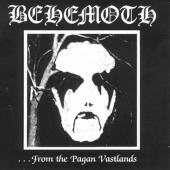

Type: Demo
Release Date: 1994
Label: Pagan Records
Genre: Black, Death
1.
From Hornedlands To Lindesfarne
2.
Thy Winter Kingdom
3.
Summoning (Of The Ancient Ones)
4.
The Dance Of The Pagan Flames
5.
Blackvisions Of The Almighty
6.
Fields Of Haar-Meggido
7.
Deathcrush (Mayhem Cover)
Review by Felix on February 14, 2024.
There are two things one must know about Behemoth. Firstly, their best phase began very early on. Secondly, their best phase ended very early too. Thank Lucifer, the demo “...from the Pagan Vastlands” is among the oldest releases of the band. With the first tones of the opener – blowing winds welcome the listener – the release reveals a very high degree of atmosphere. “From the Hornedland to Lindisfarne” scores with a haunting, enchanted mood, fragile acoustic guitar tones that duel with sinister e-guitar lines and croaking vocals. Moreover, well integrated keyboard carpets show up and the drums are hammering somewhere in the distance. It goes without saying that one cannot expect a professional recording, but the crucial thing is that “...from the Pagan Vastlands” has definitely a lot of raw underground charm. The mix is like the artwork, both can rely on a simple yet adequate recipe.
Compared with the opener, “Thy Winter Kingdom” offers an almost smooth flow. Already in winter 1993/1994, Behemoth were able to manage more than just one approach. Nothing on this demo sounds formulaic or predictable. Behemoth followed their then black hearts and this way of proceeding resulted in archaic, authentic and spiritual tracks. The dudes did not shy away from a proper number of melodies – nevertheless, “misanthropy” is written in big letters over each and every track. Maybe it is correct to say that the excellence of this demo is based on the rare mixture of a surprisingly early achieved musical maturity and absolutely non-commercial individualism. Okay, Behemoth did not grow up in a vacuum and therefore their mid-paced tracks breathe the spirit of bands like Graveland. Anyway, the dudes are able to bring their personality into the compositions which are expressive, charismatic and equipped with an atmospheric density which turns out to be a big plus.
What does not really work here? Well, nothing sucks, only minor details are irritating. The Mayhem cover comes after the “outro winds” of “Fields of Harr-Megiddo”, which actually close the circle. And speaking of this song, its solos are slightly confusing for the listener, because they are more or less airy, light and almost emotional. Yet if I ignore them, the further parts of the track are on a par with the remaining material – songs that are full of suspenseful moments and in which the almost 35 minutes pass by quickly, although the single pieces themselves often only move at a medium speed. However, especially the strong “Blackvisions of the Almighty” illustrates that the musicians did not suffer from an allergy against speed.
The story of Behemoth (Nergal) is a story of musical evolution, to say it positively. From my point of view, it is a story of fickleness. Today the words “Black Metal is not a trend (inverted cross) it’s a cult!”, printed on the digipak, seem like mockery. Drive through Poland and if you see a guy pissing with the wind, it will probably be Nergal. But if one takes “...from the Pagan Vastlands” alone, and I guess this is meaning and purpose of this review, it is definitely a great document of this thing we call true black metal and an auspicious harbinger of Behemoth’s masterpiece from 1996, “Grom”.
Rating: 8.4 out of 10
1.71k