Mgła - Official Website - News


Age Of Excuse

Poland Country of Origin: Poland

2. Silent Towers, Screaming Tombs
3. Orkblut (Sieg Oder Tod)
4. The Saint Of Murder
5. Scarlet Suite For The Devil
6. La Plus Longue Nuit Du Diable - Guiding The Nameless
7. Tartaros Tides
8. Flood Of Wrath
9. Terrorkommando Eligos
2. Age Of Excuse II
3. Age Of Excuse III
4. Age Of Excuse IV
5. Age Of Excuse V
6. Age Of Excuse VI


Review by Felix on October 9, 2023.

First of all, a note on my own behalf. I have nothing to reproach myself for, because I gave this album many chances. Believe me, my original intention was to fall in love with “Totschläger (A Saintslayer’s Songbook)”. Why? Well, Abigor once belonged to the most promising black metal pioneers. Furthermore, they were part of the legendary Austrian Black Metal Syndicate and I love this kind of secret societies. “Verwüstung…” and “Orkblut…” appeared as the first steps into a golden (or black metallic) future. But things turned out differently and contrary to my hope, “Totschläger” is not a return to old strength.

Forget the overlong intro with piano tones, “Gomorrha Rising – Nightside Rebellion” has an accessible structure and a more or less conventional approach. After listening to it roughly 666 times, I more or less like the opener. But already the next, multi-layered number shows the inner conflict of the band. I do not know what this song wants to stand for. Dissonant tones and ill-defined, nasty guitar lines – every member seems to play its own song here. “Orkblut (Sieg oder Tod)” makes it easier for me, it wants to be a disgusting repulsive creature that scares the hell out of every mainstream music consumer. But the guitar lines are mediocre, the feeble blast beats drown in the nerve-shattering, noisy production and the shortly occurring triumphant atmosphere remains a quickly vanished highlight.

This is not to say that the entire work sucks. Some moments are exciting. My personal analysis is that Abigor want to be unique, that’s why they throw at least 667 ideas into each and every song, but ironically they have their best form whenever they deliver a more or less conservative approach. The riff of “The Saint of Murder” offers both depth and heaviness. The crooked, polyphonic and pseudo-melodic singing in the middle of the piece costs some sympathy. Anyway, under the bottom line, this track was the first one I began to like (already after 333 spins). The track is okay, no more, no less. But let me mention another positive detail. Abigor have courage and conviction. One cannot create this form of extravagant infernal sounds without having sold your soul to Satan. Abigor and, for example, Atrocity lie alphabetically in close proximity, but spiritually there are lightyears between the Austrian and the fickle formation from my homeland.

What I really miss is a coherent flow of the songs. Worse still, sometimes I do not have the feeling of listening to songs at all. Broad parts of the material seem to be a randomly occurring part of a monstrous cacophony. Then, out of the blue, comes a calm segment – but mostly it is not very well connected with the rest of the song. If I was forced to characterize the majority of the songs, I would do it this way: confusing metallic parts, calm intermezzos, confusing metallic parts again. By the way, the barbaric voice contributes to the confusion as well, because it adds a further element to the chaos. Maybe I am only an easy-listening black metal fan, or, in other words, no true supporter of the genre at all. But forgive me, I am not able to decode pieces like the very memorably titled “La plus longue nuit de diable – Guidng the Nameless”. Frankly, I doubt that a code for this song exists at all.

Our highly appreciated reviewer Michael quoted me in his review “Abigor makes music for schizophrenics“. This is still my opinion, although their music has a small dose of charm for non-schizophrenics as well. Nevertheless, I do not like this over-ambitious melange of noisy and / or sick elements. Abigor express agony and torture in a painfully consequent manner. This would be okay with an attractive musical environment, but exactly this is missing here. Anyway, if you want to take the challenge – Abigor’s “Totschläger” is awaiting you. I am curious if you will find your way out again of this jungle of explosive outbursts, blastbeats, odd and crooked guitar lines, strange intermezzos, solos that do whatever they want and a variable lead singer who knows how it feels to be possessed by Lucifer.

Rating: 4.5 out of 10

   2.81k

Review by Michael on December 14, 2020.

Abigor actually released a new album secretly, without me noticing anything about it. This year, Inquisition and Beherit have already managed to do that (although I would have been better off not knowing about "Boredom Lives" either). Very strange, I think I'm getting old.....

Well then, before I also forget to review the CD, I'd better get started. The cover is very nobly designed and shows the young Cain with a crown of thorns, who is in a flaming inferno. Fits quite well to the title Manslayer (A Saintslayer's Songbook), because that's what he was with his little brother. And according to the bible also the first murderer of mankind. I actually thought that the cover was designed by Eliran Kantor, but on inquiry the band informed me that it was "only" designed by an acquaintance of the band who paints and restores frescoes.

Musically it remains with the Abigor-typical elements in the first three songs. The first track ('Gomorrah Rising') starts after a short orchestral prelude with a hateful scream and raging guitars and drums. However, Abigor again ensure through many breaks and tempo changes that the song is very varied throughout and thus surprises again and again. In the further course of the disc I was reminded again and again of Deathspell Omega, because Abigor also sometimes uses these dissonant sounds (for example at the beginning of 'Silent Towers, Screaming Tombs'). What I had to smile about was the beginning of 'Orkblut (Sieg oder Tod)', which sounds like a boss battle melody from Final Fantasy, but then the song rises to a real inferno. Sometimes the characteristics of the old Abigor outputs (especially the first three albums) appear in the songs, be it the acoustic passages with flute or also from the guitar riffs and the drums. Also the slightly disturbing song structures they used on their newer albums are used again and again, which thus results in the album becoming their strongest so far in my opinion. Abigor creates a rather oppressive atmosphere that rarely gives you a sense of hope or warmth. Only 'La Plus Longue Nuit Du Diable - Guiding the Nameless' germinates a little hope at the beginning like a small ugly plant (most likely a cactus), which, however, by the vicious growling its leaves or needles directly loses again and at the latest when Silenius roars "Destruction...!" is torn from the ground. The beginning reminds me quite a bit of King Diamond, maybe it's because of the spinet or the somewhat macabre atmosphere it creates. The penultimate track 'Flood of Wrath' often brings back memories of old Emperor, on one hand by the use of keyboards and on the other hand by the vocals, which remind me a bit of Ihsahn.

In the further course Abigor still provides for two thick surprises. On one hand 'Tartaros Tides' sounds quite punky and I somehow have the feeling to have heard it somewhere before. Anyway, the song already sounds a bit like a party (sorry if that sounds inappropriate) but pretty cool in any case! Definitely the catchiest song on the album. 'Terrorkommando Eligos' clears pretty much everything and everyone out of the way and paves its way into the brain of the inclined listener as a crowning conclusion and without mercy. An absolute killer that crashes through a little more than 6 minutes.

My dear colleague Felix, who as you know also writes for MetalBite and Metal Archives, is of the opinion that Abigor makes music for schizophrenics. I definitely don't think so! And neither do I!!

So I have to state, after I already chose the new Sorcier des Glaces as the best black metal album of the year, that Abigor is at least on the same strong level. They have written an incredibly intense album that does not let go in the least and that will probably be heard by me many times in the coming weeks and months.

Rating: 10 out of 10

   2.81k

Review by Felix on September 24, 2023.

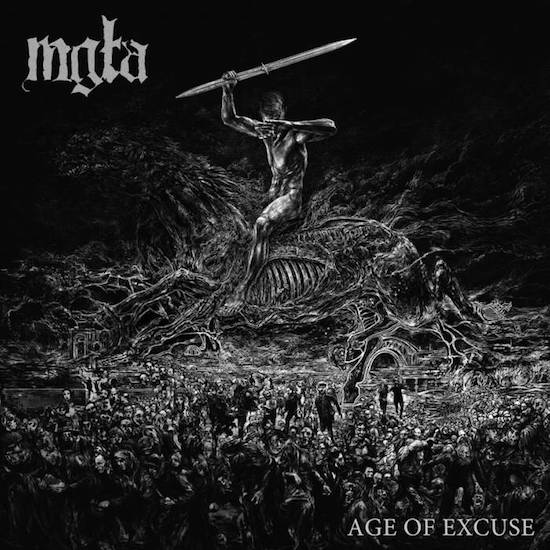
Change is always risk and chance. The better your current status is, the higher is the risk. Considering these self-evident facts, it is not surprising that Age Of Excuse continues the line of the stupendous Exercises In Futility. Only those strange people who confuse staying true to one's roots with stagnation find that stupid. Mgła, on the other hand, write continuity in huge letters across the complete work from 2019. The artwork, the booklet and even the back cover shares the design of its predecessor, we get the same number of songs and even the playtime is almost identical. Thus, the comparable musical content just adds the final brick.

Nevertheless, the Polish duo does not choose a despondent approach. It goes without saying that the six tracks present new nuances within the given stylistic frame. The aggressive and outstanding 'III', for example, delivers some shrill tones that lend the song a quite hysteric touch and the average velocity of the pieces seems to be a bit higher than before. But the defining elements remain unchanged. There are, not only in the opening 'I', still relatively hypnotic parts, the vocalist still sounds like someone who does not tolerate contradiction and the guitars have not stopped to create endlessly flowing lines. Even the production lies in close proximity to Exercises In Futiliy. It’s a professional, dense, more or less well-balanced mix. It captures the essence of the sinister music in a good manner and adds value to the full-length.

The album’s title is almost ironic and flirtatious, because Mgła do not need any excuses. Once again, no weak track has crept in and, as a matter of course, the homogeneity of the album is once again striking. Moreover, the band operates far away from all clichés. The opener starts with slowly plodding sequences instead of exploding in your ear immediately. Another big factor are the melodies that the duo presents. They are neither extremely morbid nor do they breathe the spirit of utter cruelty, but they cannot be blamed for softness or inappropriateness as well. They are an important tool to convey the dark spiritualism that characterizes the music of the two protagonists. The same goes for the lyrics which seem to deal with existential questions exclusively. Of course, black metal is not known for its exuberant humour, but Mgła contribute an extra portion of seriousness. In other words: it would be completely stupid, to release this album on red, yellow or orange vinyl. Only black is appropriate here.

'III' is not the only track that bursts out of the speakers in a pretty violent manner. 'IV' is another fast-paced celebration of cold obscurity. That’s why I appreciate the centre of the album the most, but, as already said before, I am able to enjoy all tracks and the full-length offers many swift sections. On the other hand, the despair of part 'V' of Exercises In Futility remains unrivalled here. Nevertheless, Age Of Excuse manifests the flawless reputation of a band that does not lack individuality. No need to change, just go on this exciting way.

Rating: 8.5 out of 10

   2.81k

Review by Fernando on September 27, 2019.

Mgła have proven themselves to be the flag bearers of the Polish black metal scene and have taken the underground by storm. Their trademark style of melodic and gritty black metal have made them stand out and they have returned with their fourth full length album, Age of Excuse.

In Age of Excuse, Mgła continue where they left off on Exercises in Futility, the album that catapulted into the black metal spotlight with a new sense of refinement and even some progressive elements. Indeed, this new LP is very reminiscent of its predecessor, however the band have added more flair and complexity to the music. The compositions are much more dynamic and there’s a stronger focus on creating an ominous atmosphere with moments of aggression as opposed to the direct approach from their previous records. The influence from the band’s members other project, Kriegsmaschine is very apparent and that band’s last album was also a blackened progressive outing with complex and dynamic music. M. and Darkside seems to have carried some of that musicality into Age of Excuse as a sort of seasoning, hence the aforementioned refined style of the music, but make no mistake, this is still very much a Mgła album and everything of what fans want is still present; the cold riffs, complex drumming and sense of dread that only the Polish fog can do.

Drummer Darkside continues to be the main standout of the band. His drumming is as layered and complicated as ever but there’s much more panache and focus added to Darkside’s near robotic precision; he makes full use of the drum kit and gives an every song a distinct rhythm that makes them unique aside from his expertly executed blast beats and double bass drumming. But no talk of Mgła would be complete without founder and mastermind M. who once again handles the lion share of the job by handling vocals and strings. The first thing to notice is the vocals and M.’s unique take on shrieking vocals which on this album take a much more controlled approach; the vocals sound as menacing as ever but there’s a sense of holding the rage inside. In a weird way the vocals sound as if they’re being restrained but you can still sense all the frustration and rage, like a rabid dog that’s collared and trying to get up, which complement the subject matter of the lyrics perfectly, describing a world gone to ruin wherein its inhabitants accept to live in the squalor while a select few try to break away from being drowned in the filth. A fitting and topical concept for our current times. The guitar and bass work continue to be as impressive as ever; the refinement I already mentioned is most present in the string sections, a droning wall of sound to maintain the fast pace which is then broken into dynamic and complex riffs to carry the rest of the song, the grimness and dread of the music lives and breathes on M.’s riffs and masterful tremolo picking. And all of this is accompanied and brought together by the excellent production quality, which only Mgła succeeds in balancing the grit of any good black metal album with the right amount of polish to make it sound great, and as such you get the best of both worlds.

However while this album continues Mgła’s stride of exceptional black metal, it’s major shortcoming is the main problem of all black metal bands, which is the repetitiveness. This is a Mgła album through and through but beyond the added progressive elements and refined musicianship, this album doesn’t stand out that much from either Exercises in Futility or With Hearts Toward None. Make no mistake, this album is a quality black metal album and it does feel like this is the last hurrah of this era of Mgła, but it also has the death rattles of the end of an era, so to speak. Overall Mgła does what they do best but if by the next album they still retain the same sound of the last 3 albums, then most people will move on to the next big black metal band, for sure.

Best tracks: 'Age of Excuse II', 'Age of Excuse IV', 'Age of Excuse VI'

Rating: 8.2 out of 10 

   2.81k