Pombajira - Official Website - Interview - News
Pombajira |
Brazil
![]() |
|---|
Review by Arek on December 16, 2017.
Four chilled, but spurting with musical ideas Swedes created a band that moves in the territories of post-metal and sludge. They chose Antarktis for the name, because there isn’t a place that’s colder, and anything south of Antarctica is pure hell. Do you know In Mourning or October Tide? Antarktis guitarists and founding fathers - Björn Pettersson and Tobias Netzell are playing in the first one, and Tobias scored a 3-year episode in this second band. I must tell you that you can hear particles of In Mourning in Antarktis. The album composed of 6 tracks lasts almost 52 minutes in total. After the release of the last albums of In Mourning and October Tide, Antarktis also fell prey to Agonia Records.
When starting the analysis of Ildlaante, some questions arise. Is music played by this Swedish quartet even metal? In my opinion decisively YES! Will it tickle the likes of metal brothers? Most certainly not all of them. Sludge incorporated in post-metal melody is quite a specific trend to have such causative power. This music is much closer to rock than to the extremely violent rhythms of death and black metal, not to even mention grind. However, it is the sound of guitar, bass and furious roar of Daniel Jansson that makes this melodic rock gain the power and aggressiveness of metal. Musical art is such a camouflaged slut that you have to do her in order to check its power and action. Preferably several times and in different phases of mood and if you have an open mind, Antarktis may just shoot itself in. In the debut of the Swedes, we will not find meat chunks, blood-spattered walls, or Christ's corpse hanging upside down. Crazy moshing, or headbanging will also be difficult during the show. In Ildlaante the compositions are long and stretched, but due to their diversity and melodies, they do not wear you out at all. Melodiousness is not exaggerated, nor it is over sweetened, but slightly dirtied and coarse sound wise, and thus creates a more brutal impression.
The form and atmosphere of the songs makes me hear, at times, (e.g. in Ildlaante) Noc Lekkich Obyczajów of Biesy and in ‘Svalbard’ for example I hear echoes of LG Petrov from ‘Descent Into Inferno’. You may say that it is so retro, that it is so yuck! Some may even say, "it's such a clone of Cult Of Luna", and yet thanks to this Antarctic cold incorporated into music, thanks to this roughness born of black metal, death metal guitars and vocals, the differences are noticeable. You just have to want to and allow these slow sounds settle in our neuron ganglia so that they can build this cold, dark and sad climate. For example, the ending – ‘Cape Meteor Pt.2’ needs nearly 8 minutes to attack, but when it explodes - its rage can hurt pretty badly. In this album I found an atmosphere saturated with coldness and sadness, as well as furious emotions.
Yes, I agree that Antarktis is no new discovery and where is that metal fire? But does hell have to be associated with fire and seething tar? Well, no, and they are the perfect proof of it. The murderous frost and white abyss can be as infernal as fire and black. Although Antarktis does not have much in common with the hell of black metal, the sounds they spit out spin round in such dark areas that there is no reason to look for hope in there. Cold and depressing metal served by the Swedes probably will suffer comparisons to their older compatriots from Cult Of Luna, and for good reason, because, as the proverb says, when you walk among the crows, you must croak like them. Therefore, playing music in the same genre and originating in Sweden, they had to expect that such a patch will be stuck to them almost automatically. But, I dare to say that even when creating music in other metal sub genres it would happen all the same. I think that since there is a lot of room for different bands playing similarly, Antarktis music will defend itself in post-metal, the more so because their compositional ideas and musical possibilities are undoubtedly their strong points. Nothing pressures them and they’re not in the pinch. They tailored out a great material, even though the prototype was made earlier. It seems to me that it is not their last word and I will be holding my fingers crossed for them.
Rating: 8.5 out of 10
912Review by Alex on November 30, 2019.
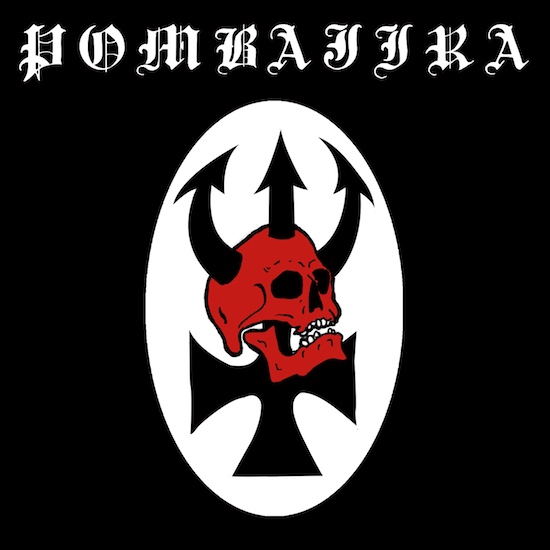
Doom metal coming from Brazil is not something I get to interact with often given its scene has been thrash and speed metal dominated for many years up to now, so when Pombajira's self-titled debut showed up, turning away from it was out of the question. If you were looking for some kind of ugly produced, raw and instrumentally candid doom metal with one foot outside of its circle playing tag with horror punk, Venom and Celtic Frost while predominantly doom metal, then you have stumbled upon the ideal release. I’ll admit the artwork did help in garnering my interest, but it was also that mystique attached to Brazilian culture that pushed it. Brazil is known to have rich customs and beliefs that often times come to be represented through all forms of their music; on Pombajira there is no exception. The name itself even without knowledge seems to reference something of occult folklore which is true; 'Pombajira' is indeed an Afro-Brazilian deity associated with female desire, beauty and sexuality among other things.
By attaching such a name to the band, it should come as no surprise occult imagery and themes would be ensued. Environment and upbringing usually come to influence the music most musicians make; hence the expectation is fulfilled. The trident lineup of T. Splatter (drums), Blizzard (guitars, bass) and HellSon Röcha (vocals, guitars) have approached their full length with a steady footing in pace. Most of what you will hear on Pombajira is slow to mid-tempo with their fastest and one of the favorites being 'Queen of the Night' slightly breaking away from the formula. Casually opening with 'Gira' the band quickly conjures the atmosphere with this guitar dominated instrumental. Though fairly basic, it does the job in setting the tone for 'In Reverence' by use of a track shaped in mimicking a stoner doom posture minus the fuzziness. With most, if not all tracks referencing Pombajira the deity, I did find a toggle among different moods occurring as each song tried to reflect certain aspects of her existence, ranging from sexuality, to domination, to her malicious and vengeful nature.
'The Lost Exit of Darkness' is centered on doom metal taking the quicksand-esque approach to fuel an insidious atmosphere. In addition to carrying a bare bones production, Pombajira's musicianship is not over the top, the drumming is like I would expect it to be in having more to do with melody support and pace keeping, the guitars have soloing moments ('Vital Lucifer', 'Queen of the Night', 'Malandro e Mulambo') while the vocals are raspy and find comfort in Tom G. Warrior's early Celtic Frost range and pattern occasionally. It's the reason that old school organic black/doom/heavy metal feeling is so dominant here. As mentioned earlier, a horror punk rock/metal vibe emerges on 'Queen of the Night' that I wish had been used more on the album due to how well it grooves and sits well with the rest of the songs and themes, given that sniff at new air did prove to be refreshing.
Pombajira is carefully paced through its 29-minute run-time but is far from nimble and maintains a rewarding roughneck feeling aimed at the jugular. However, the potential to expand/explode into other territories is there but for a start Pombajira will serve as a satisfactory introduction to the band and glimpse into Afro-Brazilian culture.
Rating: 7 out of 10
912