
Trapped In Purgatory - Official Website
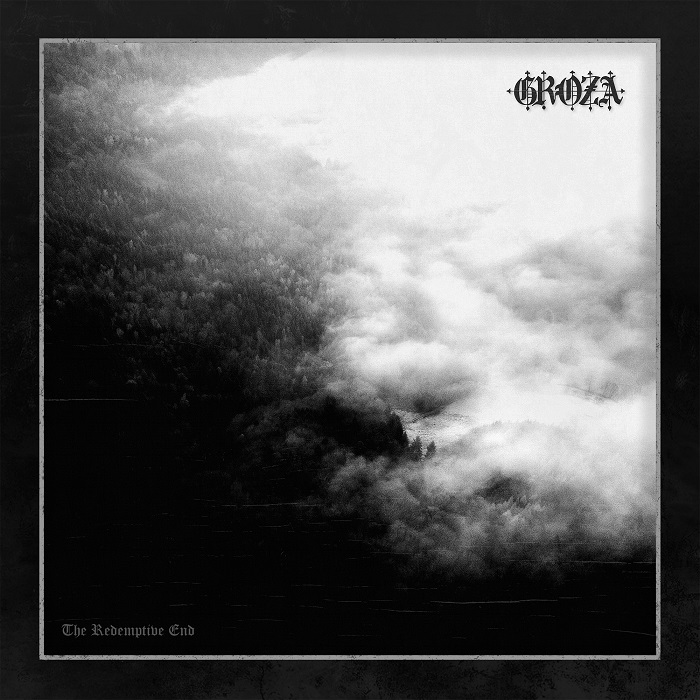
The Redemptive End |
United Kingdom
 |
|---|

Buy on: Bandcamp
Type: Full-Length
Release Date: July 30th, 2021
Label: AOP Records
Genre: Black
1.
Sunken In Styx - Part I : Submersion
2.
Sunken In Styx - Part II : Descent
3.
Elegance Of Irony
4.
The Redemptive End
5.
Nil
6.
Homewards
Review by SzejkElRopa on February 5, 2026.
"Unified In Void", the first album by the German quartet Groza, was the main reason why the band earned a reputation as Mgła copycats. After reviewing that album, this reputation did not come as a surprise to me. But hey, Groza didn't give up after such a bummer, and three years later they released another full-length, "The Redemptive End". From certain reviews on the internet, it can be guessed that the accusations of stealing and lacking originality haven't stopped with that release.
First differences one might notice when listening to this album compared to "Unified In Void" are that the sound is much more polished and that Groza undoubtedly decided to include more clean passages, reminiscent of post-black metal. Featuring atmospheric breaks in the title track as well as in 'Homewards,' they distanced themselves from Mgła in this field. The atmosphere, as previously, bursts with nihilism, resignation, and fury. There is also a pinch of depression and melancholy that can be found in some riffs, such as the one opening 'Elegance Of Irony'. Speaking of this track, it is built around a repetitive riff that, with very few almost unnoticeable changes, lingers throughout the whole song. Groza deserves praise here because this song doesn't even at one point become boring. The same can't be said for the title track, because while the chorus is powerful and instantly remarkable, the atmospheric section is a little bit too long, and eventually, at one point, my mind wandered somewhere else. Moreover, there is one thing that Groza didn't abandon compared to the previous album. In 'Nil', a heavier, even core-ish riff can be heard. The same happens (to a much lesser extent, however), in the second part of 'Sunken In Styx'. This is a subtle element that I believe is a nice addition, though I am certainly not a fan of any of the "-core" genres. On the other hand, in songs such as 'Elegance Of Irony', there are more melodic parts, which make the album balanced between heaviness and melodicity, without, what is most important, copying anyone.
One of the strongest points on this album is the vocals, especially the growls of the lead guitarist. Their inclusion added power to the album and made the refrain in the title track very remarkable. The main vocalist sounds very furious, and his performance is also one of the pros of the album. There are several added samples with voices, though I am not sure what is said there; they for sure introduce the album well (the intro), as well as prepare for the final (the start of 'Homewards'). Another praiseworthy aspect of this album is the drumming. It improved much, much more compared to the previous album. Moreover, it is more audible. The drummer employs a wide range of techniques, fills quite frequently, and his performance finally feels coherent. As I mentioned before, the riffs are well-crafted and not instantly forgettable. The bass guitar can be heard, which is another strong point of the album.
There are, obviously, some links to Mgła that one can find, especially in the lyrics, which deal with the same topic. However, they don't seem copied or rewritten in a bad way. Focusing solely on music, I couldn't find any striking similarities to that or any other band. With that, it can be said that "The Redemptive End" isn't an album that can be classified as stolen or "worship" in any way. I give it 8.9 because the weaknesses were minor, and on the whole, this was a very pleasant and interesting listen. The only bad thing is that on 'Nadir', Groza started to lean again, this time toward Harakiri For The Sky.
Rating: 8.9 out of 10
4.52k