
Blackbraid - Official Website
Blackbraid II |
United States
 |
|---|

Buy on: Bandcamp
Type: Full-Length
Release Date: July 7th, 2023
Label: Independent
Genre: Atmospheric, Black
1.
Autumnal Hearts Ablaze
2.
The Spirit Returns
3.
The Wolf That Guides The Hunters Hand
4.
Spells Of Moon And Earth
5.
Moss Covered Bones On The Altar Of The Moon
6.
A Song Of Death On Winds Of Dawn
7.
Celestial Passage
8.
Twilight Hymn Of Ancient Blood
9.
Sadness And The Passage Of Time And Memory
10.
A Fine Day To Die (Bathory Cover)
Review by Raphaël on September 18, 2023.
Less than a year after he released his first album, the highly anticipated Blackbraid I, Sgah'gahsowáh (Jon Krieger) is back with his second album, the surprisingly titled Blackbraid II. Let me tell you that, although the title might lack a bit of originality, that’s the only place you will get a lack of anything on the album. With a runtime of an hour and six minutes, he packed so many ideas that, for the most part, fit perfectly in this continuation of our exploration through the wonderful and mystical musical universe Jon is creating. Before diving in, I think it’s important to talk about who Blackbraid is and what is background is. Originally from Guadalajara, Mexico he now lives in the Adirondack Mountains, in New York. I’m not entirely sure from what tribe he is from but, based on a quick search on Google, it’s probably the Huichol people. This would explain his first video for the song 'The Spirit Returns'. He probably wanted to go back to his roots (but more on that later). As well as, recording, mixing and mastering, Neil Schneider also played drums on the, album. And that’s it! Blackbraid is the genius of one man! The fact that it’s all done independently is kind of mind-boggling. Seeing his meteoric rise in the metal universe has been quite a joy!
Without further ado, let’s start our journey. The album opens with 'Autumnal Hearts Ablaze', a beautiful and slow acoustic guitar picking reminiscent of the folky and soft side of Agalloch. The first and last few seconds is only the sound of a small wood fire crackling gently. It instantly brings you on a warm summer night in the woods. The peace and quiet is cut short when 'The Spirit Returns' starts with a black metal riff. Fast tremolo picking and blastbeats assault your ears in the most satisfying way. The entire song has a simple yet infectious melodic riff making you get the feeling you are in a vast open space. The atmosphere is simply mesmerizing. In the video they made for this song, it appears they are in a vast desert, in a place that looks like Mexico. Lyrically, it revolves around themes of our ancestors and how we can harness strength from them: “Within our hearts their fallen spirits thrive, To ride out on rolling thunder, Bathed in ancient blackened majesty”. Considering Jon is originally from central Mexico, it all makes perfect sense to film this video in a location that must be dear to his heart. It’s going to be a central theme throughout the album, his ability to paint a beautiful scenery with his words and music, that are intrinsically working together. This is an album where, if you don’t pay attention to the words, you will lose something important to fully understand this work of art. Back to the music, after taking us in a journey in a vast open field, the song cranks up the speed and aggressivity to finally end kind of abruptly, holding one note for a few seconds and then go straight into the next song.
'The Wolf That Guides The Hunters Hand' starts with a super atmospheric tremolo picking and after a few seconds, the epic howl of a wolf is heard, welcoming you into the world of the rest of the album. The drum starts immediately after this chilling howl, accompanied an atmospheric riff, that leads into a super fun and complex drum break. We are now entering the heart of the song: fast black metal riffs, all layered at different relative pitch so to come out separate in the mix. Everything starts slowing down leading to some type of post-metal, solo-ish part, think of 'Silvera', from Gojira. It progressively gets quieter with a fadeout that is a beautiful transition to the next song. Before moving on, I have to show another example of how the music and lyrics are linked together. He says: “The sweetest memory is the time taken, To sow the seeds of love in times of death Time marches on, Like rolling thunder on the edge of the rising dawn” other than how beautiful the image of sowing seeds of love is, when he talks about the time marching along like rolling thunder, the drums sounds exactly like that, rolling thunder, precisely as he says the words. Next, 'Spells Of Moon And Earth' is a beautiful folk interlude with traditional Native American flute. It’s probably a Zuni: Tchá-he-he-lon-ne but, to be honest, I don’t really know. That flute is accompanied by an acoustic guitar, playing hypnotic major and minor intervals. All of this and we are just getting started, the two next songs: 'Moss Covered Bones On The Altar Of The Moon' and 'A Song Of Death On Winds Of Dawn' are, in my opinion, the pièce de résistance of the album. Clocking in at 13min30sec and 11min05sec, they are both massive song and the highlight of this album.
Being this long, it gives time to incorporate many ideas and dynamics. It starts with simple, traditional native American drum, joined quickly by a regular drum and a catchy riff and rhythm. The song takes his time, slowly but surely getting progressively faster, until a full black metal assault! Within this buildup, he sings: “Encircling the altar in the pale moon light, Called down by blood and bone, They join their spectral bodies into mine, Imparting me with a sacred song” just after saying, with a sacred song, a beautiful flute solo is played. It is literally a song within a song! It expertly conveys images of the altar and the blood on the bones, calling the spirit of his ancestors. Towards the end it all slows down and we get a taste of his lower growled vocals, which truly gives a sensation of impending doom. For the rest, it’s a slow and doom-ish riff that ends abruptly to immediately transitioning into: 'A Song Of Death On Winds Of Dawn'. It starts with an epic riff, suddenly taking you completely elsewhere, reminding me of a good old finish folk metal band. It’s not long before it evolves into full raging black metal. Neil Schneider shows of his talent as a drummer with relentless and fast blastbeats. Jon also shows of his talent with is fierce and powerful black metal vocals, while singing such beautiful words: The seeds sown, in times of death, Blossom into the heaviest of hearts, The greatest test of all, Learning to let go, Of the love that lights the flame, Of sadness within our hearts. The way he writes about grief is truly moving. Straight in the middle of the song, there is 2 minutes and ½ minutes interlude. Cranking of the atmosphere to 11, with the sound of the wind in the background, there is a simple and repetitive acoustic guitar picking combined with a moving flute passage. While still being in trance, the drums slowly start back with that epic sounding riff to then go back to that full raging black metal assault like in the beginning. The song ends with him saying those words: “My eyes they settle, On the coming dawn, And I give myself, To her sweet song”. Screaming the word song and holding it for a long time.
The only negative points I would give this album comes from the song 'Twilight Hymn Of Ancient Blood'. It is by no means a bad song, it’s just completely out of place. The song is divided into two halves. The first is a slow and super heavy, almost death/doom part with Jon’s powerful death growls. It is still super atmospheric so it’s not that part that takes me out of it it’s the other one, a straight up blackened thrash metal ragger, complete with a shredding solo courtesy of Randy Moore. The last song is a cover of 'A Fine Day To Die' from Bathory. Again, on its own it’s really good but I feel like it doesn’t fit in the context of the album. The best way to enjoy the album, for me at least, is to skip 'Twilight Hymn Of Ancient Blood' and the cover and finish with the song 'Sadness And The Passage Of Time And Memory', which is a perfect way to end, with his beautiful lyrics and long and slow fadeout the end, which actually feels like a sunset. Always with the perfect lyrics: “Waning twilight whispers, My spirit sheds its skin, Cloaked in flowing dreams”.
Jon Krieger showed us, once again, his incredible talent as a songwriter, musician and lyricist and gave us the perfect following to his first record. Plus, the fact that he has been touring all year long, makes me certain that blackbraid is an unstoppable force in the metal world. Usually when there is a lot of hype, you get disappointed but, in that case, believe me the hype is real!
Rating: 9.5 out of 10
789Review by Vladimir on July 8, 2023.
Today is the day when we witness the return of everyone's favorite Last Mohican, and no, I am not talking about Daniel Day-Lewis and his role in the award-winning feature, but a US atmospheric black metal band which was a hot subject in 2022. The band I am talking about is none other than Blackbraid and their second full-length album Blackbraid II, released on July 7th. This band was basically everywhere on social media since the release of their debut album Blackbraid I in 2022, which was due to the fact that it’s a black metal band lead by a Native American known as Sgah'gahsowáh. I did get to check out this band when the album came out and I liked it overall for what it is, but I must admit that I was very put off by the overwhelming fan hype surrounding the band. Although I tend to look away from such things, I was very hesitant to check out the second album, but in the end, I gave it a chance just to see if the band still holds up or if it was just a hype thing after all. So, what’s the conclusion then? Let’s find out…
Blackbraid’s signature style which was established on the previous album is very much present here as well. The band’s recognizable heavy guitars in C# tuning, with tremolo riffing, melodies, blast beats, double-bass drumming and harsh vocals make a return to once again to dominate on this album, yet this time it seems that the riffs and the melodies this time are a lot heavier than the ones on the previous album. On top of that, the songwriting also seems to have become more progressive with all the complex arrangements and some moments of technical riffing, with the best example being 'The Wolf That Guides The Hunters Hand'. This time we receive three great acoustic instrumental tracks ('Autumnal Hearts Ablaze', 'Spells Of Moon And Earth', 'Celestial Passage'), all equally beautiful and mesmerizing to listen to, whereas the track 'Spells Of Moon And Earth' brings back one most important element and my favorite aspect of Blackbraid, and that is the Native American flute, which was so wonderfully combined with ambient sounds of owl hooting and the acoustic guitars. The Native American flute would make a return on other tracks such as 'Moss Covered Bones On The Altar Of The Moon', 'A Song Of Death On Winds Of Dawn' and 'Celestial Passage', which despite their nonfrequent presence still manage to steal the moment once they appear.
A personal favorite of mine is the eight track 'Twilight Hymn Of Ancient Blood', which at first is very slow and melodic, then all of a sudden it switches to a surprising heavy metal extravaganza on the second half, dominating with headbanging mid-tempo downpicking guitars and beautiful guitar solos. This album also has a very surprising inclusion, which is the cover of Bathory’s 'A Fine Day To Die' as the album’s closing track, although executed differently in comparison to the original and various cover versions. The song starts out right away with harsh vocals on the intro rather than the clean vocals that would usually be the common case, but on top of that it also has some slight tempo changes and even frequent tremolo leads. I personally never get tired of this song, and seeing it appear on this album was more than a welcome feature for someone like me who stayed a diehard Bathory fan for years.
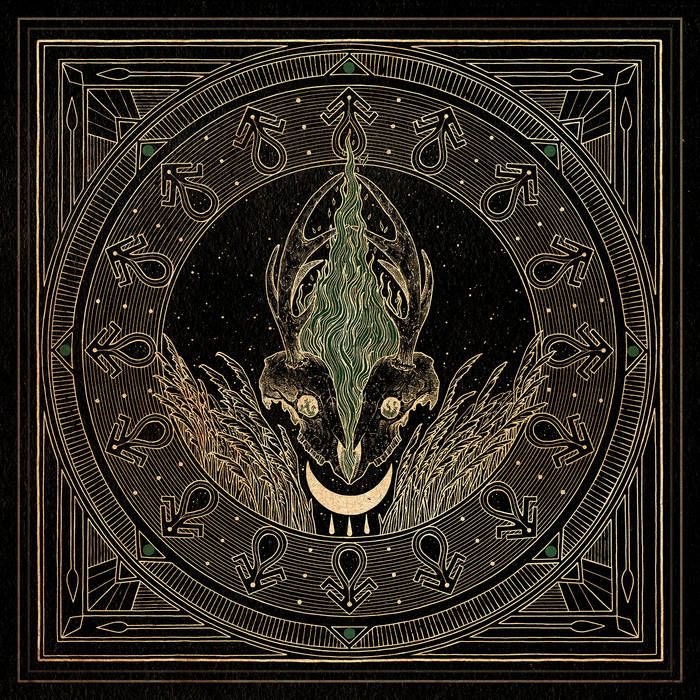
Something that I always admired about Blackbraid is the magic that flows through the music, which not only keeps your attention from start to finish, but also helps the mind visualize images in your head. I personally think that Sgah'gahsowáh really went ahead this time when it comes to the overall songwriting, taking it a step further where the listener can transcend even deeper into the world of Blackbraid that’s surrounded with nature and spirituality. The second album is considerably longer than the first one, which is due to the fact that the songs themselves are longer and the fact that the album has a total of 10 songs instead of 6, bringing it up to one hour and six minutes. Even though I personally hesitated to go so far to compare it with the first album in terms of execution, I did find myself in an unescapable situation where I couldn’t help but notice that I actually liked the second album more than the first one. It may sound unusual, but everything that was established on Blackbraid I seems to be improved and taken to an eleven with Blackbraid II, even the songs are much more engaging and powerful. I would even say that the visual presentation is carried even better with the return of artist Adrian Baxter, who applied his wonderful and imaginative skills on the album’s artwork. As for the production, it is more or less the same as it was on Blackbraid I, maintaining that heavy guitar and drum that was the crucial factor in the band’s sound.
Blackbraid I may be the great introduction to the band, but I personally think that Blackbraid II takes the grand prize. Although I do get tired of people talking about this band constantly, hyping to insane levels where it becomes tedious, I still manage to enjoy Blackbraid’s incredible musical work and admire the creative direction of Sgah'gahsowáh. Blackbraid II is not only a great sequel to the first album that stood and delivered, but it’s also a great expansion of the band’s background which I think will be even more talked about, especially with all the new fans on the horizon.
Rating: 8.6 out of 10
789