Skyforger - Official Website


Latviešu Strēlnieki

Latvia Country of Origin: Latvia

1. Within The Machine
2. Serpent Nebula
3. Fractal Entity
4. Covenant
5. Upon The Hills Of Divination
6. Stormbringer
1. Latviešu Strēlnieki
2. Kauja Pie Plakaniem, Kauja Pie Veisiem
3. 1916. Gada Marts
4. Nāves Sala
5. Sešas ārprāta Dienas
6. Pulkvedis Briedis
7. Tīreļa Purvā
8. Esat Kā Vīri
9. Dzīves Vismelnākā Stundā
10. Uz Kariņu Bāliņš Jāja


Review by Dominik on March 4, 2025.

When Sun Worship announced Upon The Hills Of Divination after five years of silence, I hoped for the best and prepared for the worst. I found myself locked in the eternal struggle of every metal fan: clinging to hope while bracing for disappointment. Would they refine the blistering fury of Emanations Of Desolation, or would they, like so many before them, stumble under the weight of their own previous triumph? Of course, I wanted a continuation—or, dare I say, an improvement—compared to their previous album. But experience has taught me to temper my expectations. How many bands do you know that follow up a masterpiece by outdoing themselves? Exactly. The history of sophomore albums is littered with wishful thinking, where reviewers convince themselves that something—anything—justifies calling it an improvement. Unfortunately, Upon The Hills Of Divination doesn't quite reach the heights of its predecessor.

What has changed? Not much on the surface, but just enough to sap some of the fun out of the experience. The good news is that Sun Worship's signature sound remains largely intact. The production is once again powerful, reinforcing the impact of the compositions. The band still refuses to acknowledge the existence of a bass guitar, and for the most part, it remains a non-issue. But beneath the surface, slight shifts in Sun Worship's formula at times nudge the experience toward frustration. These are not catastrophic deviations, mind you—no wild prog experimentations or none called for synth interludes. However, the blackened death metal influences, which were only subtle hints before, now take up more space, sometimes to the detriment of the album's overall atmosphere. The same can be said for Lars' vocals that once were a bleak and commanding presence, but now seem to have succumbed to either age or intent, sounding increasingly strained and monotone and lost some of their bite. He was never known for vocal variety, but here, his delivery feels especially one-dimensional, with one notable exception (more on that later). The occasional clean vocals also feel less organic than before, working hard to provide the balance they might have intended.

The subtle shift in sound is most evident in tracks like the opener "Within The Machine" and "Fractal Entity", where the dense, overwhelming guitar work struggles to keep one foot in black metal. The former does feature an interesting vocal duel, with wailing clean background vocals clashing against aggressive growls, which adds some unexpected contrast. But one of the best moments on the album is "Serpent Nebula", a track that immediately pulls you in with compelling riffs and an intensifying build-up. It radiates urgency, seamlessly shifting between hypnotic repetition and ferocious speed.

Another highlight is "Covenant", where Lars finally breaks away from his usual low growls, injecting a sense of desperation that adds some variety to the vocal approach. The guitars remain the driving force, either dictating a steady mid-tempo pace or pushing into high-velocity blast beats. The title track, the album's shortest, stands out particularly in its second half, where it channels pure relentlessness, that reminds us why Sun Worship is still a force to be reckoned with.

And then there's the closer "Stormbringer", the album's frustratingly mixed finale. It starts off exactly how I wish the whole album had been—immediate, punishing, and brimming with urgency, a storm worthy of its name. But just when you expect it to escalate further, it instead slows down, eventually settling into a drawn-out, plodding groove. It doesn't smell like teen spirit, but it does reek of a song being deliberately stretched to hit the ten-minute mark. Where Emanations Of Desolation ended in a blaze of finality, this one just…. wanders off, leaving a faintly bitter aftertaste.

Ultimately, Upon The Hills Of Divination is a solid album, just not quite at the level of its predecessor. Some of my issues stem from my general skepticism about mixing black and death metal, so your rating may vary. The death metal influences remain within acceptable levels most of the time, but they do occasionally get in the way of what Sun Worship does best. Still, the band remains a compelling act, and even with its minor flaws, this album is more than worth the time. Just don't expect divination—only intermittent glimpses of it.

Rating: 8.2 out of 10, because even the hills of divination have occasional dead spots.

   1.76k

Review by Felix on February 3, 2024.

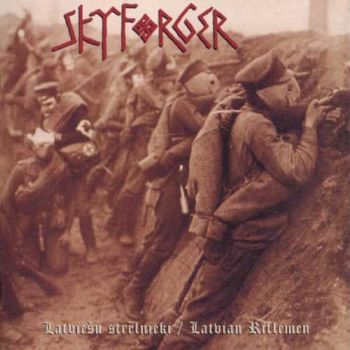
"Latvian Riflemen" must be deemed as the most direct full-length of Skyforger. The nightmarish cover does not only indicate the cruelty of war. It is simultaneously an omen for the pretty brutal overall impression of the musical content. I concede that the folkloric elements are not completely marginalised. For example, the band has chosen one of these fragile melodies for the beginning of "Battle of Plakani, Battle of Veisi" and the vocals of "Death Island" follow the more or less heroic approach that these long-bearded pagan bands usually use. Nevertheless, Skyforger have put the focus on a proper mix of thrash and heavy metal that does not lack of gruesome vibes. This decision is simply consistent, because the warlike concept of the lyrics and the almost romantic love of nature are mutually exclusive.

Songs such as the highly explosive "The March of 1916" illustrate the violent path of the formation. Hammering drums, straight guitars, a modicum of melodies and the unpitying nagging of the lead vocalist take the audience to the front line. The listener is confronted with the smell of powder, the filth of the disturbed ground, the blood of the fallen comrades and his own cold sweat. Of course, the apocalyptic scenario is described from a Latvian perspective and it seems as if each and every soldier of the Baltic country has been a true hero ("The Siberians flee, but Latvians still stand!"). In this respect, it comes as a surprise that the German Empire won the war in the East. Anyway, the primal catastrophe of the 20th century did not produce a great number of winners. Skyforger's music expresses the tragic of the European mass suicide. Especially the grinding "In the Tirelis Swamp" illustrates the hopelessness of the soldiers and cements the feeling of no escape. "Be Like a Man" points on the same direction, especially its instrumental part which combines sharp guitars with melancholic lines. The crude mixture of personal pain, national pride and mortal fear is well captured by the band.

From the beginning to the end of the album, Skyforger do not present any sloppy tracks. Instead, they guarantee a solid quality level. The guitars are very dominant and create a dense atmosphere without delivering stale riffs or vapid leads. "Latvian Riflemen" was recorded by a guy called Lundberg and the band itself. In my opinion, this team has done a good job. On the one hand, the vigour sound does not kill the emotions that the music evokes. On the other hand, it shines with the necessary degree of robustness and stability. Hence it follows that pure metal lines like those at the beginning of "Six Days of Madness" come into their own. By the way, this song bundles the main features of this album, the metallic compactness, the dramatic concept, the brave attitude of its protagonists and, during the second half of the tune, the murderous intensity of the battles. No doubt, thumbs up for an autonomous full-length without any serious shortcomings.

Rating: 8 out of 10

   1.76k