
Christ Agony - Official Website
Anthems |
Poland
 |
|---|
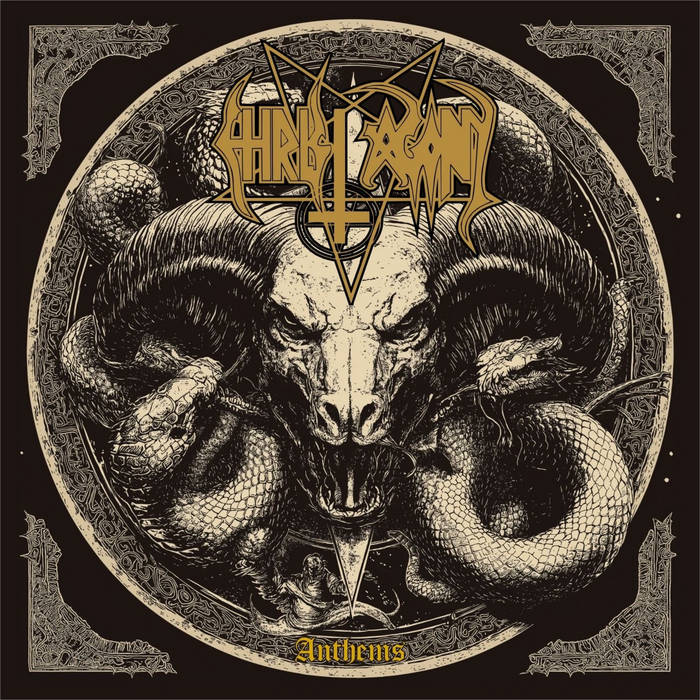

Buy on: Bandcamp
Type: Full-Length
Release Date: September 26th, 2025
Label: Deformeathing Production
Genre: Black, Doom
1.
Empire Of Twilight
2.
Throne Of Eternal Silence
3.
Sanctuary Of Death
4.
Rites Of The Black Sun
5.
Dark Waters
6.
Nocturnal Dominion
Review by Norbert on January 3, 2026.
In the Polish underground metal scene, they're a cult band. A legend. An artistic entity existing since the early 1990s, with a distinctive, inimitable style, whose music holds up to this day, beyond the context of time. Except that's precisely what happened – Christ Agony's style and history aren't a fairy tale about a simple march to glory, but rather a saga of adversities, tangles, disappearances, returns, and controversies that more often concerned the lives around them than the notes themselves. I say "them," but it's worth remembering that although Christ Agony functioned as a band, in practice, almost from the beginning, it was Cezary Augustynowicz's project. This explains both the stylistic continuity and the long-term breaks in activity.
recognizable musical language – and the first traces of it can be heard on their demo recordings, which are like photos from their youth: it might seem a bit embarrassing to show them to family because of their sound and hairstyles, but without them, the whole story wouldn't be complete. The strong>Sacronocturn and Epitaph Of Christ demos were a record of exploration, in which even then it was possible to detect the seeds of what would later become the band's trademark: long forms, dark ritual, melodicism based more on hypnosis than aggression. On Unholyunion, these ideas took fuller form, strong>Daemoonseth – Act II deepened them towards an even greater trance, and the album Moonlight – Act III concluded this stage in their most mature and coherent form – and, paradoxically, also the most accessible, even though they were still six long compositions, not a set of singles for radio. Everything here was refined: the structures became clearer, the motifs more condensed, the dynamics better handled, and the whole thing gained a monumental quality without bombast. Christ Agony went against the grain of the primitivist trend and showed that black metal could be expansive, melodic, and yet still diabolical, intense, and unique. For many, it's a monumental album—even if some fans prefer Act II for its grim and primal edge. Darkside proved to be an ambiguous album—for some, an attempt to transcend the existing formula, for others, the first sign of a stylistic crossover. And after Darkside, Christ Agony's story began to become distinctly complicated. Subsequent releases—Trilogy, Elysium, and then a long silence broken by Condemnation and subsequent albums—provided moments of interesting ideas, but rarely coalesced into a coherent whole comparable to their earlier achievements. It was a period of exploration, experimentation, and dispersion, in which Cezar's original vision was still present, but increasingly often it failed to meet the expectations of listeners.There was also personnel turmoil, breaks, reunions, side projects, and, at one point, albums that some listeners talk about mercilessly (and others remain loyally silent). It was these years that made Christ Agony function more as a name with historical weight than as a band expected not even to deliver further breakthroughs, but even new material. There were fears they wouldn't return. Yet they did – and worse (for skeptics), in a form that forces you to tip off your hat, even if you only wear a hoodie.
Released in September, Anthems – their first album in nine years – works precisely because it doesn't try to pretend it's 1995. This isn't a reenactment of youth, but an album recorded three decades later, fully aware of what has passed – and what can no longer be surpassed. We get six tracks and about forty-five minutes of music in a dark, dense atmosphere, mostly at mid-tempo, with moments of uptempo, but without the edgy need to prove anything with blast beats. Instead, we get a more contemplative Christ Agony: heavy melodies, sultry chords, distinctive riffing, and a mystical aura. Importantly, it all flows naturally, without the impression that someone is forcing the obligatory "trilogy references" into every other bar. There are elements here that reinforce the material's ritualistic nature: keyboard backdrops that build space, discreet folk melodies, episodic male choirs that add majesty, and a didgeridoo—a traditional wind instrument of the Australian Aboriginal people—used on 'Throne Of Eternal Silence.' Production-wise, the whole thing sounds polished and modern, but without being plasticky.
Anthems' greatest strength lies in its recapture of that distinct feeling of unease and fascination with a dark, dense atmosphere that slowly envelops the listener with each passing minute – something always found in Christ Agony's best recordings. This music doesn't attack directly, but gradually draws you in with its cool melody, dense arrangements, and patiently built tension. The vocals are surprisingly good – "like in the old days," in the sense that they have character and manage to carry the mood. Sure, some passages won't appeal to everyone, and there will always be someone who finds the album repetitive at times, but this doesn't change the overall picture: Anthems is Christ Agony's best material in many years, and for some, even their best since Moonlight.
This album confirms that Christ Agony remains one of the few bands in Poland with such a distinct identity. It's not about tempo, riffs, or vocals, but about the way they build narrative and atmosphere, the consistency of their melodies, and that rare ability to create music that's both heavy and flowing. Therefore, their return doesn't sound like a reunion for the sake of reunion, but like a continuation—perhaps belated, perhaps sacrificed for everything along the way, but a true one nonetheless.
Rating: 8.5 out of 10
1.17k