
Draugaskógur
Fullmoon Hypnotic Ritual |
Serbia
 |
|---|
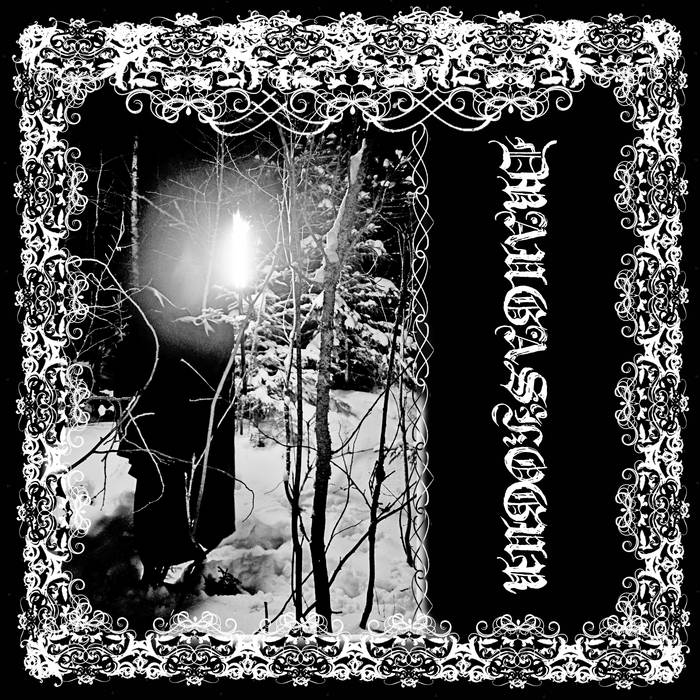

Type: EP
Release Date: April 25th, 2025
Label: Independent
Genre: Black
1.
Astral Visions
2.
Through The Gates Of Death
3.
Moonghost
4.
Ash
Note: Also released by Inferna Profundus Records (digital and cassette) and Astral Nightmare Productions (CD)
Review by HanSathanas on May 4, 2026.
The frontman of Draugaskógur, one Vampiru Kista, contacted me via email requesting a review of his band’s debut release, Fullmoon Hypnotic Ritual. For those who are regulars on this website—especially the mods—you’ll know I’ve been around for quite some time without much activity. If I remember correctly, this is the first time someone has contacted me directly asking for a review.
So, is this EP any better than what we have heard—or will continue to hear—in the realms of extreme metal nowadays? I wouldn’t go as far as calling it groundbreaking. It is not. Perhaps it doesn’t have to be.
From the first press of play, we are greeted with a wintry, cold atmosphere. It feels as if a blizzard is trying to burst its way out of my headphones. That alone is enough to get me interested in this EP. Because of that, I can’t really break down each track individually or point to clear favorites. They are all good, but nothing truly great. Do they sound similar? Well, aren’t they supposed to?
Nevertheless, I commend Vampiru Kista for keeping things cohesively atmospheric. Quantitatively, each track follows standard songwriting structure, even within a subgenre that is often diluted. It speeds up when it needs to and slows down just enough to generate that liquid-nitrogen, cryogenic atmosphere that freezes everything in place with layered chords and sustained riffs.
Generic? Kind of—but not without merit. Because of the near-industrial texture of the guitars, especially the sustained chord work in the background, the music flows with clear intent and passion. This is what keeps the songs from falling apart (not that the songwriting is weak to begin with). The synths or keyboards deserve credit here as well for shaping much of that frozen atmosphere.
Perhaps early Burzum is one of the key influences here, though I wouldn’t call it exclusive. I would agree with other reviewers that Hvis Lyset Tar Oss is a likely reference point. That record is notorious for its frostbitten keyboard work, and the resemblance is hard to ignore.
The general feel of the riffs is droning but razor-sharp, with rich mid-tones—typical of the Scandinavian black metal school, but with subtle psychedelic undertones, likely driven by the synth work. The Work Which Transforms God also comes to mind, as does Puressence Of The Primitive Forest by Sorcier des Glaces, one of my personal favorites in the genre.
Is there variety? Yes. From the blizzard-like opening of 'Astral Visions' to 'Moonghost', each track shifts in pace and dynamics. Expect repetitive structures played at different speeds, with tremolo riffs throughout. There are stop-start moments, minor cymbal accents, and drum fills. Nothing groundbreaking, but it binds the songs together effectively.
I miss the days when drums sounded like they did on Close To A World Below, A Blaze In The Northern Sky, or Blessed Are The Sick. Here, the drums are a bit quieter and more distant than I prefer. That said, it’s not necessarily a bad thing. Many modern metal productions—across death, black, and related genres—suffer from overly polished, digitally quantized drum sounds, which can be exhausting.
Here, the drums sound slightly more organic, even if they remain within the expected black metal production framework. It might even be a drum machine—but it works. The snare and kick are still present in the mix and remain audible during blast sections, which is appreciated. Often, blast beats bury the snare completely, as heard in Satyricon’s Nemesis Divina, where, despite its legendary songwriting, the drum mix is notoriously thin.
The vocals are, well, nothing particularly new. It’s a style we’ve heard countless times before: haunting shrieks filled with despair, echoing through cavernous space. Competent, convincing, and fitting. I can feel it. The delivery is eerily calm—far from Hat-level intensity, but still dark and effective. A perfect match for the music, and just as cold as the riffs. At times, the vocal tone even recalls Nortt, albeit slightly less oppressive.
Overall, listening to this EP is a journey I wouldn’t mind taking again. While it only offers a brief glimpse into Vampiru Kista’s vision across its four tracks, it’s enough to suggest what Draugaskógur may deliver in the future. 'Ash' doesn’t feel like an ending so much as a beginning.
This type of black metal is nothing new, but it remains a niche with enduring appeal. It’s becoming increasingly difficult to find bands that truly reinvent the wheel, and this release doesn’t attempt to. Still, it’s a promising debut, even if not without flaws. The songs are memorable enough for repeat listens, especially in the right setting—preferably with the lights off and the AC blasting so you can fully freeze into Fullmoon Hypnotic Ritual, as intended.
Download this EP. Better yet, buy the CD if you can find it—the run is limited to just 300 copies. One day, it may resurface on eBay for ridiculous prices. Hopefully, it will see a re-release in the future.
Recommended for those who like their black metal cold, grim, and free of politics.
Rating: 8.5 out of 10
739Review by Lawrence Stillman on January 8, 2026.
So, out of the blue, somebody asked me to review this album, and so I decided to give it a listen. Surprisingly, I like it a lot, considering how short and how regular black metal tends to have a stereotype of being pretty "same-sounding." The first song has a pretty drone-y intro to it and quickly transitions into a Paysage d'Hiver tribute song, or at least sounds as close to one. While it does not bury all the instruments under the wall of guitars as Paysage did, it definitely gives off the image that the band is trying to copy that sound. Overall, a strong start to the album. I do like Paysage a lot, so it's a decision I would welcome.
But then the second song of the album becomes a Dissection-worship song, which is something I did not expect since the first track sounds like anything but Dissection; it is dominated by evil-sounding yet uplifting guitar melodies, and honestly, it is a pretty groovy change of pace. The lead guitar riff of the song is something I can listen to forever, so I'm not complaining. While the rest of the album follows the same formula as the second song did, more melodic yet uplifting black metal, the last song of the album decides not to do that and plays some ambient dungeon synth instead. Maybe this is the composer's way of telling us that whatever "ritual" he was putting the listeners through is over, and the song is an audible message telling us that.
The central aspect, I think, for the album is the word "hypnotic," since it is also in the album title, and I think the songs here really lived up to the definition of the word itself. The songs here are very droning and repetitive, but due to the nature of the lead riffs, it is also quite hypnotic since those riffs are something I can see myself listening to forever. The production here also helped that somewhat; while it is not as extreme as what Paysage did, the audio quality is bad enough where everything blends, and it allows the repetitive nature of the songs themselves to serve as a weird form of sleeping music for the accustomed ones. I do notice that the keyboards are used in a more electronic and cosmic way to create a more ethereal and mystic sound to sell the "hypnotic atmosphere," but to me, it feels like it's just there, neither helping nor harming the music, but this is just my opinion.
So, do I like it? I can say that I did enjoy it, but I doubt I would deliberately look this band up myself if somebody (actually the guy behind the band) didn't message me out of the blue to check out this album. But hey, when somebody gives me a good black metal album, I'll listen to it.
Highlights: It's a 22-minute album; just listen to the whole thing.
Rating: 7.5 out of 10
739Review by Nekrist on December 28, 2025.
Black metal has always been characterized as one of the most romantic (in the nostalgic sense of the word) and passionate extreme musical styles in existence. Every time I encounter new young bands in this genre, I listen to them with attention and curiosity, hoping to find out what path they've chosen to take within the many variations of the style.
Some choose to play elaborate, avant-garde, and complex soundscapes, pushing all the genre's characteristics to the limit; others embark on melodic and neoclassical paths. However, some choose to remain faithful to the old formulas that characterized and cemented the foundations of everything we now know as black metal. Draugaskógur is a project that decided to take the latter path.
I don't have many references for Serbian black metal, as it's never been a country on my radar for musical exploration, so I honestly didn't know what to expect without clear points of reference to write an objective and honest review. The only band I'd previously heard of from that distant Balkan country is the Dissection-influenced band known simply as Bane, a really good band by the way.
I did some research on the available material to listen to previous releases (if any) to get a better idea of what I was going to encounter. To my surprise, this EP, entitled (very aptly) Fullmoon Hynotic Ritual, turns out to be the debut album from this mysterious one-man band.
The band's name caught my attention, as in Old Norse it can be translated as "Draugr's Forest" or something like that, with Draugrs being mythological creatures comparable to zombies in Norse mythology. Once I analyzed all these aspects, I started listening to this EP, and I truly wasn't disappointed.
Fullmoon Hypnotic Ritual presents an old-school black metal sound strongly reminiscent (at least to me) of classic releases by Finnish bands like Sargeist and Horna in their most ethereal and contemplative moments. The synthesizer use is majestic and elegant, adding a subtle but very important sonic layer to the overall composition. The riffs carry and transmit nostalgic and memorable melodies that transport us back to the mid-'90s and recall the former glories of Emperor and Satyricon. The drums remain in the background, providing stability to the atmosphere woven by the keyboards and guitars. Meanwhile, the vocals seem like ghostly, distant howls lost in the middle of a wintry forest.
Draugaskógur features four songs (the last being an instrumental closer) that evoke feelings from a distant past and continue to keep alive a legacy that's more present than ever. You won't find anything new or experimental here; you'll just find sincere black metal with all the elements that made this style majestic.
Rating: 9 out of 10
739