
Ildfar - Official Website
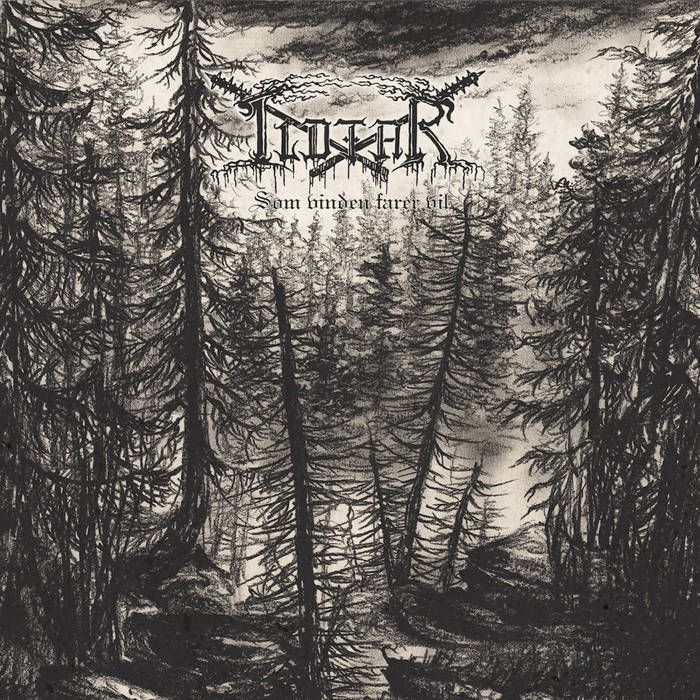
Som Vinden Farer Vil |
Norway
 |
|---|

Buy on: Bandcamp
Type: Full-Length
Release Date: May 14th, 2021
Label: Northern Silence Productions
Genre: Black
1.
Taakeheimen
2.
Under Sorte Vinger
3.
The Last Dawn
4.
Den Gamle Mannen Hvisker Mitt Navn
5.
Som Vinden Farer Vil
6.
Vandring
7.
Under The Graves (of 1994)
8.
Pesten
9.
Behold The Throne
10.
Lyset I Skumringen
11.
Norges Haller
Review by Dominik on December 30, 2025.
Do you belong to those people who need pictures—at least in their mind—to drive a point home? Fine, here’s one for you: imagine a parabola, or if you prefer something more scientific, a Gaussian distribution. That’s Living Death’s career and discography curve right there. The band started somewhere in the lower basement with their charming, but chaotic piece of early speed metal (“Vengeance of Hell”), which was heavily sabotaged by a rotten production and vocals so “unique”, that you were never entirely sure whether you were listening to a human being or a bizarre hybrid of a duck, frog, and someone whose private parts were undergoing a medieval torture session. The follow-up “Metal Revolution” was more refined, but still didn’t fully live up to its ambitious title. Then suddenly, against the laws of probability, the band peaked with the album at hand. Everything afterwards obeyed mathematical logic, and the curve obediently slid back down to basecamp.
Even with hindsight, it remains difficult to grasp how Living Death managed to churn out such a gem of thrash history. Where the debut felt like a rough draft scribbled in an old school notebook by a restless teenager during math class, “Protected from Reality” sounds as if an ancient thrash deity took that notebook and rewrote it with elegant calligraphy. Everything is tight, tighter than an old shirt I occasionally try on, convinced that my supposedly “well-worked-out” body will fit into it again (it doesn´t). Musically, the potential had always been there, but here it finally unfolds in full. The decisive factor, however, is a slightly refined vocal approach. Yes, Thorsten Bergmann still sounds like a leather-clad goblin calling across dimensions and shouting warnings from a parallel universe, but instead of fighting this peculiarity, the band embraced it. And it worked. His voice now feels like an essential element, not an accidental intrusion by a comic-book villain who took a wrong turn into a speed metal rehearsal.
Why the album falls just short of absolute perfection has to do with the slightly weaker B-side. Most of what follows “Vengeance (Horrible Infanticide Part Two)” cannot quite keep up with the quality of what came before. The closer, “Eisbein (mit Sauerkraut)” (“Pork Knuckle with Sauerkraut”), which is the only German-language track, feels both generic and naïve, displaying a kind of adolescent humor that sticks out like a slapstick sketch in the middle of a gothic thriller. “The Galley” plods along as if stuck in the mud, without leaving much of a mark, whereas “Nature’s Death” on side A proves that slow doesn’t automatically mean less gripping, so there’s no excuse, gentlemen.
Side A houses four songs that many bands would happily commit minor war crimes to call their own. The opener “Horrible Infanticide (Part One)” and especially “Manila Terror” are high-speed eruptions driven by dueling guitars racing to see who can lead the pack by the tip of its nose. The wild solos and the decision by the vocalist to retain some of his “uniqueness” while adapting to the actual music show how far they had come. The songs are much less simplistic than on the early outputs and showcase how gripping the Teutonic thrash scene of those days could be. The fact that, even today, I regularly return to at least side A is proof of the material’s timelessness.
However, and this is why I dedicate a separate paragraph to it, the real highlight sits at the end of side A: “Woods of Necrophiliac”. An instrumental, which is one of the most atmospheric and haunting I’ve encountered in decades of metal listening. It’s not a progressive masterpiece, and it doesn’t aim to be. It thrives on gloomy acoustic guitars alternating with simple yet memorable riffing, timid background choral whispers which drift by like haunted souls, and even some keyboard lines hiding in the shadows and lurking at the edge of your perception. The track never reaches pure thrash velocity, but it radiates thrash energy nonetheless. The atmosphere perfectly fits what the title implies. You feel like walking through a dark, uncomfortable place where someone with severe psychological issues is lying in wait and engaging in something both illegal and deeply unethical. You feel the chill even without lyrics spelling it out.
Sometimes a band comes together in a rare moment where ideas, chemistry, timing, and emotion align perfectly. You can’t plan that, and it’s almost impossible to recreate. “Protected from Reality” is a testament to such a moment. Why Living Death moved away from that successful formula is still beyond me. Maybe the guys became trapped trying to reproduce it. Because paradoxically, trying to write another classic can be the very thing that prevents it. Still, I’m grateful they managed it once.
Rating: 9 out of 10, because every masterpiece needs a tiny scratch in the paint to prove it’s real.
2.17kReview by Felix on December 30, 2025.
Living Death's debut suffered from terrible sound, but their second full-length presented a great improvement. Protected From Reality went a step further and showed the band in top form. It offered some of the best German thrash metal tracks from this period. And it may sound very patriotic, but you surely know that Germany had a lot of strong thrash bands during the eighties of the last century. It was therefore for every thrash brigade a challenge to achieve a high position in the national ranking.
Violent Force were of the opinion that "Velbert is absolutely dead". But Living Death, who also originated from this town, did not share that fatalistic point of view. They acted with determination and tenacity. Bulky riffs opened the album in a very rude way. It became immediately clear that the band knew how to pull you into the tracks. 'Horrible Infanticide (Part One)', the furious opener, unleashed a tidal wave of thrash metal. After its crude beginning, it turned into a straight high-speed attack. The song was thematically related to the opener of the B side, 'Vengeance (Horrible Infanticide Part Two)'. Also, the musical approach of these two tunes was fairly similar. 'Vengeance' reached the same level of ferocity, straightness, and poisonousness, among other things, because of its crunchy chorus and some mysterious breaks. The atmosphere of the cover artwork especially matched the aura of these songs.
Lead vocalist Toto Bergmann, strongly disputed in view of his Micky Mouse performance on the first album, made his best contribution so far. He still sounded very individual, but his high-pitched screaming followed a more controlled approach. Nevertheless, Toto's way of singing remained a unique selling point. He no longer sounds like the well-known mouse but like a dying cat in its last minutes. In other words: simply ingenious. These two words could also be used for the description of the drilling guitar sound that did not fail to deliver an extra dose of aggressiveness. Overall, the mix reflected the spirit of thrash metal while impressing with both its density and its liveliness. In particular, the entire A side was an orgy of phenomenal riffs, vibrant breaks, and menacing melodies. 'Wood Of Necrophiliac' constituted the most remarkable track. This instrumental piece created a very sinister atmosphere because of the interplay of emotional guitars and flattening riffs. Without any question, it is still one of the best instrumentals that I have ever heard. Much to my surprise, I did not miss the expressive vocals of Toto. Each and every riff, as well as every single guitar line, hit the mark. Rarely used keyboards and simple background vocals enhanced the effect of the aforementioned atmosphere. The only error of the song was that it ended too soon and too abruptly.
The B side surprised with a broader musical range. 'The Galley' pummeled you with a doomy heaviness while 'Eisbein (Mit Sauerkraut)' was meant to be the funny conclusion. To be honest, it was not very funny at all, but the composition itself met the expectations. Nevertheless, the B side could not compete with the first half of the vinyl. With the exception of 'Vengeance', the songs were slightly weaker than the pieces of the A side. However, the band did not present any throwaway track. While being driven by its musical conviction, the five-piece found its own way so that Protected From Reality did not lack originality. Nevertheless, the band did not undermine the principles of the genre. Admittedly, it would be an exaggeration to say that Living Death managed to square the circle. But nobody could ignore the surprising development of the band. Just think back to the immature debut.
Rating: 9.1 out of 10
2.17k