Lömsk - Official Website
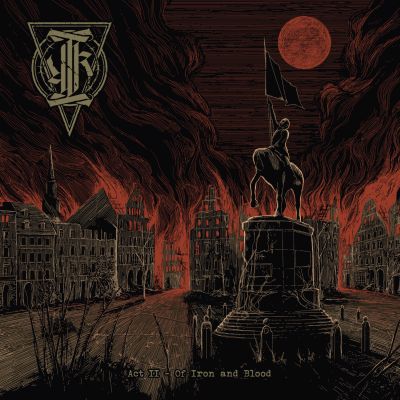
Act II - Of Iron And Blood |
Sweden
 |
|---|

Buy on: Bandcamp
Type: Full-Length
Release Date: March 6th, 2026
Label: Vendetta Records
Genre: Black
1.
Fields Of Elysium
2.
Of Iron And Blood
3.
Requiem Of Fire
4.
Entropia
5.
The Gathering Storm
6.
Chimaera
7.
Stare Into The Void
8.
Furia
9.
The Silence Thereafter
Review by Dominik on November 18, 2026.
I've been dodging this review for quite some time now, but I guess I can no longer avoid the inevitable. Not because "Act II – Of Iron and Blood" is an outright disaster. It isn't. Still, I am slightly disappointed with the direction the band has chosen to take. Welcome to the realm of Mgłömsk. The Swedish band that does everything it can not to sound Swedish. In my review of "Act I", I already highlighted the fact that these dudes suffer from a severe case of Mgła worship. However, they did it with enough spontaneity and seemingly good intentions to not degrade themselves into a simple copy-and-paste machine. Furthermore, the best song on their debut EP showed enough original ideas to keep the flame of hope burning that the band would further refine its sound and find a good balance between the "own" and the "borrowed".
Refine their sound they certainly did. In the wrong direction, though. Everything has been cranked up a notch, so now I am stuck in a dilemma. I find myself sitting in front of a technically well-executed album, boasting a very professional production and songs that come with all the expected trademarks of the black metal genre. Unfortunately, my inner self stubbornly refuses to emotionally connect with it. Maybe because I can't tell whether I am listening to the Poles' little brothers or another very close relative. Maybe because, while transitioning from "Act I" to the album under review, the band lost too much of its spontaneity and created a release whose main strength stems from the fact that nothing has been left to chance on the one hand, while somehow feeling utterly predictable and rather dispassionate on the other.
Let me share some more insight into a band that is very competent at what it does but leaves me wondering how much of its musical identity actually belongs to its members. "Fields Of Elysium" is a good opener and one of the album's best songs. It offers a good cross-section of Lömsk's interpretation of black metal. The guitarists deliver a very solid performance. Their delivery is sometimes a bit repetitive or hypnotic and is often built around melancholic melodic patterns. The drumming feels almost mechanical at times and alternates between blast beats and mid-paced sections. Already "Fields Of Elysium", despite being one of the shorter tracks, reveals another weakness: it contains extended passages that develop through repetition rather than constant changes. Nothing fundamentally wrong with that. My problem remains that if I can't tell whether I happen to be listening to "Exercises In Futility" or "Act II", then we're not dealing with an accidental resemblance. Although the vocals are convincing and suitably bleak, the vocal pitch is relatively uniform, and the similarity to the "originators" is evident.
The title track continues along the well-known blueprint. Two-thirds into the song, a calm spoken-word passage proves that simply inserting a little variation of your own can immediately distance you from your main influence. Which is a good thing and should have been done more often. The war-drum-like introduction to "Requiem Of Fire" is another example, but unfortunately, the song too soon tumbles back into Polish territory. Apparently, it was simply afraid of getting lost without a map.
In an interview, Lömsk mentioned that Darkthrone, Mayhem and Taake shaped their foundation, whereas bands like Deathspell Omega left their mark in terms of dissonance and twisted compositions. Well, I am certainly not the most gifted person when it comes to technically dissecting compositions, but I am struggling to detect these influences in Lömsk's music. And although some of the songs, like "Entropia" and "Furia", are quite long, they aren't overly complex. Instead, they rather draw out one theme before moving on to the next section. As mentioned above, the repetitive nature of the music isn't necessarily a weakness in itself. The difference is that repetition needs to create something compelling or emotionally rewarding. Otherwise, it simply becomes repetition. Both "Entropia" and "Furia" spend quite some time in that damned twilight zone where a song simply floats by without being a nuisance or an ecstatic revelation. For many minutes, it just "is", and despite the professional execution and obvious songwriting skills, the spark simply refuses to jump across.
Having just released their second album, it is definitely not too late for Lömsk to refine their approach. If they went back to some of the ideas presented on their debut EP, with "Spetälsk" being the prime example, I am confident they could win me back. Obviously, this wouldn't be the key to their future success, but it would give me a good feeling and prove that the band has more in it than sleeping in Mgła underwear.
Rating 6.9 out of 10, because imitation may be the sincerest form of flattery, but it makes for a rather poor identity.
980Review by SzejkElRopa on March 21, 2026.
Anyone who knows my taste in music knows I absolutely love the idea of combining black metal with themes of war or history. Bands such as Minenwerfer, Antrisch, or even in some part Imperium Dekadenz are prime examples of this. Another band that I have recently discovered that does exactly that is Swedish Lömsk, whose name (according to all-knowing Metal Archives) means "insidious" in Swedish. Their recent opus, "Act II - Of Iron And Blood," seeks to convey the tragedy of war through intense black metal.
While the Swedes don't take up the topic of any exact war or period of time, unlike the bands mentioned in the beginning, they certainly do their best to find a middle ground between the apparent, tragic glory of war and the black metal aggression. Fortunately, their efforts paid off. On the lighter side, several elements assure that the theme of this album is, indeed, war. For instance, opening drums to "Requiem Of Fire" sound as if taken from a war orchestra. Another example is that the title track ends with a speech by Warren G. Harding, one of the US presidents. As for the music itself, the most atmosphere is given by the subtle keyboards, which appear in tracks such as "Entropia" or "Stare Into The Void", as well as on the other tracks throughout the record, which gives a slight touch of war glory, and adds another layer to the album. There are also two instrumentals, which certainly enrich the album with the sounds of war, especially "The Silence Thereafter", which works as a good album closer. As I said before, some straightforward elements equalise the atmosphere. The full-length is mostly led by guitar riffs that are kept in a rather traditional, yet modern-sounding black metal style. One of the best examples is the whole song "Chimaera", which is full of great riffs. The beginning of the song is dynamic and vehement, which is followed by a very memorable and equally brutal chorus. On the other hand, the middle section slows the song and conveys the tragedy and nihilism extraordinarily well with its repetitiveness. Moreover, a certain amount of aggression can be found in the vocals, which are nothing less than quite standard black metal harsh vocals. Even though they are not extraordinary at all, the vocalist (and the bassist) gives a very convincing performance. This can be felt in songs such as "Furia", which is one of the more aggressive songs.
The album is certainly based on some amount of repetitiveness, which is obviously thanks to the riffs and choruses. The songs, fortunately, don't tend to become tedious due to that. Usually, they are quite balanced, maybe except for "Furia", which could last for a minute less. The riffs are predominantly played in tremolo style, resembling more modern bands such as Mgła or maybe Groza. As I said before, one of my favorite riffs were the ones on "Chimaera"; however, the whole album keeps a good level from start to end. Ranging from fast and vehement (usually in the choruses) to slower and more atmospheric in the middle sections, the riffs on the release are of at least good quality. Tremolo is also used in the opening of the longer songs, such as "Requiem Of Fire", building the tension with a headbanging riff. The vocals are convincing and brutal, although not special for the genre. Although there is little to no variation in the vocals, they at least don't become tedious in time, which is certainly a plus, taking this record's length into account. The drumming is one of the better parts of the album. The man behind the kit varies between blastbeats and carefully implemented drum fills. While The Captain isn't the best drummer I have encountered, the relatively small things, such as the mentioned before opening to "Requiem Of Fire", made me like the album more.
Lastly, one of the topics that is often discussed regarding Lömsk and this album is the similarity to Mgła. In my opinion, I can agree that this album is played in a similar style to Mgła's newer works, and the people behind Lömsk are very likely to have been inspired by the Polish band. However, as much as I love Mgła, I couldn't find any elements that could have been blatantly stolen or replayed stupidly. There were some similarities that I found in the lyrics, though. The chorus to "Furia" with the line "Per aspera ad astra" very much conjures up the ending song of Groza's latest album, which, as far as I remember, used the same Latin proverb. And lastly (take it with a grain of salt), after listening to the end of "Chimaera", I officially have heard "now I have become death, the destroyer of worlds" for the third time in my short life in the black metal scene. The first time I heard it was in Groza's "Nadir", and the second time I heard it was in Varnheim's "Void". Come up with more original additions, please! Jokes aside, this will not, obviously, affect the final score.
"Act II - Of Iron And Blood" was an enjoyable album that once again proves the fact that black metal and war are, indeed, a great mixture that can work together in a good way. The album wasn't the most original or groundbreaking that I have heard in my life; however, it was gripping enough to give this album a final score of 83%. Most of the songs are good, with a few well-crafted, emotive moments that make this album remarkable. Recommended for the fans of Mgła and, in general, modern black metal.
Rating: 8.3 out of 10
980