
Sisyphean - Official Website
Divergence |
Lithuania
 |
|---|
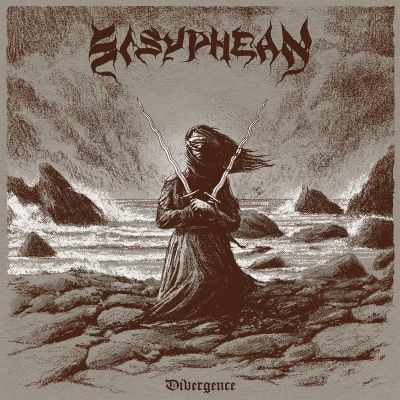

Buy on: Bandcamp
Type: Full-Length
Release Date: April 3rd, 2026
Label: Edged Circle Productions
Genre: Black, Death
1.
The Tower
2.
A Point In The Abyss
3.
Occultation
4.
Stupor Mundi
5.
Hunting For Answers
6.
In Divergence
7.
Black Bird That Brings No Joy
8.
Sangfroid
Review by HanSathanas on April 14, 2026.
Modern black metal has come a long way from its tumultuous genesis. Period. In reference to the Second Wave, all the albums that served as the cornerstone of the genre have been released less than a decade into its existence. Notwithstanding the genre and its virulent mutations that have gone global, more strains are becoming increasingly available for us to choose from.
Sisyphean’s Divergence falls into this category in what I would personally describe as belonging to the “new wave” movement, which entails a legion of bands that embraced the ritualistic qualities of later Deathspell Omega what with high-strung chords that ring louder than any church bell would; the kind of sound that is generally embraced by darker, post-apocalyptic belligerence that are distributed far and wide, where in places like Iceland, outfits like now-defunct Sinmara and Svartidaudi, as well as Misþyrming have championed the style. If those don’t seem to ring a bell, other similar traits are observable with Blaze Of Perdition and Nightbringer, both of which seemed to excel in their respective post-modern take on all things occult.
Thus, the evolution of what was once reserved for the supposed Orthodox niche has now become a go-to template for newer acts to emulate while incorporating various experimentation. Here, one can identify the riffs in 'The Tower' as hot tapping into 'Epiklesis I', thereby establishing its tempting association with the new French “extremity movement”, which again includes household monikers like Blut Aus Nord thanks to The Work Which Transforms God. Sisyphean appear to blend all the elements from those bands into their own cauldron of captivating synthesis, which produces a potent psychoactive elixir that, upon consumption, will leave you in a lethargic state of void. The evocatively atmospheric riffing on songs like 'In Divergence' created a sense of contradiction, particularly during the bridging passage – toying with your deeply buried anticipation into thinking that the atonalistic melody will reveal an elevating precipice of its jagged rhythm, only to spear you off the edge of a cliff in an unholy act of betrayal.
The same essence is captured in 'Black Bird That Brings No Joy' what with its repetitive alternate picking that tastefully segues into ever so melodious disharmony on the verse section. Yet another dissonance is created after the chorus, with the second guitar actively delivering a disjointed melody that, taken on its own in isolation, may sound completely off-key and out of place. However, the band eventually merged this juxtaposition of counterpoint melody with a brief lead solo that reminds me of what Vetis Monarch has written in "From The Devil’s Tomb".
There is no shortage of interesting moments in this album. The pendulous fixation between the more boorish mechanized aggression and dazzling ritualistic meditation is somewhat perfectly balanced. The closing 'Sangfroid' is a good example of this, featuring a grooving mid-section that is supported with a “less is more” approach on the double pedals before waterproofing the surface with the usual blast beats. The guitar playing also incorporates the minimum requirement of tremolo picking, but this is reserved for sharpening the overall listening experience as opposed to a feature that the band is solely relying on. Additionally, the song closes with a distorted clean picking, further enhancing that mysterious aura. 'A Point In The Abyss' also adheres to this dichotomy that pits hypnotic riffs against the aggravating intensity that, by now, should have become the band’s trademark sound. The songwriting does meander between such an interplay, which is strongly evident in the appropriately named 'Occultation'. One of the guitars is strummed with ferocity while the other builds a web of mesmerizing trappings that will send you further down the abyss, all the while emptying your body of the soul, and your eyes bear witness to the ever-widening darkness of its seemingly bottomless chasm, thanks to the low-frequency tremor produced by the bass guitar. Such a competently delivered performance with best-in-class production truly helps in contributing to the enjoyment of listening to this album. 'Stupor Mundi' carries this concept no less than the rest of the songs, featuring murderous compositional topography that is layered with equally creative haunting melodies that seem to capture the essence of its structural integrity with tremendous tact.
Whether you are 'Hunting For Answers' or just trying to get casually acquainted with these Latvian combatants, Sisyphean seems to have everything under control. Yes. The songwriting has good quality control despite its modern, polished sound. Tribalistic mid-tempo pummeling on the floor tom awakens the primal urge in the listeners, and the song carries this vision to the front-end design with tone-specific parameters. It doesn’t feel the need to lurch forward with great speed. Instead, the band opted to preserve the methodology of contrasting, counterpoint disharmony with such rigor that it transcends beyond mere musical notes. Drums are generally standardized to complement the songwriting without fail. Could have used a lot more creative fills, that’s my only gripe with the drums so far. The overall sound is also predictably clean and modern, abandoning the bygone aesthetic of more unrefined iterations that are often associated with rawer, more nihilistic acts that occupy the great portions of the early 90s. This is essentially the kind of black metal that branches off the beaten path of the tried-and-true formula.
Sisyphean has immense potential. Should the band invest further in the songwriting, they can do great things with their ideas because they already have a lot in mind, not just in Divergence, but other materials that preceded this record. The vocals are also okay for me. For what it’s worth, they are, after all, suitable for the type of music Sisyphean is delivering. The throat-like singing in the middle of 'Stupor Mundi' is a plus because it creates a moving dissonance that lobotomizes the mind without warning. Alas, it is used just for that short section, and despite this, I think it is better to leave it that way. My fear is that if such a technique suddenly becomes subject to redundant abuse, it would take away the significance of the listening experience.
I must say, it has been an honor to discover this band because, truth be told, I have never listened to anything coming from Latvia. I just hope that the band will be able to further improve with future releases because their touch of blackness on Divergence is already worthy of praise. For those who have never listened to this band before, I suggest you do that now, especially if your listening habits leaned more toward the new wave of French extremity and its Icelandic offshoots.
Rating: 8.5 out of 10
2.39k