Days Ov Yore - Official Website
The Tale Of Vlad Țepeș Part I |
Finland
 |
|---|

Buy on: Bandcamp
Type: Full-Length
Release Date: June 17th, 2026
Label: Independent
Genre: Black, Melodic
1.
The Tale Of Vlad Țepeș
2.
Born To War
3.
Sultan's Hostage
4.
Betrayed By The Boyars
5.
The Exile
6.
Rise Of Mehmed The Conqueror
7.
Transylvanian Voyage
8.
Return To Wallachia
Review by J.C. on June 10, 2026.
Russian doom metal band Shallow Rivers released a new album a few days ago. I have always been fond of this band and have listened to their previous albums countless times, so naturally I was eager to hear their latest work. Their previous album, The Tales Told Under The Willow, left me somewhat disappointed, as the band's characteristic style did not fully emerge, and several passages felt unnecessarily drawn out. This new album, however, is a different story altogether. It is truly excellent.
Shallow Rivers have never been a typical doom/death metal band. Their music incorporates a considerable amount of progressive metal and technical death metal, particularly on their second album, The Leaden Ghost, where the band constructed a labyrinth of intricate riffs as dense and bewildering as Kowloon Walled City itself. That album, however, was also the least melodic release in their catalog. Their debut, while equally complex, featured far more memorable melodies. Those melodic passages emerged from seas of dissonance, suddenly slowing into moments of sorrow and crushing heaviness, like a cursed giant dutifully carrying out its eternal task. In short, Shallow Rivers are not always slow and mournful, but whenever the doom elements surface, the atmosphere and emotion of their music become impossible to ignore.
Most of the songs on this album are of moderate length, with none exceeding ten minutes, though the record still stretches to roughly an hour in total. The compositions are filled with shifting sections, ranging from delicate acoustic guitar passages to heavy yet beautiful melodies, alongside harsher and more unconventional moments. The riffs in the faster sections are aggressive and melodically unusual, occasionally displaying a progressive edge. When the music slows down, the guitars become heavier, reinforcing the emotional weight of the melodies.
Vocally, the album is dominated by extreme metal techniques, alternating between beastly growls and a higher vocal style reminiscent of Norther. Outside of the harsher moments, whispers and spoken-word passages appear throughout the softer sections. The drum sound is exceptionally clear and powerful, even though outright fast passages are relatively rare. The bass is equally clear and weighty, though wisely mixed as part of the overall sound rather than being pushed to the forefront. The keyboards deserve special mention, as they are more effectively integrated than ever before. Rather than merely adding atmosphere, they function like connective tissue, binding the album together and strengthening its overall identity.
The opening track, 'В путь', serves as a two-minute introduction and is perfectly paced. The second track, 'Сквозь заснеженные берега', begins with a string-driven introduction before erupting into a brutal riff. Its unusual atmosphere may discourage impatient listeners unfamiliar with the band, preventing them from reaching the melodic passages that best represent Shallow Rivers' strengths.
The third track, 'На гордом корабле', and the fourth, 'Царь морей', are arguably the most melodically striking pieces on the album. The former is elevated by beautiful keyboard arrangements during its second half, while the latter uses a multi-part structure to great effect, allowing a deceptively simple central melody to leave a lasting impression.
The fifth track introduces piano passages that add a sinister elegance to the music. Its opening notes seem inspired by the piano melody from 'Утонувшие' on Mental Home's 2012 album, though the songwriter expands upon the idea in a far more elaborate and engaging manner.
As for the seventh track, 'Чёрное сердце', its combination of piano, spoken-word sections, and heavy melodic passages evokes memories of Saturnus' debut album while still retaining the band's distinctive identity. The eighth track, 'Зов тёмных вод', stands apart from the rest of the album almost immediately. From its introduction onward, it projects a unique character. As the longest composition here, it contains a wealth of ideas: tranquil passages emerging after moments of intensity, beautiful keyboard arrangements, spoken-word sections, and riffs built around unusual scales and rhythms that recall the work of elite progressive metal bands.
Although I still prefer their debut album, Nihil Euphoria—a deeply sad and philosophical work—this new release nonetheless resonates with me on an emotional level. Its atmosphere is captivating, its songwriting is consistently strong, and it is undoubtedly an album that I will return to again and again in the years to come.
Rating: 9.5 out of 10
966Review by Norbert on October 6, 2026.
Bytom, 1996. It is hard to imagine a better time and place to start a band playing music that, for the next several decades, would sound as if it had been recorded two floors underground. And I am not talking only about the obvious association with Silesia, mines, and coal. Bytom has the weight of an old industrial city, monumental tenement buildings standing next to crumbling courtyards, and ground that was drilled through so intensively for decades that in places it eventually started demanding its due. It can be beautiful and fucking ugly at the same time, dignified and run-down. It is hard to imagine a better backdrop for Throneum. This is where Tomasz "The Great Executor" brought Throne to life, a band renamed Throneum a few years later.
Musically, Throneum were most interested in the moldiest branch of extreme death metal. Not the surgically precise kind of death metal, but the kind that remembers the days when everything was supposed to be above all evil, heavy, and unhealthy. Autopsy with its rotting riffs, Asphyx with a steamroller crushing your chest, the underground abyss of Incantation, Necrovore sounding like a message intercepted straight from hell. Add some old black metal, a bit of thrash venom, and the belief that if the amplifier is crackling, it does not necessarily need fixing. Over the years, this has resulted in a discography that looks like the product of pathological hoarding: albums, demos, EPs, tapes, seven-inches, and a whole army of splits. Even someone who has been following Throneum for years might wonder whether they have somehow missed something along the way.
If the 2018 album The Tight Deathrope Act Over Rubicon was the first, somewhat timid tremor in Bytom's underground old-school death metal mine, then the follow-up Oh Death… Oh Death… Determinate, Preach And Lead Us Astray, released two years later, showed that something strange had happened in this ecosystem that had remained stable for years. It was still Throneum, only apparently after a few psychedelics. Long-form compositions, trance, ambient spaces, doom-laden slowdowns, dissonance, and on 'Delta: Self-Appointed-Grandeur,' even female vocals. The old death metal corpse was still lying in the basement; only apparently it had eaten something and started seeing colors. You could have considered it a one-off trip. Six years later, the album Love Is The Law But Death Is The Frame — officially premiering on October 16, although the material is already available to stream online — shows that it was more likely the first dose. It is also Throneum's second consecutive studio album released by Godz Ov War Productions, and it is hard to imagine a better home for the band's current incarnation: a label uncompromisingly rooted in the extreme underground while remaining open to its twisted and experimental fringes.
On the new album, death metal has become just one of the languages Throneum use whenever they feel like it. A fragment that sounds like a band from fifteen years ago can sit next to one in which metal practically ceases to be the main point of reference. Psychedelia, jazz excursions, ritualistic rhythms, and much freer playing push their way into the old riffs without knocking. And there is no sense that the band is deliberately showing off its new toys. They simply throw everything into the same cauldron and see what starts bubbling. And this is where something emerges that has not changed in Throneum one bit: they have always given absolutely no fucks about what people expect from them. Once, that meant playing archaic death/black metal and releasing one split after another for a handful of maniacs. Now it apparently means there is no reason to limit themselves even to the formula they spent decades building. The jazz is therefore smeared in mud, the psychedelia reeks of a basement, and a freer passage can suddenly get smacked in the face by a death metal riff. Throneum let plenty of new things into their music, but they do not allow a single one of them through the door wearing clean shoes.
This music mutates more than it "develops." A riff can still nod toward old-school death metal, only to become the starting point for something narcotic a moment later; instead of pushing a song forward, the rhythm starts circling around its own axis, and the guitar does not always feel obliged to produce another riff. Plenty is happening underneath it all, too. The bass does not obediently follow the rest of the band, but runs its own lines, while the drums, apart from the usual pounding, are given room for looser and at times almost ritualistic playing. At times, the whole thing feels like an organism that has grown extra limbs, and nobody has any intention of amputating them just because they are not supposed to be there according to the rules of anatomy.
The vocals are another trip altogether. The Great Executor has significantly expanded his arsenal: he modulates his voice, changes its tone and phrasing, and can sound aggressive but also simply deranged. He no longer reduces every part to the same kind of metal rage; his voice deforms along with the music and becomes another tool used to throw the whole thing off balance. There are also plenty of female vocals here. They are not some guest decoration dropped into a couple of passages, but one of the album's defining elements: sometimes melodic, sometimes distorted, haunted, witch-like. A female voice already appeared on "Oh Death…", but here it is no longer a guest briefly allowed into the basement. It has been given its own set of keys.
Despite all this madness, there is still no problem recognizing Throneum. Their characteristic riffing, melodies, filth, controlled chaos, and that particular kind of metal arrogance keep the album grounded. It therefore does not sound like a side project accidentally released under the wrong name. The old Throneum has not been replaced by a new one; it simply got a lot more tools and immediately started using them against the instructions. That makes it genuinely difficult to predict where the music will turn next, and trying to organize it or trim away all the protruding elements would be a bit like renovating an old Bytom tenement building and finishing the job by covering the façade with styrofoam insulation. Sure, it would look more even. But what the fuck for?
Love Is The Law But Death Is The Frame will probably put off some maniacs who simply want another serving of filthy death/black metal. Anyone who considered "Oh Death…" too much six years ago will have even more reasons to complain here. The thing is, it is hard to imagine a band less interested in such a problem. After thirty years, Throneum are still doing exactly the same thing: making music on their own terms and giving absolutely no fucks about how many people will want to follow them. The only thing that has changed is the answer to the question of what Throneum feel like doing these days.
And that answer has become one hell of a difficult thing to predict.
Rating: 8.5 out of 10
966Review by Jeger on October 8, 2026.
Vlad Țepeș - Vlad III - Vlad the Impaler… Legends of his cruelty precede him: impalement, skinning, genital mutilations, boiling, burning and olde fashioned hangings - all implemented with fervor at the hands of one of History's greatest monsters. But what of the golden chalice? The one that stood at town centre, the one that no one would steal. Vlad had become so renowned for his savagery, particularly towards thieves that the chalice stood each day untouched out of simple fear. Many argued that Vlad's methods, though barbaric, were highly effective. Other ghastly tales involve the luring in of poor folks from town into a multi-coursed feast where they were allowed to eat just before they were surrounded by guards and burned alive. Vlad viewed these acts as mercy killings that freed the poor from their impoverished lives on Earth into Heaven. Unfaithful Women were met with the worst treatment: various sexual organ mutilations and removals along with posthumous mutilations of unborn babies. And of course all bodies put on display throughout the Ville.
Throughout history, the life, Military campaigns and ruling methods of Vlad III have been detailed widely. Some have been exaggerated by those who feared him such as the Turks and the Saxons, but for the most part, the stories are true. And what a concept for a Black Metal record…
Enter Finland's Days Ov Yore - something a bit, or a lot different than the bands you've become accustomed to who call Suomi home: no Occult mumbo-jumbo or misanthropy/nihilism, only a journey through the annals of time into places never forlorn - legendary tales to come, but first, it's into Segesvár, Hungary - now Romania where twilight Eves were rung in by the Rack and the Gallows where we venture as we prepare to take in Days Ov Yore's debut LP, 2026's "The Tale Of Vlad Țepeș Part I". And let the executions commence!
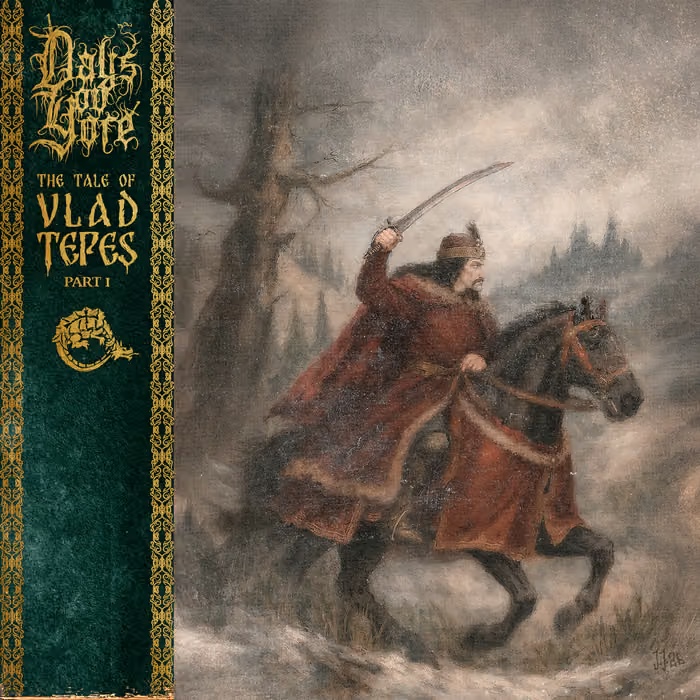
Right out of the gate with cinematic drama to set the tone - a message? A soliloquy? A proclamation… Pensive mutterings to draw you in before the momentum of the experience exerts itself; propulsory riffs and rolling rhythms drive the tale onward into great battles! Grisly fates and History in the making during the statement-making title-track. The following track, "Born To War", places us in the warmth of Suomi familiarity, of Black Metal appreciation while you're reminded of fellow Finns, Bloody Valkyria, by every epic composition and Sargeist by the fundamental melody of the music. A true Finnish Black Metal record, a criminally overlooked one. Just a beautiful album from outside in: the classic cover art, the true Suomi sound and the story of a true Legend of brutality. Each track continues the story with clarity and resolve whilst it captivates your attention the whole way through and not much effort will be exuded in trying to understand the lyrics. Lyrics are in English and vocalized clearly in comparison to most BM albums; creating a free falling experience; effortless and memorable.
Enter the filthy Mehmed the Conquerer! A dirty Muslim with visions of Ottoman victories and conquests over the likes of Vlad. "Rise Of Mehmed The Conquerer" - a formidable adversary indeed. A foe earned through childhood conflict that spilled over onto the fields of battle. Vlad attempted to assassinate Mehmed but to no avail. Mehmed outlived Vlad by five years and died of natural causes. Musically, expect a highly visual piece that invokes imagery of Ancient horizons backing a foreground of great battles taking place or of Soldiers galloping toward the scourge. Variations in tempo allow for the guitarist to explore different techniques but the overall vibe here is classicism as it should be. Such a worthy subject deserves nothing less than the lavish treatment. Sitars create a very immersive environment where one can imagine scantily clad mistresses swaying to their sound or of great feasts or sacrifices taking place.
There is a bit of Emperor worship, particularly during the above-mentioned "Rise Of Mehmed The Conquerer", but outside of that, "The Tale Of Vlad Țepeș Part I" is pure Finnish gold. The ever-fertile Finnish Underground proving once more to be the most thriving school of BM. "The Tale Of Vlad Țepeș Part I" closes with "Return To Wallachia" - a slathering on of every element of greatness that has formed the record thus far: soaring melodies, a myriad of percussive techniques and an atmosphere of enthrallment. Vlad the III met his demise on the battlefield against the Ottoman Empire in January of 1477. His body was decapitated and his head was sent to Constantinople as a trophy and put on display… A warrior's death? Perhaps not, as some Historians believe he was accidentally or purposefully killed by his own Men.
Days Ov Yore continues the story with their following LP, "The Tale Of Vlad Țepeș Part II" and so long as evil thrives, so long as there are Tyrants, Dark Overseers or any other form of dastardly Man, BM will have a voice. A History lesson packaged in Black Metal - the most alluring, versatile and deep Genre of Extreme Metal… Take up your swords! Jump on a horse and go conquer something. Just don't get arrested…
Rating: 9 out of 10
966