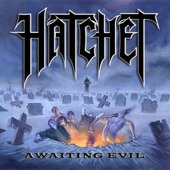
Hatchet - Official Website


Awaiting Evil

United States Country of Origin: United States

1. Darkening Skies
2. Frailty Of The Flesh
3. Sealed Fate
4. Frozen Hell
5. Attack Imminent
6. Morlocks Tomb
7. Storm The Gates
8. The Dead Will March
9. Awating Evil

Review by Rosh on February 14, 2022.

Coming off a string of EPs and live releases, Iron Man had reached their most prolific point by the early 2010's, when "Screaming" Mad Dee joined on vocals. I'm particularly impressed by this late chapter (trust me, I wish it didn't count as "late") of this Maryland staple, because as the culimating effort of this era, South Of The Earth, proves, all the pieces needed to stay highly relevant in the doom scene of the time were there. It doesn't top their first two excellent Hellhound albums from 20 years prior, but it also circumvents the need to. Compared to those albums, it deviates from Al Morris' usual three-fourths 70's Sabbath meets one-fourth 80's Sabbath approach here and there, but sacrifices none of his trademark grooviness, or his amazing guitar tone.

Upon first listen, you'll be able to tell there's a palpable (but still relatively minor) southern/sludge feel on this album, enhanced by Louis Strachan's bass style (as well as its presence in the mix) and Dee's grittier, hoarser vocals. The entire first half of South Of The Earth is particularly reminiscent of a classic doom/heavy metal band taking subtle queues from the best of modern stoner/sludge, and if this sounds like a winning formula, that's because it absolutely is. Maryland doom has always been adaptable and focused on musicality first and foremost - bands of the scene can range from being highly accessible for most heavy rock fans, to being rather burned out and despairing. The opening title track here does both really well, and is perhaps better for converting someone to hardened, gritty doom than the typical culprits like Saint Vitus (though I have always felt Morris is a far too overlooked pioneer of American doom for how indispensable his works truly were).

'Hail To The Haze' reaches a chorus that seems similarly brooding, but during its verses, it rides on a rhythm section that comes off a bit like the first couple Motörhead albums. This is perhaps an unlikely comparison for a doom metal band, but it nonetheless resonates with me - when I showed a metalhead friend of mine who's more into black metal and the dissonant side of tech death a lot of the American doom classics, he did say that a lot of it comes of as "biker." I've always gotten that impression too, because this style is badass by all accounts. I like how this "Hellhound doom" style is less influenced by the textbook NWOBHM/traditional heavy metal sound of the 80's than, say, the epic heavy/doom sound. It's much more inspired by 70's heavy rock/early metal, and the acid rock before it, but is still generally very heavy sounding and not too slow either. Now, I don't need to tell you this if you've heard Pentagram's 1970's recordings, because that much is obvious. However, what you might not have extrapolated from this point is that what you get with those kinds of musical sensibilities is a more free feel - this means they can conjure Sabbath as per usual, Motörhead if they feel like it, and traces of the sludge/stoner sound as I mentioned earlier.

'The Worst And Longest Day' might initially seem to be a standard slow-paced doom metal song, but this is where Iron Man, particularly the lineup here, is so many steps ahead. Morris hangs back a bit in the riff department in this song, but this works a little better than it would on Black Night due to the very strong clang of Lou's bass present here, and most notably due to Dee's really, really foreboding, not-so-clean singing. "Screaming" Mad Dee is an amazing doom metal vocalist; his gritty style comes off kind of like Scott Reagers and Lee Dorrian combined into one, with at least as much charisma as Bobby Liebling's voice, too. Anyway, after the tense overtone is set, Morris belts out that solo style he was really renowned for and it leads to an awesome jam to conclude a doom metal song like this. Marvelous first half.

'The Day Of The Beast' comes back swinging, however, more of a return to the faster-paced 90's Iron Man. This song further drives home the power of this band's final lineup, what they can do with the faster-paced, more athletic traditional doom approach. 'Dunwich, Pt. 2' has an intro and first half that feels almost too close to stoner/doom with that droning, in-and-out-of-focus kind of feel, but then when you remember this is Iron Man's Rise Above album, fine, whatever. It's also still way heavier and groovier than most stoner/doom, because after all, Al Morris would never let his guitar work become that tame and ineffectual. Not at all.

South Of The Earth is a really complete package of an album, classic doom metal that I do think fans of sludge, groove, and stoner will thoroughly appreciate. It's also interesting for this reason and that's without even bringing up some of the peculiar song titles here; I shortened a couple of their names when discussing them. I actually wonder what would become of it if labels like Rise Above eventually acquired more legacy doom acts that they themselves did not initially get off the ground. It'd sound interesting. On the topic of legacies, though, Alfred Morris III's will never, ever be forgotten and in fact I hope his impact only continues to grow over time. If you want a good companion piece to South Of The Earth, I highly suggest checking out what the other guys who played on this album are doing in Spiral Grave now. Doom remains fresh to this day!

Rating: 9.6 out of 10

   966

Review by Rosh on February 14, 2022.

Coming off a string of EPs and live releases, Iron Man had reached their most prolific point by the early 2010's, when "Screaming" Mad Dee joined on vocals. I'm particularly impressed by this late chapter (trust me, I wish it didn't count as "late") of this Maryland staple, because as the culimating effort of this era, South Of The Earth, proves, all the pieces needed to stay highly relevant in the doom scene of the time were there. It doesn't top their first two excellent Hellhound albums from 20 years prior, but it also circumvents the need to. Compared to those albums, it deviates from Al Morris' usual three-fourths 70's Sabbath meets one-fourth 80's Sabbath approach here and there, but sacrifices none of his trademark grooviness, or his amazing guitar tone.

Upon first listen, you'll be able to tell there's a palpable (but still relatively minor) southern/sludge feel on this album, enhanced by Louis Strachan's bass style (as well as its presence in the mix) and Dee's grittier, hoarser vocals. The entire first half of South Of The Earth is particularly reminiscent of a classic doom/heavy metal band taking subtle queues from the best of modern stoner/sludge, and if this sounds like a winning formula, that's because it absolutely is. Maryland doom has always been adaptable and focused on musicality first and foremost - bands of the scene can range from being highly accessible for most heavy rock fans, to being rather burned out and despairing. The opening title track here does both really well, and is perhaps better for converting someone to hardened, gritty doom than the typical culprits like Saint Vitus (though I have always felt Morris is a far too overlooked pioneer of American doom for how indispensable his works truly were).

'Hail To The Haze' reaches a chorus that seems similarly brooding, but during its verses, it rides on a rhythm section that comes off a bit like the first couple Motörhead albums. This is perhaps an unlikely comparison for a doom metal band, but it nonetheless resonates with me - when I showed a metalhead friend of mine who's more into black metal and the dissonant side of tech death a lot of the American doom classics, he did say that a lot of it comes of as "biker." I've always gotten that impression too, because this style is badass by all accounts. I like how this "Hellhound doom" style is less influenced by the textbook NWOBHM/traditional heavy metal sound of the 80's than, say, the epic heavy/doom sound. It's much more inspired by 70's heavy rock/early metal, and the acid rock before it, but is still generally very heavy sounding and not too slow either. Now, I don't need to tell you this if you've heard Pentagram's 1970's recordings, because that much is obvious. However, what you might not have extrapolated from this point is that what you get with those kinds of musical sensibilities is a more free feel - this means they can conjure Sabbath as per usual, Motörhead if they feel like it, and traces of the sludge/stoner sound as I mentioned earlier.

'The Worst And Longest Day' might initially seem to be a standard slow-paced doom metal song, but this is where Iron Man, particularly the lineup here, is so many steps ahead. Morris hangs back a bit in the riff department in this song, but this works a little better than it would on Black Night due to the very strong clang of Lou's bass present here, and most notably due to Dee's really, really foreboding, not-so-clean singing. "Screaming" Mad Dee is an amazing doom metal vocalist; his gritty style comes off kind of like Scott Reagers and Lee Dorrian combined into one, with at least as much charisma as Bobby Liebling's voice, too. Anyway, after the tense overtone is set, Morris belts out that solo style he was really renowned for and it leads to an awesome jam to conclude a doom metal song like this. Marvelous first half.

'The Day Of The Beast' comes back swinging, however, more of a return to the faster-paced 90's Iron Man. This song further drives home the power of this band's final lineup, what they can do with the faster-paced, more athletic traditional doom approach. 'Dunwich, Pt. 2' has an intro and first half that feels almost too close to stoner/doom with that droning, in-and-out-of-focus kind of feel, but then when you remember this is Iron Man's Rise Above album, fine, whatever. It's also still way heavier and groovier than most stoner/doom, because after all, Al Morris would never let his guitar work become that tame and ineffectual. Not at all.

South Of The Earth is a really complete package of an album, classic doom metal that I do think fans of sludge, groove, and stoner will thoroughly appreciate. It's also interesting for this reason and that's without even bringing up some of the peculiar song titles here; I shortened a couple of their names when discussing them. I actually wonder what would become of it if labels like Rise Above eventually acquired more legacy doom acts that they themselves did not initially get off the ground. It'd sound interesting. On the topic of legacies, though, Alfred Morris III's will never, ever be forgotten and in fact I hope his impact only continues to grow over time. If you want a good companion piece to South Of The Earth, I highly suggest checking out what the other guys who played on this album are doing in Spiral Grave now. Doom remains fresh to this day!

Rating: 9.6 out of 10

   966

Review by Nick on July 6, 2008.

It’s apparent within the first 20 seconds of the opening track that Awaiting Evil is an anachronism: raw, ferocious, minimally produced thrash metal from the Bay area in 2008? That’s the equivalent of running down the street listening to an iPod and being hit by a DeLorean. It’s just plain rare.

Once the acoustic intro, Darkening Skies, drifts into the sunset over San Francisco Bay, Frailty Of The Flesh cracks the foundation open like a quake ripping through the streets. The song is immediately reminiscent of Kill ‘Em All-era Metallica, mixed with some Slayer and Exodus. In fact, reach your hand into the proverbial grab-bag of 80’s era thrash and you would pull out some applicable influences.

Sealed Fate is another no-frills slab of thrash. The guitar riffs pummel and spurts of schizophrenic lead melodies overlay this pile of smoking metal. The vocals are primordial and appropriately raw. Frozen Hell, despite its horrific title, is a track that makes the undisputed case that Hatchet is for real, not just a cover band-turned original act. Frozen Hell churns like acid-laced bile and captivates throughout its 4:24 running length. In an era where metal is increasingly progressive and epic, Hatchet demonstrates that less can be more, and simplicity is the new complex.

The fifth and sixth cuts, Attack Imminent and The Morlocks Tomb, are both slightly more intense than the previous tracks, reminding me more of Slayer’s Hell Awaits than Metallica or Exodus. On both tracks, the tempo has been injected with a stimulant and the riffing is more aggressive. On Attack Imminent, there is a sense of chaotic urgency, which makes the song quite cacophonous. I obviously want to give Hatchet credit for being their own band in a time when such music is mostly absent, but the downside to re-creating a successful era is to constantly compare. But such comparison is more complimentary than anything.

Storm The Gates begins with a riff that comes across as a bit recycled. While I appreciate the continued effort of re-energizing a genre that has been widely laid to rest, this track misses the mark. There are a few sporadic highlights within the song, but the track fails, as a whole.

The eighth song, The Dead Will March, sounds eerily like a B-side from Slayer’s Seasons In The Abyss. There is a paranoid feeling throughout the track, which adds a darkened layer. The guitars are ferocious and constantly evolve from riff to riff without hesitation. Again, the vocals are spewed venomously, with no regard for melody or harmony.

The album ends with the title track, Awaiting Evil. In true thrash form, the title track captures the epic glory. Awaiting Evil is…well, evil. Hatchet holds nothing back on this ending track. Marcus Kirchen’s vocals mirror everything from King Diamond to a young Tom Araya. The guitars are absolutely punishing. Period.

Hatchet’s Awaiting Evil is a welcome exception to the typical new millennium’s selection of metal. While there is clearly a lot of amazing metal being released in 2008, it’s fun to watch the genre come full circle. What was inspired and built upon in the late 80s has found its way back to the place of its birth. Awaiting Evil is concise, angry and simple. It’s metal the way metal was when rock gave birth to it and named it.

Categorical Rating Breakdown

Musicianship: 8
Atmosphere: 8
Originality: 8
Production: 7
Overall: 8

Rating: 7.8 out of 10

   966