
Mercyful Fate - Official Website
Don't Break The Oath |
Denmark
 |
|---|

Buy on: Bandcamp
Type: Full-Length
Release Date: September 7th, 1984
Label: Roadrunner Records
Genre: Heavy
1.
A Dangerous Meeting
2.
Nightmare
3.
Desecration Of Souls
4.
Night Of The Unborn
5.
The Oath
6.
Gypsy
7.
Welcome Princess Of Hell
8.
To One Far Away
9.
Come To The Sabbath
10.
Death Kiss (Demo)
Review by Mandeep Arora on June 23, 2025.
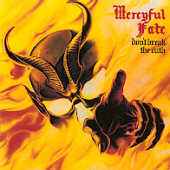
'Don't Break the Oath' oozes character even when it's not playing. I mean, look at that blazingly saturated yellow cover - it seems preposterous that anyone could harbour the notion that this is anything but a bona fide classic. And complementing all that allure is an equally iconic album - the type that's captivated fans since its origin and gains new ones every day thanks to its immortalisation in the metal legions, here on Metallum and everywhere else on the internet, because hey, these are modern times. My personal experience says that early twenties are the most impressionable years in a person's life and majority of what you consume during this time is also what, in certain ways, shapes your personality and your taste in things. I was a voracious listener of Mercyful Fate, Dissection, and a whole lot of Norwegian black metal in those days, which definitely drew me towards the dark subject matter, then seeming alluring and intriguing but also a bit naff. That certain gravitation towards this end of the spectrum stayed and I still take a keen interest in themes seethed in darkness and immorality. If anything, 'Don't Break the Oath' cemented that affinity more so than others. I think it covers the occult and Satanic themes in a deft, grown-up sort of a way, with lyrics that actually make sense and stories that are masterfully narrated through King Diamond's punishing falsettos. Right from how it looks to how it sounds, this album is the devil itself.
It may have taken even less than a complete year to be released after 'Melissa' but the progress is quite incremental. The atmosphere, for one, is denser and more enveloping. It's seethed in scorching hellfire and sounds straight out of the pits of hell, with roaring and impious guitar melodies taking centre stage in relatively uptempo songs. There are many moving parts, yet everything seems beautifully assimilated into one another, all splattered on an average song length of five or so minutes. Barely anything seems misplaced or needlessly crammed in. Where the instrumentation is crucial in evoking that blazing atmosphere, along with the production values of course, King's Diamond's vocals are equally compelling too. A definite step up on 'Melissa' which perpetrated that awe and shock and paved the way for this unmistakable vocal style; the falsettos this time are more focused, more controlled, and hit harder on account of some very high notes. I'll admit, they do get a bit grating at times, especially on songs like 'Nightmare' and 'Night of the Unborn', but for the major part, this may be one of King's best vocal performances this side of 'Abigail' and 'The Eye'. The haunting vocal melodies that he pulls off on the last two tracks are beautiful beyond words; I'm not exaggerating when I say that King Diamond is the only singer who's capable of such an ethereal sound effect through his voice.
The overall production is very low-fi and old-school, a bit tamer than even 'Melissa', but it's more nuanced and characterful. The best bit is that it allows every element to shine equally and undeniably. Let's start with the guitars. We've all talked enough about how Denner/Shermann's guitar duo is one of metal’s greatest assets, and conjointly, they spawn guitar harmonies that seem utterly anomalous and inhuman - the solos here, especially the long notes, are akin to wailing shrieks at times, such that they may have arisen only out of the deepest confines of hell. Likewise, the rhythm section has that dark-tinged hypnotising effect, with brilliant and emotive undertones when the solos take over. Now bring King Diamond's vocals into the mix, and we have with us music that's equal parts beautiful and equal parts unholy. It's far removed from black metal's first wav,e let alone the second one as far as achieving that all-evil sound is concerned, as most of the compositions dwell in the good ol' heavy/speed metal category. But it's the seamless coalescence of every single element that brings about a full-bodied diabolical effect. For all his vocal duties, King Diamond has also always had a strong say in the overall songwriting, and the man has strived for this sort of sound for as long as one can remember. A haunting atmosphere, theatrical vocals, and infections guitars is why even the shorter compositions like 'Gypsy' and 'To One Far Away' are so memorable, while the longer ones like 'The Oath', which get much more room to play with a volley of sound effects, are so expressive.
There’s more cohesion to the song structures and the album steadily flows at more or less a very fast pace. Part of that briskness are the drums; I don't think we talk enough about Kim Ruzz and his generous contribution to the early Mercyful Fate sound, where he bestows it with so much potency and muscle. Whenever every element starts playing together, his drums do not act as mere ancillaries to others; the fills are straightforward yet catchy, fast yet precise, and brief yet memorable. It's kind of a shame we didn't see more of him when the band reunited almost nine years later to record 'In the Shadows', another fantastic album. Almost identical to his case are Timi Hansen's contributions, kind of underrated and not as much talked about. Not that the man's never received his laurels, but the generalised conversations about Mercyful Fate/King Diamond seemingly only talk about the shocking and unique vocalist and the fantastic guitar duo. A good bit of Mikkey Dee too when he became the star drummer of the other band. Hansen's style is nothing too flashy like a Steve Harris or fortifying like a Geezer Butler, but he's there, lurking in the shadows, conjuring some very delicious basslines and ensuring the album has a hearty bottom end. The bass intro on 'Nightmare', or the unanticipated bass licks on one of 'The Oath's' many guitar solos definitely stay with you as some of the album highlights.
Barring the vibrant and frightening yellow cover, I don't think 'Don't Break the Oath' is a direct influence to 'Fatal Portrait', but you do see some foreshadowing hither and thither. Of utmost prominence is the storytelling aspect; now, this one's far from a full-blown concept record, but it does narrate a few mini-stories on certain songs, with King Diamond playing multiple characters and modulating his voice accordingly to fit them. It may be in its infancy stage here, but it quickly became a signature King Diamond trait on his wholly concept albums. Personally, I think he's a fantastic storyteller and comes into his own on songs like 'Nightmare' and 'Come to the Sabbath', the latter of which is also a continuation of the story from 'Melissa's' title track and album closer. Additionally, while the longer compositions are quite dynamic and even a fair bit progressive, the shorter ones like 'Gypsy' and 'Welcome Princess of Hell' are primarily carried by one main riff, a formula they keep repeating on 'Fatal Portrait' and its many short compositions. This eventually spawned off entire albums with such a predominant style.
As I keep listening, constantly headbanging and never relaxing, I struggle for reasons why this isn’t the most thrilling heavy metal album I’ve ever listened to. Back in its day in that year, it went up against some serious competition from heavy metal titans like Dio's 'The Last in Line' and Judas Priest's 'Defenders of the Faith', both really good and acclaimed albums. However, I personally think 'Don't Break the Oath' wipes the floor with them both because of how distinctive and razor-sharp it sounds. In fact, I'd go so far as to say that it's even slightly better and tighter than the ginormous tour de force that is Iron Maiden's 'Powerslave', released just four days prior to this and apparently that year's biggest heavy metal album. The fact that this forty-year-old brute still sounds more ferocious than the majority of modern-day extreme metal is a testament to the top-notch talent and musicianship of its creators and how far ahead it was for its time. For the major part, you find yourself swaying in the melodies and swooning over their elegance, while the vocals and riffs instil in you a certain awe, a certain fear; it's a roller-coaster of emotions that is kind of hard to emote. Not many albums have been able to coalesce such moments of sheer ferocity and moments of exquisite beauty this effectively. It stands atop the heavy metal pyramid as not only one of the greatest albums ever but also a very influential one; a definitive end of an era for Mercyful Fate, but by far their most peerless album and a magnum opus.
Rating: 10 out of 10
1.02kReview by Felix on July 6, 2022.
I always try to be careful with the use of superlatives, but here I am pretty sure: “Don’t Break the Oath” has the best artwork of all times. The artist, Thomas Holm, did an excellent job. The flame-covered devil points at us, the then rapidly growing metallic community, and the evil of the genre cannot be expressed in a better way. Phenomenal picture!
The evil of the genre… but what genre are we talking about? The EP and “Melissa” had already revealed the innovative force of the Danes. I see that M-A categorises Mercyful Fate simply as heavy metal. That’s neither wrong nor right, because on the one hand, the five-piece evaded any poser/thrasher scheme, on the other hand, their early albums were so much more than “only” heavy metal. The occult touch of all nine compositions characterizes their second album and separates it from almost each and every other output from 1984. Priest’s “Defenders of the Faith” was also released in George Orwell’s year and it is a sensational metal output (“Freewheel Burning”!), their best and more or less the epitome of pure heavy metal – but it spreads completely different vibes than “Don’t Break the Oath”. Main composer Hank Sherman and his comrades had a totally individual understanding of metal-compatible melodies. To paint it black and white: Judas Priest (and some other pioneers) delivered power, power and even more power – great! Mercyful Fate were the gateway to a further dimension, the band that unlocked the floodgate for those who wanted more than pure power. The King and his henchmen presented horror, discomfort, power (of course), melancholy, maliciousness, nightly atmosphere and a perfect symbiosis between their sound and the visual aesthetics (unfortunately, Priest’s painted tank on “Defenders…” appears rather infantile.) Again: great!
How did Mercyful Fate create all these moods and feelings? Naturally, the falsetto of the King must be mentioned. But it goes without saying that his performance does not explain the inner strength of the instrumental parts. The guys from Copenhagen combine atmospheric sounds with straight rocking lines, they dish up tons of bulky, pretty progressive riffs and a few softer sequences are connected with earthy, metallic guitars. Just listen to the title track – it will confirm every statement of the previous sentence. Nevertheless, the band was not stuck in just one song-writing formula – nowhere near! The direct neighbour of “The Oath”, namely “Gypsy”, shows that the quintet was also familiar with the stunning vitality of simple, direct songs. Especially this track profits from the unique, glass-shattering vocal lines of the King and his lyrical brilliance. He creates awe-inspiring pictures before the inner eye when he sings about “a light in a magic winter night” or “gypsy wagons left in the snow”. Better still, he leaves his mark in every song – just experience the fantastic “Even in the night I see a light shining bright” line in “Welcome Princess of Hell”, a song where raw and bulky riffs melt with each other seamlessly.
Production-wise, “Don’t Break the Oath” is – in contrast to all the shady creatures that are mentioned in the lyrics – free from sin. The album sounds clear and dark, transparent and sinister at the same time. It’s a taut mix without any serious flaws. The guitar tones breathe evil right from the beginning and it’s awesome to realize how the circling riffing at the beginning of the opener draws the listener into the music in a matter of seconds. Indeed, this is definitely the start of “A Dangerous Meeting” and even the church bells at the end of the song do not bring redemption. However, I enjoy a very robust song that confirms the way of proceeding on “Melissa” right from the get-go. Mercyful Fate were still the heralds of occult scenarios, but the exciting lyrical mission was never at the expense of the fundamental metal structure.
Finally, “Don’t Break the Oath” is not completely free from improvable moments. (Please forgive me this blasphemous note.) The short and soft intermezzo “To One Far Away” seems to be part of the band’s individual concept, but there is another track which does not fully convince. Sorry guys, I will not write its title here. This would be unfair against “Night of the Unborn”. It lacks expressiveness as well as coherence and cannot reach the level of songs like the multi-faceted “Nightmare” which offers everything between ghoulish metal and modern chamber music. But even the most stupid white magician must understand that these small grey spots do not hurt the overall impression in a significant manner. Thus, the enormous importance of the album is justified – by the way, this separates the diabolic monument from the slack “Master of Puppets”. Another marginal note: Jülle reveals in the movie “Total Thrash” that the first line of the title track “By the symbol of the creator” inspired him to rename his and Mille's combo. How many more arguments do you need? Either you have a problem with the singing capades of the King or you will appreciate this eerie work a lot. Without making any compromises, it marks a milestone for those who are screaming Priest or Maiden as well as for those who yell Celtic Frost or Bathory.
Rating: 9 out of 10
1.02k