Seth - Interview


The human abomination shown six years ago on "Esperalem Tkane" by Krakow's Odraza attracted my attention, so when at the end of April I got information from Godz Ov War about the second album of these black metalheads, my blood began to circulate faster. The first audition of "Rzeczom" confirmed the power and strength of the musical message of Stawrogin and Priest. While the debut was a youthful kick at a closed door, the second album turned out to be a conscious walk through the dark alleys of human existence, black metal more mature, dry and incredibly emotional. Shocked by the message of "Rzeczom", I asked the authors some questions, and here is the effect.

Arek

Thanks for taking the time for this interview. According to encyclopedic data, it is the eleventh year of your Odraza-musical existence, how do you evaluate it, especially when looking at the new album?

Hey! "Rzeczom" is a summary of thirteen years of camaraderie and eleven years of making music together. For me personally, it is largely a time of getting to know myself and determining the place that music occupies in my life. I think that in practice it had a colossal impact on the fact that today I am a relatively functioning person.

In my humble opinion, "Rzeczom" is a continuation and development of the path you have taken when creating "Esperalem Tkane", but the strength of the new album is the realization and such skillful combination of sometimes even surprising melodies with aggression, how do you see it?

It is difficult for the new album not to be this continuation - it was created by the same two people in similar conditions. From the lyricist's perspective, I knew that the album would not be a repeat of the debut - it couldn't have been, it's been 6 years. Texts for me as a form of a diary/report. The prospect of repeating yourself in this matter would be cynicism, or a lack of the capacity for any introspection. From the musical perspective, our goal was to make the arrangement more specific while looking for new forms, and finally to write an album that would be characterized by dramaturgy.

Although you were thrown into the drawer with the inscription "black metal", each of your releases is richly influenced by various genres, including those outside the so-called metal. Is it because you realize yourselves with black / death metal in other bands?

Mainly because in my opinion traditional metal playing has reached the wall in a way. I may be an old malcontent, but for several years I have not observed phenomena that would push the genre forward. Everything that is happening around me seems to be a gathering of reenacting groups and I am talking about our music as well. I will probably never be a musical revolutionist, I have no need or predisposition for it - what we do is tilt our head out of our little box to get away from the cliché, even for a moment. The second reason is simple - apart from metal, we are inspired by many musical trends.

You finished both albums with instrumental works, although in 'Tam, gdzie nas nie spotkamy' there is a short text, the song is instrumental in nature nevertheless, and "Kir" is a whole 20-minute live instrumental mini album. Do you like such compositions, or is it your Stawrogin animosity to your own vocals?

It does not result from animosity - such forms were favorable to the aforementioned works. Originally, we thought about the vocal for 'Ja nie stąd'. Firstly, however, the last words in 'Bempo' sum up what I wanted to communicate on the album with words, and secondly, the track simply does not need it. When it comes to "Kir", we also considered using the voice, but in practice words that would correspond to the music did not land on the paper. Some time ago I came across Celan's "Fugue of Death" - knowing it then, I would probably just adapt it.

I personally have great respect for your incredibly brutal and venomously-rough vocals, but it is in "Rzeczom" that you put a lot of effort into the variety of vocals. Was it possible thanks to some lessons, exercises, or did you just believe in yourself and take a chance?

Each previous recording session can be called exercises. For some time I took singing lessons, but it happened before Odraza's debut and it broadened my idea of ​​the correct voice emission. I still use these few exercises and visualize some assumptions, but it's hard to talk about deeper learning. I had clear assumptions about the vocals on "Rzeczom" - the music turns into different alleys, but the narrator had to remain the same. I tried not to overdo it and let the instruments speak.

I also have great appreciation for you, Priest. The drum lines on the new album are devastating, yet you also play guitar. Let us know, do you feel and create music more while sitting behind drums or with a guitar?

Priest: Thanks a lot. I create music mainly with Stavrogin and the instrument is of secondary importance here. My share on drums is incomparably greater than on guitar. The percussion is the means of expression that I know best and on which I most easily create on it. However, I believe there is much more that can be said with the guitar. Hence my tendencies towards this instrument. The equipment is there, but you need more self-abnegation and free time, which is getting harder and harder to get to a more specific level.

Let's go back to your mini "Kir". Tell us how this event materialized and how did this piece ended up being brought to the Krakow Museum for the "Remember with us" exhibition commemorating the destruction of World War II?

The piece was recorded during the event "Remember with us" - as far as I know, it was not accompanied by an exhibition with "Kir" as an element. The whole thing is actually the result of an acquaintance with the then employee of the Museum. We were asked to compose and play a piece that would be visually accompanied by fragments of Tadeusz Franiszyn's film presenting the area of ​​KL Płaszów. Michał (Mgła) and Kuba (Mord'A'Stigmata) assisted us on stage. The song was played, recorded, mixed in No Solace, and then released as a mini-album. That is the whole story.

Odraza is rather hard to find at concerts. Are there any chances that this will change? It is true that the current situation is not conducive to this, but after SUCH an album it would be advisable to hammer a nail on stage, wouldn't it?

We are not planning to promote the new material with concerts. Their topic hangs in the air, but the lack of unanimity and probably also clear motivation means that we do not take any steps in this direction. I was reflecting on my motivation to play both materials live and it occurred to me that I just wanted to see how these songs perform on stage. The point is, however, that I want to do it as a listener and viewer rather than a creator and performer. Preparing a concert set would mean many hours of practicing with session musicians - it does not seem very thrilling to us.

You are still playing Massemord and Totenmesse together, can you shed any light on what we can expect from these bands, especially Massemord, who has us waiting 7 years for the successor to "A Life-Giving Power of Devastation"?

Totenmesse is about to create new material, while MasseMord is not an active band in any form at the moment. Time will tell if this changes.

Do you maybe have some interesting facts about creative work in your other bands (Gruzja, Voidhanger), or maybe there are some new projects?

Everything is rather typical - in the rhythm of the functioning of a given band. Gruzja is releasing a split with Russian Neon Scaffold soon, and we are also slowly getting ready for the full album. The hit should be precise, so we plan to prepare well for it. WTZ started mixing the next full album and considers the evolution of the formula. I do not plan any other projects, there are already enough of them.
Priest: Voidhanger is silent temporarily, but it's probably the calm before the storm.

Breaking away from your bands, are Konrad and Mateusz equally busy people in their private lives? Do you find a moment to wander the streets of Krakow together, smoke a slug, have a sip of warm vodka in a piss stinking gate, or at least get into some band's concert?

We spend our time much more effectively now, life is full of duties and we want to use the moments devoted to music well. We have the comfort that the proverbial slug and friendly conversations take place during rehearsals. Wandering is, unfortunately, a beautiful song of the past, the same is with vodka at the gate. One does not drink at all, the other occasionally. What I would once call a gray and sluggish afternoon after waking up on a Sunday around 4:00 p.m. today I would rather call alcohol anxiety. My head gives me different adventures without any additional stimulation.

Let's go back to "Rzeczom". I know that the author of the cover is Sars, but I'm interested in where exactly this idea came from and how did you come across Mrs. Dorota Maria Kuźmicka? There is such sadness and anxiety in her gaze.

Dorota is our friend on private ground, and in Konrad's case also professionally. Originally, we had a few different ideas for the cover, but during the photo session accompanying the album, we managed to capture emotions that fully reflected the mood of the recording. Sars' first proposal related to this session became the cover.

The booklet contains information about the recordings for the period 2018-2020. Can you tell us what was the reason for the soooo long recordings?

Fatigue of the material - simply. The drum recording session took place in November 2018, basically until we entered the guitar studio in early spring 2019, we were finishing the bass arrangements. The guitar session itself dragged on mercilessly and completely drained me of my eagerness to write lyrics and record vocals. Honestly, I was then ready to throw it all to hell and go home. In fact, probably only the conditions that Przemek Nowak guaranteed us in the Impressive-Art studio meant that it did not finally happen. Several months of respite allowed me to catch some distance, and the last session of voice recordings took place at the end of February 2020.

I hope I didn't torment you to death. Thanks again for your time and I hope to see you again.

We also thank you for the interview!

Entered: 10/15/2020 9:11:02 PM

Send eMail 5.12k

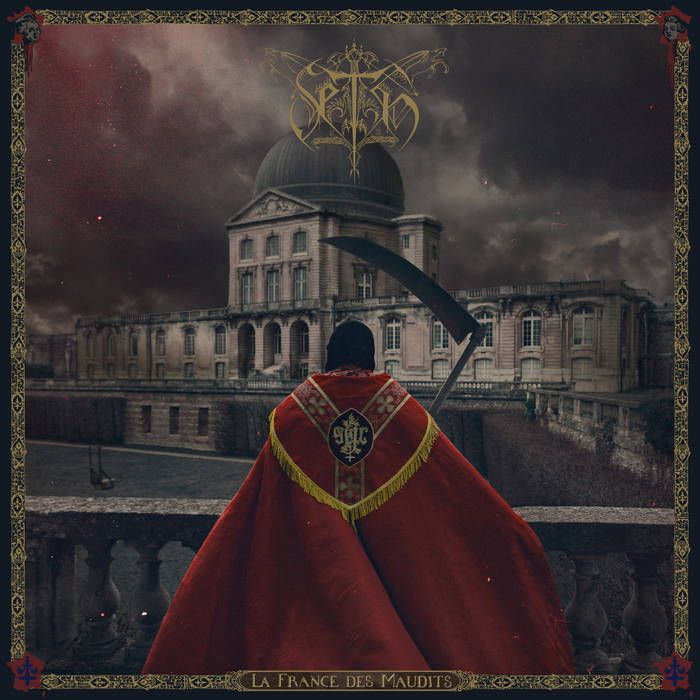
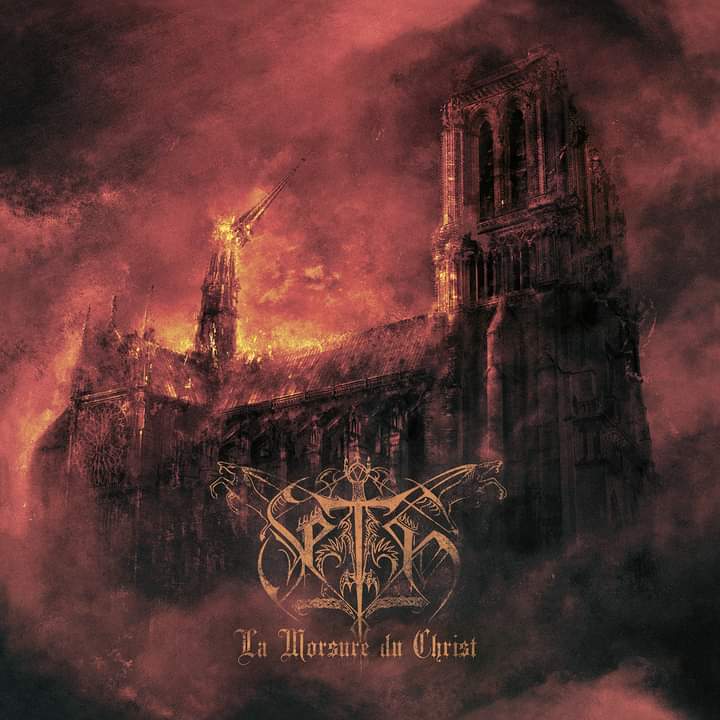
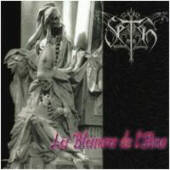
France's Seth - a veritable black metal institution whose vision for BM has been of both beauty and culture, but also of worldwide religious downfall. The catalyst to it all? The Notre Dame blaze as detailed in their previous album, "La Morsure Du Christ" and continuing on through to a revolution in their brand new LP, "La France Des Maudits". How does the French scene go underrated when its bands are this imaginative? Thank Scandinavia, but nonetheless, Seth's music is a celebration of black metal's oft-overlooked elegant side. "Like shooting an ambulance…" A different perspective regarding viewing Christianity for me, and a very wise one if I do say so. During my latest interview, Saint Vincent and Heimoth of Seth provide some insight into their views on Christianity, the nefarious Second Wave Norwegian church blazes, and into their latest album, "La France Des Maudits".

Jeger
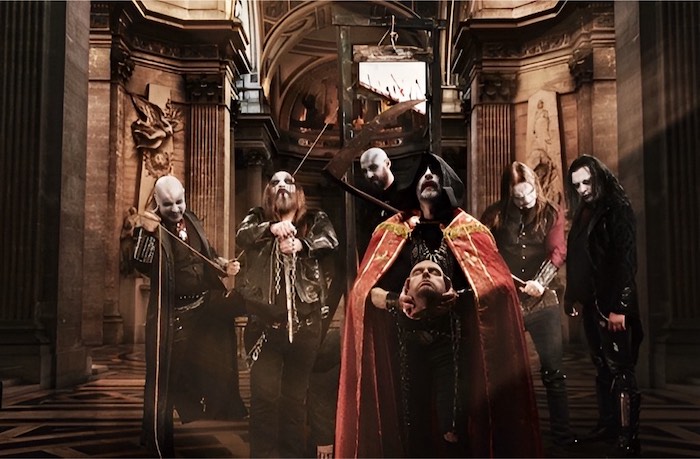
People don't realize this but Seth has been a French black metal institution since 1995. How would you describe the early French scene and what were your main influences going into your musical journey?

Heimoth: The French scene was rather ignored at the time. There were very few bands who were all too concerned with evilness to the detriment of the quality of the art they played. That means our influence did not come from France, but rather from other regions like Scandinavia.

Not safe to assume that all black metal bands hate Christianity…

Let's fast forward to your 2021 album, "La Morsure Du Christ", which saw the band in a rejuvenated state and detailed anti-Christian concepts. The cover depicts the infamous Notre Dame Cathedral blaze. I generally get a variety of different answers to this question, but what is it about Christianity that you detest most and why have you chosen to relay that message through SETH's music?

Saint Vincent: I didn't write the lyrics as a hateful statement against Christianity. I'm aiming to capture the spirit of the times. I was raised Catholic, and I saw the continuous demise of this religion. We used the image of the Notre Dame blaze because it was iconic and it epitomized this spiritual downfall. Useless to hate Christianity, it would be like shooting an ambulance.

I guess I am getting old… Feels like it was just yesterday when I read about Varg Vikernes and his treacherous hooliganism. Inspiration for the hordes…

How did you feel about the nefarious Norwegian church fires of the Second Wave? Many black metal bands voiced open support for these "acts of war".

Saint Vincent: I'm too old now to consider these fires as "acts of war" without smiling. However, back in those days, these acts were fueling the passion and the energy we were discovering in black metal music: Intensity and insanity. This was boiling my young teenage blood with fantasies. The intensity of the music was crossing the path of imagination and getting real.

You've just released a great new album in "La France Des Maudits" again via Season Of Mist. Judging by the title of the album, its curses were dealing with this time around. How would you describe the concept of the new record?

Saint Vincent: The former album "La Morsure Du Christ" depicts the downfall of spirituality in the Western World as epitomized by the Notre Dame fire. The album's last track is "Le Triomphe De Lucifer" (The Triumph of Lucifer); announcing the light of Lucifer given to all the cursed people, so they can rise in strength. The new album, "La France Des Maudits", is the direct sequel of the former album and its last track. The album deals with the rise of all those cursed people who want to overthrow their oppressors and rebel against the fatality they were trapped in.

What did you do differently as far as songwriting and recording compared to your previous album?

Saint Vincent: On the lyrical side, I used the same techniques - writing everything in French Alexandrines - a classical stylistic figure in French poetry.

Heimoth: Why would we have to do things differently? More seriously, we were happy with the process of the previous album, so we went along the same pattern of writing and recording. We are getting used to doing things that way, and it did help since familiarity brings - most of the time - better results. So, basically the whole writing process happened at my place in Paris, and most of the recording took place in Studio Sainte Marthe, Eastern Paris.

What does your live ritual schedule look like in support of "La France Des Maudits"?

Saint Vincent: We are going to tour across Europe with Rotting Christ and Borknagar in October. Other events and festivals like Inferno in Norway are being announced.

The new album, just like your previous one, happens to be pristinely produced. As we all know, some black metal bands feel a stripped-down approach to product is the only way. How do you feel about this tradition and why have you chosen to embrace more modern techniques?

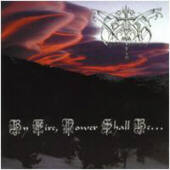
Heimoth: It is modern without sounding too modern, and that's what we wanted. From day one, in 1996, our first Mini CD, "By Fire Power Shall Be", we embraced the technologies of the time; something we've always done. However, with that one, we tried to make sure to sound a little more raw as well and improve on the drum sound for example. The problem with raw BM is that most bands sound the same right now, even with analog vocal sounds. I consider this album the best achievement we've made production-wise because it sounds powerful while not too artificial and with a good balance between all the instruments at stake.

France is most certainly known for its rich art culture and Seth has proven to be purveyors of that culture as expressed through the timeless art of black metal. Crusty basement black metal in the City of Lights? Not likely…

There's an air of elegance to Seth's music that I directly correlate with the artful nature of the French scene. What is it about French culture (art, literature, ethos, etc.) that inspires you the most?

Saint Vincent: I appreciate your remark, as we care about this aspect. The lyrics are inspired by French poetry, and I paid homage to Charles Baudelaire on this album with the first track, 'Paris Des Maléfices', dedicated to him. I wanted to clearly name him as he was an inspiration for a couple of texts in the former album "La Morsure Du Christ". Obviously, we are inspired by French art in general: paintings, culture and we always care to keep a subtle touch of French elegance.

"Just yesterday…" Life's greatest travesty is how time flies by faster as you grow old. But even as Seth stands today as middle-aged men on the other side of the hump, their art is newborn, etched in stone, timeless and proud.

What's been the most memorable thing that's happened to you during your career so far?

Heimoth: Good question. I guess the most astonishing must be the longevity of the band under activity. I started when I turned 15, and I feel like it was just yesterday, so it's a strange feeling to see that the continuity of your life has been something that you built yourself and is still alive today more than ever.

Every true artist's plight…

What's the most valuable lesson you've learned in all your years as an artist/black metal musician?

Saint Vincent: Art is a blessing and a curse. It feeds you with the highest joys while eating you alive. 

Do you have a message for the horde?

Heimoth: Never surrender to what you think is best for you.

Saint Vincent: Merci.

Entered: 9/6/2024 10:08:22 AM

Send eMail 3.07k