Asphyx - Official Website - Interview - News


Necroceros

Netherlands Country of Origin: Netherlands

1. The Sole Cure Is Death
2. Molten Black Earth
3. Mount Skull
4. Knights Templar Stand
5. Three Years Of Famine
7. In Blazing Oceans
8. The Nameless Elite
9. Yield Or Die
10. Necroceros


Review by Felix on December 5, 2022.

Do you like heavy metal? Then step in, this is your room of pleasure. “Arise and Purify”, the opener of Sanctuary’s double output (comeback and probably farewell in one) will make you feel good. Its first tones draw you into the album in a matter of seconds, the double bass motivates all musicians, the spooky bridge sets a fine impulse and the catchy chorus as well as the following solo have everything it needs to shape a few fantastic minutes of metallic glory. Needless to say, the track is empowered by a perfect sound with voluminous guitars, powerful drums, a pumping bass and, naturally, the voice of Warrel Dane (R.I.P.). It does not come as a surprise, but one more time, his charismatic and variable vocals give the album its individuality. By the way, I am speaking of a really good album. It does not express the fact that 24 years lie between the band’s second work and this one. Sanctuary did not modify their style and there was no reason to do this. 80% of the line-up of “Into the Mirror Black” reappeared on “The Year the Sun Died” and these guys as well as the new guitarist had a lot of metal particles in their blood, if I am not mistaken. Yes, there are less heavy songs than “Arise and Purify” on this output. Anyway, a more than solid number of them have this raw authenticity that separates true metal from clowns who think they are part of the scene. I do not drop names here, I am discreet. Moreover, I do not want to read the horrible word Sabaton in this review.

The first half of “The Year the Sun Died” is more or less filled to the brim with good music. “Let the Serpent Follow Me” takes the same route as the opener, although it offers an almost thoughtful chorus, a kind of contrast to the guitar power that dominates the remaining parts of the song. “Frozen” completes the triumvirate. The recipe is the same again, but the liveliness of the verses, the concise bridge and the excellent, melodic yet heavy chorus make me nearly cry in view of the fact that I forgot to check the album already in 2014. These songs show how Priest would sound if they had not lose their compass after “Defenders of the Faith”. This does not mean that the songs have Priest-compatible vibes. But this is the problem of Rob Halford’s nursing home’s community, not the one of “The Year the Sun Died”. The remaining tunes of the album’s first half deliver solid riffs, sometimes with a slightly psychedelic touch or a tragic undertone and always ennobled by Darrel’s top-class voice.

“One Final Day (Sworn to Believe)” kicks off the second half, but unfortunately, it also marks the point where the full-length begins to drift away. It’s not bad, a kind of power ballad with some discreet Wild West vibes, but without any chance to compete with the highlights. Of course, the powerful production is still there. But even the perfect technical implementation cannot hide that songs like “The Dying Age” suffer a bit from a whiny undertone. I do not say that the material lacks atmosphere. It is rather a problem that too much maturity can kill energy. It’s still good music with a lot of fine details executed by competent technicians. Nevertheless, I miss some percent of power and fury which cannot be compensated by the dignified grandeur of Moonspell-compatible songs like the title track. Regardless of these bagatelles, Sanctuary make an unforced error with the performance of a needless cover song at the end of the album. Too bad that this seems weak number seems to become their ultimate legacy. Anyway, if we ignore this isolated case, “The Year the Sun Died” houses a lot of strong material. What more can we expect from an album?

Rating: 7.7 out of 10

   1.24k

Review by Chris Pratl on March 4, 2018.

It's basically no secret that Warrel Dane is one of my favorite lyricists on the planet, not to mention one of my most admired vocalists in all of metal and beyond. That lovely little fanboy drainage aside, I love Sanctuary about as much as I do Nevermore, but I do admit to more than a little trepidation when I heard of Sanctuary reforming. Sure, nostalgia grabs me like it does any aging metal fanatic, but I immediately harkened back to the early days of Sanctuary and that shrieking high-pitched scream Dane was noted for then. Many was the time I'd see Nevermore live and yell out for "Die for My Sins," only to have a laughing Warrel retort, "Did you bring any fuckin' helium?" Oh hell, it was worth a shot....

Finally (!) the latest Sanctuary album is upon us (the first in 23-years) titled The Year the Sun Died, which is aptly titled if you're at all familiar with Dane's wildly introspective lyrical prowess. After taking it in for a full once-through, my first initial reaction was, "Well, it's...Nevermore, really." There are absolute moments of complete Nevermore-esque patterns, and anyone that says different simply isn't familiar with either band and the natural progression from 1991's Into the Mirror Black into 1995's debut, Nevermore. The first Sanctuary release in '88, Refuge Denied, was a high-pitched, speed-laced entry into the Seattle quintet's tempestuously brilliant power metal that suffered only from a muddy Dave Mustaine mixing effort. When Mirror hit a couple of years later, I definitely heard the shifting in overall tone that would eventually morph into Nevermore's self-titled debut when Sanctuary split amidst rumors of half of the camp wanting to 'go grunge.' While Nevermore possesses one of the single greatest catalogs I've ever had the privilege of hearing, that period is over.

Or is it?

Herein lies my quandary: I absolutely love this album. It's everything that I am attracted to when it comes to personal viewpoints on the unavoidable descent of mankind, be it by technological advancements or old-fashioned arrogance and idiocy. Warrel Dane is an unequaled master when it comes to this type of writing. All of this said, I'm puzzled as to why Warrel and bassist Jim Sheppard felt the need to reunite Sanctuary to produce an album that sounds so much like Nevermore it's practically a cover band, right down to founding guitarist Lenny Rutledge's blatant, if spot-on Jeff Loomis riff prowess. Don't misunderstand me, Rutledge has his own definitive sound (no one could ever fully replicate Loomis' signature sound and style), including some really really good solos, but the indelible tonal quality throughout the album simply screams Nevermore. So hopefully you see my point here - I really enjoy this music, but I'm more or less confused as to which team to root for I suppose. 

So let me get on with the album itself. The single, 'Arise and Purify,' is a strong opener, utterly pregnant with that familiar Dane tone that bellows and commands subservience. As is the nearly-perfect standard with Nevermore (I choose to forget that horrid Kelly Gray butcher job), the production is sharp and crisp to the point of forcing the foundation to shake underfoot. There's a sentimental fluidty to the sound that always impresses me; I hate to keep saying this, but if you like Nevermore's sound, this album will not negatively sway you. Now and again, a track will come and dismiss the aforementioned tone and throw a musical wrench into the fray, evident in the track 'Question Existence Fading.' I also really like 'I Am Low' with its incredibly somber Metal Church intro and verse riff that calls upon 'Watch the Children Play.' This is the one track that seems to stray from the formula, completely revisiting the Into the Mirror Black aura that is further complimented by a quick and resonating guitar solo. The dual attack of Rutledge and Brad Hull (formerly of fellow Seattle natives Forced Entry) here is an all but forgotten art form these days, but it's nestled nicely in the evenness of the track.

I will say that by the time 'Frozen' literally pummels out of the stereo I'm smiling and nodding my head to that oh-so reminiscent gallop I've been entranced by for the last twenty-five years with these guys. The vocal melody is both forceful and resounding, which is typical for Warrel Dane when he needs to get across the point with all of the gentility of a speed-laden Venom fan in the R&B section of your local record shop. These are also some of my favorite lyrics on the record; I'm always ready for a truly encompassing experience when I engage some of Warrel's lyrical offerings. It can be exhausting and enlightening, but you could definitely be a different person if you truly understand what he says and why he says it. In short, very few can do what this man is capable of doing, and being backed by incredible musicians throughout his career has only enhanced the experience(s). As he's great for doing, Dane uses vocal pattern magic to dictate the flow of any song, which is wonderfully presented in 'The World is Wired.' As his vocal melodies shift and augment rather indiscriminately, the music then tends to follow with enchanting peaks and dips, creating a musical see-saw effect that keeps the music from ever lulling into boredom or bleak simplicity. While many people may long for the King Diamond-like screams from the first album (where not even a trace is found herein), I personally feel Dane's best work is in those haunting lows and double-tracked harmonies that make him one of the most underrated singers out there. For the special edition of the CD, the band keeps up with a long-standing tradition of covering some classic tracks by amazing bands from the 60's. The cover of the Doors' 'Waiting for the Sun' makes me wonder just what would have transpired had Jim Morrison and Warrel Dane been locked in a studio together for a few hours. Provided they both emerged alive and relatively sane, it might well have been majestic poetry crossing borders and genres with indelible ease.

As for the band, this is a Sanctuary that is new and, some might argue, vastly improved with the times. The age of the "upbeat" thrashy power metal seems to be over, or at the very least hidden in the shadowy corners of the genre where only local clubs and haphazard Mp3's might find occasional rays of light. The dark, brooding, almost grooving style adopted here is a somewhat fresh slant on an older band. Gone is original guitarist Sean Blosl, but the main frame of the band still finds itself viable and relevant. In the grand chasm of nostalgic reunions that seem endless today, Sanctuary might be one of the more positive additions to that ever-growing list, provided you know just what to expect. 

The Year the Sun Died may well end up on my Top Ten list at year's end, and rightfully so. There is a resilience and staying factor that doesn't allow for casual engagement. At the end of the day (and about the fifth listen) I find more than a few nods to something not-so-'Nevermoreish', and that's always a plus. I'm glad that the guys got past their differences and found the magic once again, and quite magical this record is all over if you're so inclined to take on the poetics within.

(Originally written for www.metalpsalter.com)

   1.24k

Review by Felix on February 12, 2021.

Asphyx are back.

I apologize, this is probably the worst sentence in order to start a review. Let me begin again.

In football, there exists a great rivalry between Holland and Germany that started in 1974, but in metal, Dutch and Teutons are quite close. (Not much better, I admit.) Anyway, Asphyx is known to have a German compatriot smashing the drum set. Unfortunately, and this brings me immediately to my main criticism of Necroceros, this happens comparatively rarely on the new album. The deathhammer gives itself a break. For me, Asphyx have slowed down the tempo a bit too often and that's not enough. They also put the longest song, which is simultaneously one of the lamest and weakest, in the centre of the track list. It is a pity about the good, anti-Maoist lyrics of 'Three Years of Famine', but the piece breaks the flow of the album. Ironically, van Drunen said in an interview that he sometimes skips this song. I think I agree with that, although of course he didn't justify it with the lack of class of the title. Fortunately, there are also some very well-executed tracks.

Just take 'Molten Black Earth' with its Bolt Thrower riffing and groove. Of course you know the typical, tragic sounding riffs of the British legend. They deliver the perfect background music for a film scene in which a once proud warship slowly sinks into the deadly waters. 'Knights Templar Stand' is also pretty cool due to its double bass driven parts in the centre of the song and the casual and catchy main riff, which is somehow airy and heavy at the same time. Yet I have to say that I miss an adequate amount of tracks like 'Botox Implosion'. It relies on the speedy, murderous formula that already made songs like 'Deathhammer' or 'Wildland Fire' that great. This implosion marks a very nice explosion, but on 'Necroceros', it almost stands alone. The dominance of slow or medium-fast rhythms robs the album of some percent of its impulsiveness. In the past, you could count on the shorter songs to be deadly neckbreakers, sheer outbursts of hellish energy. Today, the relatively short 'The Nameless Elite' has a fast-paced section, but its average speed would not cause a stir on any German autobahn.

Yes, it’s true: with the focus on doomy tracks, Necroceros does not overflow with spontaneity. Aggravating the situation, 'In Blazing Oceans' extends the album without reinforcing it and 'Yield or Die' suffers from an underdeveloped individuality. The closing title track also does not deliver pure excitement. Yet it is a solid slow-moving song with insistent guitar lines that represents a full-length full of dragging cuts (and good, partly original lyrics) in an appropriate manner. Incidentally, it goes without saying that the production is flawless, Asphyx sound as they always have sounded since their comeback in 2009: voluminous, brute and relentless. Thus, the album is not disappointing, I’m happy that Asphyx is alive and healthy. But the long-players of their “death trilogy” from the years 2009, 2012 and 2016 were better and I guess a lot of fans with an affinity for high velocity will agree.

Anything left to say? Yes – I am completely convinced that back in 1974 the Dutch team with King Johan lost the final of the World Championship rightfully. And I am absolutely not biased on this issue… hahaha, kleiner Witz, sorry, little joke.

Rating: 7.1 out of 10

   1.24k

Review by Michael on January 28, 2021.

There is a reason to celebrate. The Dutch demolition company Asphyx, by now a Dutch-German cooperation, since Stefan "Husky" Hüskens (formerly Decayed, Desaster and Sodom) has been sitting behind the drums for two albums now, releases their tenth album. And it is the first album that has the same line-up as the previous album has recorded. What does that mean musically? Stagnation or progress (whereas stagnation is not necessarily a bad thing musically in my eyes)?

First Asphyx starts with a usual fast song ('The Sole Cure is Death'), which grooves pretty cool and goes straight into your blood. The second song 'Molten Black Earth' is also quite a banger, which reminds of Bolt Thrower in places and, how fitting, also revolves around the topic of war. Strong beginning up to here. With 'Mount Skull' Aspyhx goes down a gear and moved more in the death-doom area, to then become a bit faster and catchier again in the next track. With 'Three Years of Famine' Asphyx have composed a track that is rather unusual in their biography, because it is very melodic in parts and has an interesting acoustic part. The beginning reminds me quite a bit of 'Skullcrusher' by Overkill. The song is a slow, crawling track that lives from its intensity. Lyrically, it deals with the famines in China in the middle of the last century, which cost the lives of many millions of people. Let's see if the new Asphyx will make it to the Middle Kingdom with this song on it. The following tracks are a mixture of faster and slower songs, with 'In Blazing Oceans' coming across as a bit uninspired and boring. The other songs on the other hand know how to please, because they sound much more varied and catchy. Particularly noteworthy would be 'Yield or Die', a fast, stomping song, which is also very melodic and the title track, which develops from a slow crawling track to a mid-tempo bang-your-head song and maintains the tension until the end.

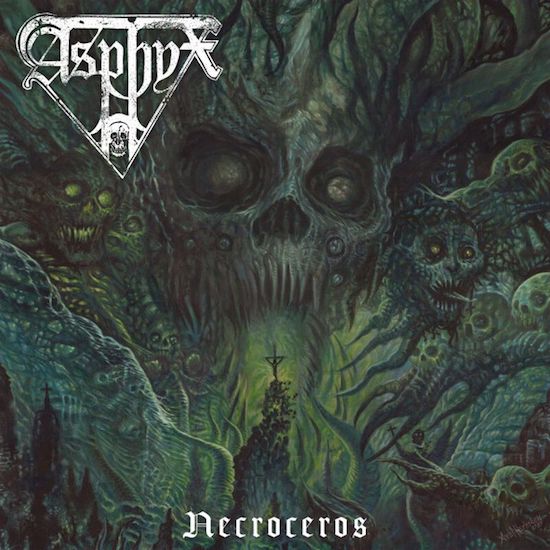
Production-wise there is nothing to complain about at all, the drums sound clean and punchy, the guitars as well and Martin's voice rattles as always. Also the cover is very nicely designed, like the last time by Axel Hermann. It reflects the dark atmosphere of the album well and has many interesting aspects to discover.

I asked at the beginning whether stagnation or progressiveness prevails on Necroceros - well, in a certain way Asphyx have developed further especially on 'Three Years of Famine', otherwise they have remained stylistically very true to themselves, which is also good. Personally, I find the band particularly convincing when they pick up the pace, so for me there are one or two tracks on the album that don't really sweep me off my feet, but that's very subjective.

All in all, a very solid tenth album, which could happily be followed by ten (or more) more. Gefeliciteerd and Herzlichen Glückwunsch, Asphyx!!!

Rating: 8.2 out of 10

   1.24k