Azarath - Official Website - Interview - News
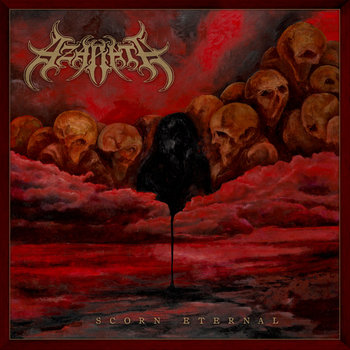
Scorn Eternal |
Poland
 |
|---|

Type: Full-Length
Release Date: November 20th, 2026
Label: Agonia Records
Genre: Black, Death
1.
Anti-Human Lord
2.
Black Rite Ascendant
3.
Profane Chaos
4.
Pyre Dominion
5.
Reborn From Cruelty
6.
Sacrament Of Ruin
7.
Revelation Of Deathly Glow
8.
Requiem Of The Dead Sun
9.
Throne Of Desolation
10.
Herald Of The Unseen
Review by Norbert on October 30, 2026.
Some time ago, I took part in an online discussion about a certain band. It began in the usual fashion, with that age-old metal lament that everything was better back in the day and that things have gone downhill ever since. The band's early albums had genuine fury, chaos, the Devil and brimstone, but then it all came to an end. The musicians mellowed out, lost their balls, and started getting clever instead of simply going for the throat. We know the drill, right? All it takes is for a band that's been around for a quarter of a century to record something more complex than an uninterrupted blast beat over a guitar massacre, and there will always be hordes of maniacs ready to declare its artistic demise. In this particular case, someone even brought up the album covers: as long as they were black, everything was fucking great, but once color appeared, true metal was dead. So there you have it: the Devil is color-blind.
To be clear, I fully understand those who value the raw, almost barbaric fury of extreme metal above all else. The early albums of many bands possess something truly unique: an untamed force, a constant sense of danger, music racing at breakneck speed as though everything were about to spectacularly fall apart at any moment. But I disagree with the conclusion that every attempt to move beyond that formula means sacrificing one's uncompromising attitude. Experience brings greater skill, better command of one's instruments, and a deeper understanding of composition, dynamics, and tension. What was once an untamed force can become consciously controlled fury, and that doesn't necessarily make it any less powerful. You don't need to blast away for five minutes straight to make extreme music. Sometimes slowing down, introducing dissonance, or carefully building toward an explosion can produce a far more sinister effect than an uninterrupted assault. Production also plays its part: a dirtier sound can intensify the impression of chaos, while a more defined one allows us to hear what's actually happening beneath all that carnage. And finally, what exactly do we expect from musicians after twenty-five years? Should they pretend to be young again and keep recording their second album over and over for the rest of their lives?
The band in question was, of course, Azarath, and that discussion came back to me during subsequent listens to their eighth full-length album, Scorn Eternal, officially due for release on November 20, 2026. Well, if anyone still believes the band went downhill when the black album covers disappeared, they should give this record a listen. Several listens, preferably. And then a few more, because it's damn hard to tear yourself away from this album, and every spin reveals another little detail worth appreciating. This isn't a return to Infernal Blasting. Thankfully. Instead, it's a natural continuation of the path established on the two previous albums, In Extremis and Saint Desecration. It's closer to the latter, perhaps, but also draws on the band's entire history.
The opening track, 'Anti-Human Lord', immediately brings its predecessor to mind. The calm, widely spaced chords recall the way Saint Desecration began and ended, creating a kind of circular structure. This time, however, they're merely an introduction before Azarath gets down to business. It was announced that Scorn Eternal would be a more epic affair, something that might raise a few warning flags when it comes to contemporary extreme metal. Especially when you learn that Inferno is also responsible for the orchestration. But relax: nobody is trying to make a second Behemoth here. There are no pompous passages designed for concertgoers to wave their fists in the air, no choral chants or collective displays of anti-religious identity. The orchestration is subtle, sometimes barely noticeable, serving as an additional layer rather than the main attraction. After all, the Devil doesn't need to arrive onstage in a golden carriage surrounded by a choir and a symphony orchestra. Sometimes all it takes is one fucking great riff.
And Scorn Eternal has those in abundance. That's probably the album's greatest strength. Azarath have always been capable of writing excellent riffs, but here their sheer density and memorability are particularly impressive. Many of them have an almost catchy quality, of course, in the death metal sense of the word. No melodic little choruses or concessions to accessibility. We're talking about distinctive rhythmic patterns, syncopation, unsettling note sequences, and motifs that burrow their way into your skull. In this respect, the strongest association is with later Immolation. The riffs are tight, heavy, rhythmically distinctive, occasionally dissonant, and damn catchy. There are even some characteristic pinch harmonics in the style of Robert Vigna, although in considerably smaller doses than those employed by the Americans. Azarath draw more from their approach to guitar writing than from a collection of recognizable tricks.
'Pyre Dominion' is an excellent example. Those piercing, Immolation-esque pinch harmonics are audible right from the beginning. Later comes one of the album's most interesting moments: against a backdrop of fluid, delicately ornamented orchestration, the guitar delivers a jagged, heavily syncopated riff that sounds almost nervous. This is where the thoughtful use of the additional instrumentation becomes most apparent. The orchestra doesn't simply double the guitars or pump up the artificial grandeur. Instead, it creates a contrast with the fractured rhythm, making the riff sound even more unsettling. This is epic music infused with anxiety, not triumphant bombast.
'Black Rite Ascendant', meanwhile, is just two minutes and fifty seconds of merciless punishment. The blast beats lash the listener without restraint, brief slowdowns offer a moment to catch one's breath, and then Inferno unleashes hell all over again. Somewhere around the halfway mark, a riff appears that could easily compete for the most memorable motif on the entire album. It returns several times, delivering just as much pleasure with every appearance. Sometimes all you need is a sub-three-minute massacre and one fucking great riff placed exactly where it belongs.
'Sacrament Of Ruin' opens with a steady, sharply defined motif that brings to mind Teutonic thrash from the late '80s and early '90s. There's something of old Kreator or Sodom in it, albeit filtered through a considerably more extreme musical approach. Then comes a barrage of blasts and a reminder that Inferno remains one of those drummers who treat their instrument with exceptional cruelty. Despite all the technical precision, his playing retains an intensely physical and aggressive character. In this track, as well as 'Throne Of Desolation', you can also detect similarities to Nile, particularly in the dense, technical riffing and the way those riffs are rhythmically constructed. 'Throne Of Desolation' grabs the listener by the throat right from the start, like Azarath on their earliest albums. A brief slowdown, another acceleration, and then it's pedal to the metal. If anyone finds the old fury missing here, they must be listening with their amplifier switched off.
'Requiem Of The Dead Sun' reveals another side of the band. It begins majestically, briefly venturing dangerously close to the aesthetics of modern Behemoth. Fortunately, instead of developing that grandeur into another stadium anthem, Azarath launch into a furious death metal assault. More importantly, the opening motif isn't simply discarded. It returns later in a transformed form, becoming an integral part of the song's structure. This is a good example of the compositional awareness that defines Scorn Eternal. Rather than mechanically alternating slow and fast passages, the band builds drama from motifs that complement one another.
'Profane Chaos' most strongly evokes the spirit of Morbid Angel. Violent, sometimes almost swirling riffs, chromatic passages, and controlled chaos all point toward classic American death metal. At times, this is further enhanced by the technical density of Nile's riffing. The combination brings to mind Behemoth around the time of "Zos Kia Cultus", when the influence of both American bands was particularly apparent in their music. In 'Reborn From Cruelty', the Nile connection goes even further, with the opening guitar passages displaying a distinctly Middle Eastern character. Gradually, these motifs dissolve into more conventional death metal riffing. This is another example of how skillfully Azarath handles their influences. They're not taking a sightseeing tour through their heroes' discographies; they're processing that musical language and making it their own.
We shouldn't forget the black metal tremolo picking, either. It regularly intertwines with the death metal riffs, bringing to mind the period when Necrosodom was still in the band. That sinister atmosphere didn't disappear when the vocalist changed. It remains part of Azarath's musical DNA, although it now operates in a somewhat different context. Skullripper brings a more direct, death metal-oriented expression, but the guitar work can still take on that characteristic black metal chill. As a result, even the most technical passages never descend into mere instrumental gymnastics. There's evil, unease, and that distinctive diabolical element supposedly lost after the band's first albums.
Most importantly, however, Scorn Eternal isn't an album to be admired solely for its musicianship or carefully considered construction. It's simply a fucking great record to listen to. It's packed with riffs you'll want to revisit, motifs that stick in your head, and arrangement details that only reveal themselves after repeated spins. At the same time, the whole thing never feels over-intellectualized. The music works immediately, but it doesn't exhaust itself after a few listens. You can focus on individual compositions, absorb the album from beginning to end, or simply concentrate on the guitars and discover one nuance after another. There's always a reason to return.
Scorn Eternal is a more mature album, but no less extreme. More varied, but not watered down. The old barbaric fury is still there, although it is no longer the band's only means of communicating with the listener. Azarath can be just as sinister when they slow down, allow dissonance to ring out, or place a nervous riff against subtle orchestration. None of this means the music has become any less diabolical. Quite the opposite: at times, the Devil seems considerably more cunning than before. He no longer needs to spend every waking moment beating us over the head with his pitchfork to make sure we know exactly who we're dealing with.
Returning to where we started, I fully understand that some people will always love Demon Seed or Infernal Blasting above everything else. But the claim that Azarath have lost their fury as they've developed greater compositional maturity is simply misguided. Scorn Eternal proves that a band can develop its own musical language, explore new means of expression, and draw on the full richness of death metal tradition while remaining true to its identity. You can be brutal without blasting nonstop, epic without bombast, and catchy without the slightest hint of commercial calculation. True uncompromising spirit isn't about playing exactly the same way for your entire life. It's also about refusing to become hostage to the expectations of those who decided that metal ended with the last black album cover. And if anyone still claims after hearing Scorn Eternal that Azarath no longer has fury or the Devil in its music, well, apparently the Devil slipped right past their ears. And fucking more than once.
Rating: 8.5 out of 10
44