
Kamelot - Official Website - Interview
Karma |
United States
 |
|---|
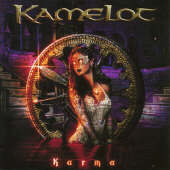

Type: Full-Length
Release Date: July 10th, 2001
Label: Noise Records
Genre: Power
1.
Regalis Apertura
2.
Forever
3.
Wings Of Despair
4.
The Spell
5.
Don't You Cry
6.
Karma
7.
The Light I Shine On You
8.
Temples Of Gold
9.
Across The Highlands
10.
Mirror Mirror
11.
Requiem For The Innocent
12.
Fall From Grace
13.
Ne Pleure Pas (US Bonus Track)
Review by Jophelerx on December 27, 2025.
The early days of Kamelot were a bit strange and confused, at least to my ear; a band from the US playing power metal of the more European variety, a sound which had only just begun to take off outside of the German scene in the early-to-mid 90s, being mostly championed by titans like Helloween, early Stratovarius, and (of course) oddballs combining the style with other ideas, like Norwegian progressive power metallers Conception. Others like Symphony X and Labyrinth were beginning to find their sound, but they were more contemporaries of Kamelot, rather than predecessors. At the time Kamelot's 1995 debut Eternity came out, it was fairly unusual to have a US band playing a more melodic, keyboard-driven style, particularly since the US brand of power metal was at a bit of a low point. I guess you had things like Virgin Steele making a comeback, but it wasn't until bands like Nightwish, Rhapsody, Dragonforce, and Sonata Arctica arrived and really popularized European power metal worldwide that other US bands began to take up the mantle. Kamelot continued to find their sound over the next several years, replacing founding member Mark Vanderbilt with Norwegian Conception alum and icon Roy Khan in 1997. Even then, the first couple of albums with this lineup - Siege Perilous, The Fourth Legacy, and live album The Expedition - felt like a band trying to ride the wave of the emerging Europower scene, albeit quite competently, rather than a group of musicians with their own stories to tell. 2001's Karma, though, sees a band finally coming into their own, presenting a darker, more mature style that was rather unusual for power metal of this era. Of note is the fact that the band's lineup was stable from 1997 until the departure of bassist Glen Barry in 2009, meaning there were no personnel changes responsible for the change in sound; instead just the product of the men involved maturing and finding their respective voices as they, perhaps, grew more comfortable in their roles as musical storytellers.
Intro "Regalis Apertura" (Latin for "royal opening") has a fitting title as it does feel very regal and triumphant, providing a very strong "cold open" into the album proper, and is one of the relatively rare times I think an instrumental intro to an album actually enhances the experience and isn't something I'm likely to skip on repeat listens. As the opening riff to "Forever" comes in, one could expect the same bombastic, energetic style Kamelot went for in the last few albums, but once Khan's vocals and the moody keyboards come in, you'll quickly realize this is a different, more nuanced beast. Famously influenced by the melody of Norwegian composer Edvard Grieg's "Solveig's Song," we see Khan's input increasingly significantly compared to previous albums; on The Fourth Legacy the lyrical direction seemed to largely be tied to Arthurian and other popular international mythology, with tracks like "The Shadow of Uther," "Nights of Arabia," and "Alexandria" feeling like more standard power metal fare as far as its source material. There were outliers, though, like "Until Kingdom Come" and "Lunar Shadow" taking on a more personal, relationship-driven direction at the end of the album. Here, we see the other side of the coin, with the majority of tracks taking on a darker, more psychological, and emotionally-charged tone. Now, don't get me wrong, I love castle and dragons and mythology as much as the next power metal fan, but in this case, it feels like the band had been using these themes more as a crutch, something they did because it was what power metal bands do rather than what they were really interested in and excited about exploring. With tracks like "Forever" taking on a more philosophical, metaphorical tone, it really feels like Kamelot's starting to find their sound.
Of course, as I said, there are outliers that could easily have appeared on Siege Perilous or The Fourth Legacy; "Wings of Despair" is one of these, with "Across the Highlands" being the other major example later in the album. These are fine songs with cool riffs and a core competence to the songwriting that still makes them far from skippable, but they're certainly not the stars of the show here. "The Spell" gives us our first taste of a more "evil," macabre Kamelot, a song oozing with seductive, forbidden charm, from the ominous urgency of the keyboards to the otherworldly ambiance of the backing female "oooh"s in the chorus, to the incredible decision to end the song with some spontaneous guitar noodling from Thomas Youngblood that provides a unique way to frame the rest of the song and somehow feels perfect in context. This is a highlight for sure, with Khan showing off his versatility and emotive expressiveness a bit more than we're used to. These aspects also steal the show in the following track, "Don't You Cry," a sad, regretful ballad written by Youngblood about the death of his father, but perfected emotionally by Khan and the orchestral strings, continuing the sense of regality we've come to expect here. It's clear the band had upped their budget by this point, and it shows, perhaps providing another reason for the ambitiousness of the compositions and arrangements here.
Following is the title track and the album's centerpiece, "Karma," a tour de force from the weird, shimmering vocal/keyboard intro to the driving, unusually aggressive main riff. There are tons of interesting, subtle decisions to find here that make this song as strong as it is - the decision to move the main instrumental melody from guitar to keyboard and back, the way the song plays with rhythm, the sheer amount of different melodies that weave in and out throughout the song's 5-minute runtime - but all of it comes together to something that's immediately accessible and memorable. Honestly, if power metal were a mainstream genre, I think this might have been the band's first top-charting single, as it feels like something that could be compared to a deceptively catchy and yet remarkably deep composition like a "Smells Like Teen Spirit" or "Black Hole Sun" (using those examples only because grunge is my favorite genre of "popular" music). It's a layered masterpiece that foreshadows the amount of different elements and yet impressive accessibility that would lead the band to further success on Epica and The Black Halo. This is easily the best song on the album, and the band knew it.
Next is the even more brooding, contemplative "The Light I Shine On You," a song that edges into progressive metal at times with the discordant, repetitive riffs in the verses underneath a strange, lilting, almost angular vocal performance from Khan that still manages to retain a core of wistful longing that yet again shows off Khan's talent and how he brought a lot of the more technical compositions together with his former band Conception. This is an understated number, one a think a lot of Kamelot fans may have a tendency to gloss over or at least not consider a favorite, but I think there are a lot of elements here that mark how mature the band had already become here, and provides a slightly different, not-quite-power-metal vibe that still has a heaviness and a gravity to it that might make fans of more progressive fare pay attention. "Temples of Gold," the album's second ballad, is another winner, one that resonates with me a lot more personally than "Don't You Cry" does, with its angsty, romanticized brand of despair I found appealing as a teenager when I first heard it. It's romantic and yet tragic, which is generally the only way I can stomach a romantic track (not to say "happy" romantic songs are bad, just not my thing), and has a quite wintry atmosphere similar to "On the Coldest Winter's Night" on Epica, and even switches things up with a cool middle-eastern influenced solo that somehow works. Both ballads on the album are quite strong, though, showcasing the band's focus being on more of an emotional gut-punch than on axe-wielding warriors.
Of course, "Across the Highlands" is a pretty big deviation, returning to a more generic power metal style that really undoes the atmospheric momentum that had been building across the last few tracks and continues afterwards. It's not a bad song, but it would have felt better to me at the beginning of the album, where things were at least relatively more upbeat. The album ends with the "Elizabeth" trilogy, a three-part epic about Countess Elizabeth Bathory, whose story is no stranger to metal (the namesake project of Quorthon's Bathory being the obvious other reference), who allegedly used the blood of virgins to grant herself eternal youth. Aside from "The Spell" and "Karma," this is probably my favorite part of the album. It really does feel like one cohesive track in many ways, with repeating musical motifs, a linear lyrical progression, and one of Khan's best and most varied vocal performances of all time. The first part, "Mirror Mirror" is a chilling, haunting ballad along the lines of something like Crimson Glory's "Lost Reflection" or Psychotic Waltz's "Halo of Thorns," and Khan's feminine banshee wails over these hideously delicate melodies is something very few vocalists could pull off (Midnight and Buddy Lackey being one of only a handful of others). The song slowly builds up additional layers and accents until the end features strings, multi-tracked vocals, keyboards, and lead guitar that has some of that expressive, almost "speaking" quality Youngblood would become known for - where it really feels like another vocalist with how much emotion he wrings out of it. This ends with some cool keyboard pulses that lead into part two, "Requiem for the Innocent," quite nicely.
"Requiem for the Innocent" opens with a more aggressive electric guitar riff but quickly goes back to a more haunting, softer verse section, then back to a heavier, more power metal chorus, though still with enough layers and emotional ambiguity, including some nice female vocal harmonies with Liv Nina Mosveen, who does a great job providing some counterpoint to Khan's menacing, over-the-top malevolence. This explodes into part three, "Fall from Grace," an out-and-out speed metal track, featuring some of the craziest guitar work I've ever heard from Youngblood in the intro before going into some of Khan's most unhinged, raspy performances over sparser, yet still menacing, guitar parts before returning to a faster, more neoclassical bent in the chorus. There's a lot going on here; it's a whirlwind that still gives everyone a chance to shine and feels like a Kamelot song while still doing things we don't often hear from the band. It's a crazy way to end the album (well, aside from the 11 minutes of silence to make it last 55:55 to mark their fifth studio release), closing with some ethereal xylophone-esque keyboard flourishes that do a really nice job at accentuating how versatile the band had become.
Overall, this is one of the band's strongest releases, behind only Epica and The Black Halo for me in terms of its highs and overall consistency and ambitiousness, and marked a turning point for the band where they really started to stand out and become a force to be reckoned with in the power metal scene. It's generally highly regarded by most fans but tends to get a bit less attention than the two albums which followed (for good reason), and even, I feel, compared to 2007's Ghost Opera, which rode the wave of The Black Halo's success but wasn't nearly as strong an effort. If you're a Kamelot fan who has yet to hear this album, or simply someone interested in a darker, moodier take on the genre than most of what's out there, I highly urge you to give this one a shot. It showcases a band still young enough to pull off crazy guitar parts (Youngblood was only 27 here, despite forming Kamelot in 1987 at age *13,* which is pretty crazy) and stratospheric vocals (though you could hear Khan going for a bit of a lower register at times, which he would continue to do over the next few albums), but old and mature enough to provide a level of complexity and jaded character that made this a more nuanced experience than what came before.
Rating: 8.9 out of 10
1.29kReview by Krys on July 12, 2001.
I have to be honest with you… not being the biggest fan of power metal, when I opened the package and saw another power metal release I said “God, why me? Are there any bands out there playing a different style of music?” So imagine how enthusiastically I put this CD into my player. And... that’s the only negative thing I have to say about this masterpiece.
I’ll say even more, this album hasn’t left my player for at least two weeks now and with a couple more CDs like Kamelot’s “Karma”, I might become one of the biggest fans of this genre. What’s so special? Everything. If you thought “The Fourth Legacy” was good, this is like comparing your garage band (not that your band sucks) to Morbid Angel. I don’t even know where to start... this perfect balance between melody and power, breathtaking arrangements, flawless use of instruments and a great selection of lyrical topics makes “Karma” easily one of the best power releases of this year.
Twelve songs, which range from fast opener 'Forever', 'Wings Of Despair' or closing 'Fall From Grace' are perfectly balanced with mid tempo tracks and slow ballads like 'Don’t You Cry' or 'Temples of God'. If title track 'Karma' won’t make your jaw drop to the ground, I don’t know what will. Forget about all those bands singing about and sounding like knights sitting around the round table, Kamelot will amaze you with mysticism and atmosphere using Khan’s outstanding voice and fantastic instrument use. As if all that is not enough, they throw in absolutely stunning trilogy that ends the record, “Elizabeth”, which is just a showcase of their musical talent and ability to compose top class melodic power metal.
Bottom Line: If you want to widen your musical horizon this is the CD you start with, for everyone else... I can’t believe you are still reading this review.
Rating: 9.5 out of 10