Ritual Necromancy - Interview
Fresh off a surge of momentum and armed with one of the most uncompromising sounds in modern death metal, Castrator continues to carve out their place in the underground with sheer intensity and conviction. Following the release of their latest album, "Coronation Of The Grotesque", just last year, the band has only sharpened their edge. At the core of that sonic assault is bassist Robin Mazen, whose experience runs deep—spanning not only her work in Castrator but also stints with acts like Derkéta, Gruesome, Demonomacy, Impure, Slag-9, Precipice, Thrash Attack, and Acrimonium. Coupled with years spent on the road working merch, her perspective offers a rare, full-spectrum view of the scene, making this conversation as much about passion and perseverance as it is about brutality and sound.
Tomek

For people just discovering Castrator, how would you sum up the band—preferably without getting us banned anywhere?
I'd describe us as five metalheads who love OSDM and love playing OSDM—coming for your balls… and non-balls.
You and I go back a bit—be honest, did you always see yourself here, or were there some "what am I doing?" moments along the way?
When I think back, I went to college, had a regular job, and played locally. I always wanted to play, but back then, I never saw the big picture. I just thought it was fun to jam and play live. I never really had a "what am I doing?" moment—I just love music, and I love to play.
You've not only been a musician but also worked merch on numerous tours—how has seeing the scene from both sides shaped your perspective?
When I first started touring, there were no other merch girls. It was just my friend and me. There also weren't many women attending shows—maybe a handful, usually with their boyfriends. That's definitely changed. As for playing versus working merch, I just do my job, or I just play. I don't see it as that different. I enjoy both.
What originally pulled you into playing bass—and when did you realize, "yeah, this is it"?
Like most kids, I started with piano. Then I always wanted to play guitar. I played guitar in high school, and I was actually still playing guitar when I first joined Derketa. During that time, I really didn't like using a pick, so someone suggested I try bass. I thought, "Hmm?" and bought a $50 bass at my local music store. That was it. I still have it.
Your bass actually cuts through (which is rare in death metal)—was that always the goal or a happy accident?
A bit of both, but mostly a happy accident. I always say I'm a frequency—no one notices the bass unless it's not there. Live, you need that bottom end, and I try to keep the sound clear and separate from the kick drums.
When writing, are you the glue holding things down or the secret agent sneaking in extra flavor?
With Derketa, Sharon writes most of it. She'll bounce ideas around—she's even called me her muse—but she has a vision. With Gruesome, it's "original covers," and the guys handle the writing. I'm more the business person there. With Castrator, it's Carolina and me. Writing riffs on bass is like building the skeleton of the song, and we just bounce ideas back and forth. We've tried other approaches, but it works best when it's just the two of us.
How does songwriting usually work in Castrator—organized chaos or just pure chaos?
As I said, it's Carolina and me, and I don't think there's much chaos. I'll send tabs and videos, she'll send stuff back. Sometimes we end up with dozens of riffs, though—putting those together is probably the chaotic part.
There's a killer balance between brutality and groove—how do you avoid going full caveman 100% of the time?
I do love some caveman riffs, but we like to keep it old school. We also pull a lot of influence from thrash, which helps keep us from going 100% caveman.
Who are some of your biggest influences—and who would surprise people the most?
When writing, you mostly write what you like, so the influences come through naturally. If I like how a riff feels to play, it's good. The drums can change that for better or worse. As for bands, it's the usual OSDM suspects.
Any non-metal influences that would make diehard fans raise an eyebrow?
I listen to everything. I don't know if it's always an influence, but you might hear some Metallica sneak in, which most people already know. I also love Slayer, Van Halen, The Guess Who, and oldies, but I don't think that really shows up in the music.
Castrator has a very clear identity—did that come naturally, or did it take some trial and error?
When we first started, we didn't use our names or photos. We wanted people to hear the music, not see us. We'd had issues in the past, and people hear the name Castrator and suddenly assume we're a feminist band. Not that there's anything wrong with that—but overall, we're just a death metal band. We play OSDM and write about history, world issues, and religious atrocities. I don't think there were questionable riffs, but the band has definitely matured. I wouldn't mind re-recording some older songs.
The "all-female band" label still pops up—meaningful, annoying, or just background noise?
All of the above. That's why we didn't show our faces or names in the beginning. It's not just men—women do it too. People can't help it. No other genre does this. In country, pop, or rap, you're just an artist. The metal scene is saturated with women in bands—why is it still treated like a separate category? We should all just be musicians.
What's been your experience navigating the death metal scene—welcoming or more "prove yourself first"?
I never felt like I had to prove myself. Maybe you had to prove what vinyl you owned or what shirt you were wearing. But mostly everyone was just enjoying themselves, living in the moment, and finding kindred spirits. It's a lifestyle, not really a hobby. I had a blast—and I still am.
What's your mindset before hitting the stage—locked in, hyped up, or trying not to trip over cables?
I'm usually at the merch booth thinking, "I need to get out of here." Lately I've been more excited, though. Once I'm on stage, it's normal—some jokes with the bandmates, hit the intro, then go time… and try not to fall off the stage.

Any live moment that really sticks out—for the right or wrong reasons?
Most shows have the right reasons, and what fun is talking about that? For the weird ones: in Chicago, I was focused on someone in the front row eating fries. I couldn't tell if she was bored or what. Another show, a girl had maps open on her phone the entire time—like she was planning an escape route. With Gruesome, the first show of a summer tour in Europe, hot as hell, no AC—Matt passed out on stage, still strumming as he went down.
Looking ahead, what can fans expect next—and how hard are you planning to hit them?
With Derketa, hopefully a new record this year or next—I keep pushing for it. Gruesome is touring Europe, heading to South America, and hopefully more shows. Castrator has some fests coming up, plans to tour this year and next, and we've already started working on the next record.
Quick Ones
Favorite bass player of all time?
The usual: Cliff, Steve, Geezer, Geddy.
One album you could survive on forever?
Anything Metallica, Van Halen, Slayer… and Consuming Impulse.
Fingers or a pick?
Fingers.
Pre-show ritual?
I'm usually at the merch table, so it's very PG.
Dream tour?
Metallica and Slayer.
Most underrated death metal band right now?
Castrator, haha.
Go-to non-metal artist?
Van Halen, The Guess Who, oldies radio.
Worst gear fail?
Not too many, knock on wood - In Colorado, my tuning peg broke, and the string just fell off the bass. Luckily, it was the last song. Another time, a transformer died at a fest. Mostly normal stuff.
If you weren't playing music?
My "real" job is in pharmacy, so probably that.
Pineapple on pizza?
No pineapple. I'd have to leave the band—or get rid of them (laughs).
To avoid any misunderstanding, before diving into the questions, I started the chat with Dolk (stage name of vocalist Per-Joar Spydevold) with something seemingly simple: what is the correct pronunciation of "Kampfar"? With that question answered, I was able to move on to more substantial topics, such as expectations surrounding the band's first visit to Brazil — for a single show on May 31st at Manifesto Bar in São Paulo —, plans for the successor to Til Klovers Takt (2022), already in an advanced stage of production, and even having him choose, under the Norwegian spring sun, the five most important albums of his life. Enjoy the read!
Marcelo Vieira (@marcelovieiramusic)

What, for you, distinguishes a standard black metal show from a Kampfar performance?
That's a good question, because there isn't really such a thing as a "standard" in this context. What we do in Kampfar has never been standard compared to the rest of the black metal community. Even though we come from the early '90s and are strongly connected to that era, what we do has always been something different—perhaps not aligned with the traditional way of thinking within black metal.
For me, it's about something more personal. It's about individual feeling. Of course, the black metal attitude and emotional core are still deeply connected to the band and to me personally. But ultimately, Kampfar is best experienced live. That's where we truly belong.
We've never really been a typical studio band—although we've improved in that regard over time. For us, it's about being out there, performing live. That's where we bring out the best in ourselves as individuals. It has to feel honest and real—that's the most important thing.
This tour celebrates different phases of your discography. How do you build a setlist that works as a narrative rather than just a sequence of songs?
That's definitely a challenge. When you've been active for nearly three and a half decades and released nine albums, putting together a cohesive setlist is no small task.
Some fans are deeply connected to the early material, while others relate more to the newer work. I've met people at Kampfar shows who grew up with the band because their parents introduced them to it, and I've also met very young fans—14 years old or even younger—who discovered us more recently.
That, to me, is the essence of Kampfar: the ability to connect generations. To bring together people who could be father and son through the same music.
When we did our 30th-anniversary shows in Europe, we made a conscious effort to weave our entire history into a single performance. It was a difficult task, but I think we managed to create a kind of flow—a journey through time. That's how we approach it now as well: we don't focus only on the old or the new; we connect everything into one continuous narrative. It's not easy, but I believe we've succeeded.
In a one-off show in a more intimate venue like Manifesto Bar, the experience tends to be more direct and visceral. Does that change the way you perform?
In a way, it does—but not by changing what we are. The core idea remains the same: to connect everything we've done into a cohesive experience.
Whether it's a large festival or a small, intimate venue, the challenge is still to present that full narrative—to reach both longtime fans and newer listeners in the same space. The intimacy of a smaller venue might make the experience feel more immediate and intense, but the philosophy behind the performance doesn't really change.
Is there any song that takes on a completely different meaning when performed live compared to its studio version?
Yes. A good example is "Det Sorte," from Ofidians Manifest. It's the final track on that album, and it's extremely personal to me.
The song deals with very dark thoughts—I was reflecting on my own existence, even questioning whether I wanted to continue living. At the same time, during the recording process, our guitarist lost his father. So the song became this kind of shared emotional space—a dark bubble we had to work through together.
Even today, performing it live gives me chills. It's deeply personal, and that essence remains very strong every time we play it.
Did you face depression?
Yes, absolutely. That's exactly where the song came from. It's a very direct answer—I was at rock bottom, to be honest. That's the origin of it.
There's a common idea that Latin audiences are more emotional and intense. Does that perception match your real experience on stage?
We haven't had the chance to properly tour South America yet, which is a shame after more than three decades as a band. However, we have played several shows there, especially in Mexico, including major festivals.
So I don't have a full basis for comparison, but I've met many South American fans over the years. Recently, for example, I performed a tribute to Darkthrone at the Inferno Festival, and I met fans from South America there as well.
You can feel how much it means to them—and that means a lot to me too. Finally getting the chance to play in South America after all these years will be very special for us. I hope it will be just as meaningful for the audience.
Is there any cultural contrast between the band's Nordic origins and its South American reception that you find particularly interesting?
Yes, definitely. I grew up in the 1970s, and back then, Latin America felt very distant—almost unreachable. But the world has changed a lot since then.
In the early '90s, when we started with black metal, we used to communicate through handwritten letters, including with people from South America. I always felt a strong connection there.
People often think of Norway as a wealthy country—and it is—but in the '70s, things were different. There was struggle, and society was very rigid, influenced heavily by Christian values. Life felt very structured, very "black and white," even literally—television was still largely black and white.
Through those early exchanges with people from Latin America, I found unexpected similarities in culture, history, and ways of thinking. Even though the contexts were different, there was a connection. It's hard to explain, but it's there.
Til Klovers Takt was released in 2022. Was this period without new material more focused on reflection, life outside music, or developing new ideas?
It's a mix of all that, but the pandemic played a huge role. When we started working on Til Klovers Takt, everything shut down. We couldn't perform live, and suddenly we had no external pressures.
The four of us went to a cabin in Hemsedal, deep in the mountains, and stayed there for an extended period. We just lived together and created music.
That isolation brought us closer to our roots. There were no distractions, no outside influences—just us, nature, and the music. It became something very personal, very real.
Looking back, it was almost liberating. The world was in chaos, but where we were felt like a free space.

Did you become more selective or more open to experimentation?
More open, definitely. It wasn't a conscious decision—we didn't set out to experiment—but the circumstances naturally pushed us in that direction.
Are there already compositions in progress for a new album?
Yes, but I have to be a bit careful—there are labels involved, and some things need to remain confidential. But yes, we are working on new material.
At what stage are they—sketches, demos, or something more structured?
They're more structured than demos. We could probably go into the studio tomorrow if we wanted to, but we'd like to refine things a bit more first. So we're well beyond the demo stage.
Thirty years in black metal is proof of endurance. What has allowed Kampfar to remain relevant without diluting its identity?
That's a difficult question. I've been involved in black metal for four decades now—Kampfar was my first band—so I've seen a lot.
The people who are still here from the early '90s are here for a reason, and it's not fame or money. It's a way of life. That's what this is for us.
We don't do Kampfar because we have to make a living—we do it because it's a fundamental part of who we are. That's true for many from that era.
It becomes something bigger than success or recognition. It becomes your life. And that's not something you can easily explain—it just is.
Black metal was born as an anti-industry movement. How do you see its place today in a digital, fast-consumption landscape?
It's challenging. Staying true to yourself in this environment is not easy.
I feel that a lot of modern metal sounds very similar—bands using the same producers, following similar formulas. But black metal still has a space where authenticity matters.
Many bands have moved toward more commercial directions, but many others remain rooted in their original vision. That's what matters to me.
I don't focus on what others do. I focus on what Kampfar does. The most important thing is being able to look in the mirror and feel proud—that the music reflects what I truly wanted to create, not what someone else expected.
What are your five favorite albums?
That's a very difficult question. But some albums have been especially important to me.
A Blaze in the Northern Sky was hugely significant—it changed the way I thought about music.
The first album by Morbid Angel was also very important. Seeing them live in the late '80s or early '90s had a major impact on me.
Don't Break the Oath is another key one—I've always been a big fan of Mercyful Fate and King Diamond.
I'd also mention Master's Hammer's The Jilemnice Occultist. That album influenced a lot of Norwegian black metal, even if people don't always admit it.
And finally, Master of Puppets—especially for its musicality and bass work. It's a masterpiece.
When did Metallica "die" for you?
With Metallica—the Black Album, for sure.
When the topic of Technical Death Metal comes up in conversation, naturally, one would be so-inclined as to discuss Chuck Schuldiner and Death, but he'd be remiss to overlook Monstrosity and what's been a stellar contribution to the sub-genre on their part. "Millennium", "The Passage of Existence" and now "Screams from Beneath the Surface" - three career-defining records with the latter having just been released via Metal Blade Records. It stands as a beacon for genre trueness, as it simultaneously pushes the limits of said genre. Not to the max, but just enough to keep the music fresh. Just the way it was meant to be.
Percussionist, Lee Harrison - co-founding member of Monstrosity and drumming phenom has been a a scene-player for decades and has seen them come and go, all the while as Monstrosity has maintained their reputation as a prolific force; having navigated their way through their own perils and industry woes; resulting in one of the most favorably reviewed discographies in the business. During my latest interview for MetalBite, Lee discusses some of the band's defining features, his outlook on the current scene and a look into their latest LP, "Screams from Beneath the Surface", released this month via Metal Blade Records.
Jeger

Greetings, Lee, and welcome to MetalBite. It's been eight years since "Passage", which was a monumental album in my opinion. Now, the "Screams from Beneath the Surface" era has begun. How do you feel about the band in its current form with such a long-awaited new LP being released?
Lee: Things are moving right along! Won't be long until the tour starts and we can get back out to playing again!
A lot has changed in the Tech-Death world since the early '90's. Some of this stuff is hardly discernible as Death Metal anymore. I feel like Technical Death Metal should still be fundamentally grounded in traditional Death Metal mechanics. You guys nailed it with "Millennium". What's your outlook on the genre as it stands today when you compare today's Tech to, say, "Individual Thought Patterns" (Death) or "Millennium"?
Lee: Well, we always try to have a balance between technicality and brutality. Some bands can go too far, and you end up confusing the listener more than entertaining them. So, we've always tried to find that balance. I think with Millennium we got a little crazy with the odd time signatures, so with the release of "In Dark Purity" in 1999, we really wanted to find the perfect balance. And I think that's what we did. We've kind of been perfecting that formula ever since. For some of the younger bands playing technical music, there are some great musicians out there. But like anything, there's good and bad; it just depends on the perspective of the listener and the influences they bring into the experience.
Which era of Monstrosity do you feel has best testified to the band's overall vision for Technical Death Metal?
Lee: Well, if we're strictly talking about technical metal then Millennium is definitely the album that people are going to consider the best. That being said, I think all of our songs have a certain degree of technicality. We just want to retain the essence of strong songwriting and the art of arrangement. Technicality for its own sake can sometimes come across as showing off, and that's not really our thing. We do like to incorporate odd time signatures when it serves the song, though.
How would you say the last eight years has shaped Monstrosity? The world is a different place than it was when "Passage" was released.
Lee: I mean, we learn a little something from every album. There wasn't really anything in particular that happened in the last eight years that changed me. I was basically quarantining before quarantine was even a thing, so the pandemic didn't really affect me that much, to be honest. Obviously, life events do inspire us and influence us in certain ways, but I'll leave it up to the listener to decide whether it's for the better or for the worse.
What was your biggest challenge in recording "Screams from Beneath the Surface"?
Lee: Nothing too crazy, of course. It was mainly just the usual scheduling difficulties. We put in the time and work to make sure the material was as good as it could be. During the mixing session, we got a little critical about the guitar sound and ended up going back to change a few things. Of course, with every album there are things you'd change, and this one is no different. So really, everything's pretty much as expected. LOL
Exile, paralyzation and bewilderment appear to be some of the abstract concepts pertaining to the new material. Does "SFBTS" follow a concrete theme?
Lee: I don't know about those three words in particular, but we've always drawn on similar apocalyptic themes and end of the world scenarios as subject matter for our song lyrics. Death, destruction, war, all those kinds of things have been central to the inspiration behind our lyrics. This album is no different in that respect. I purposely try to retain a certain level of familiarity.

What does your touring schedule look like in support of the new album?
Lee: Well, at this point we're starting the tour on April 18th in Lucerne, Switzerland with Napalm Death. From there, we continue headlining for another three and a half weeks. Then we come back and play Maryland Deathfest again; this time with Napalm Death and Sinister. That should be a good one. After that, we're playing the Milwaukee Metal Fest. In August, we head to the Czech Republic for the Brutal Assault Festival. Following that, we're hoping to confirm a US tour for the fall, and possibly a South American tour after that. We'll see what happens. It's possible some of that may spill into 2027. But hopefully we can just keep the ball rolling and keep moving forward.
When you look back at Monstrosity, what about your career would you say has stood out most?
Lee: I'd just say we've stuck to our guns and persevered for as long as we have. We haven't given in to the usual business garbage that tends to bring bands down. We've been fortunate to keep it rolling this long, and hopefully it won't stop anytime soon. We'll see what happens. Thanks for the interview. Hope to see everyone out on the road. For merch and everything else, check: out www.conquestmusic.com and www.monstrosity.us.
Epic, solemn, and deeply human, doom metal has always demanded more than casual listening—it asks for immersion. Few voices embody that ethos as completely as Robert Lowe. From his defining work with Solitude Aeturnus to his celebrated tenure in Candlemass, Lowe helped shape the emotional and sonic identity of epic doom, forging a style that balances power with vulnerability and grandeur with raw feeling. Now preparing to connect with Brazilian audiences, Lowe reflects on a career built not on trends, but on conviction. In this conversation, he opens up about artistic identity, the evolving nature of heavy music, the realities behind band dynamics, and the enduring importance of emotion in an increasingly digital world. Unfiltered and grounded, his perspective reveals an artist who remains driven not by legacy, but by the simple, relentless urge to create.
Marcelo Vieira (@marcelovieiramusic)

Over the decades fronting Solitude Aeturnus and later singing for Candlemass, your voice became one of the most recognizable signatures in epic doom metal. How do you define your artistic identity today beyond the bands' names?
How do I define that? Okay, I'll keep it quick and simple. I just do what I do. I know that might sound a bit egotistical, but that's not the case at all. It has to be a journey for people—music should feel like something, represent a moment in time. When you listen to something, you want it to capture that feeling.
Doom metal often balances near-liturgical grandeur with stark human vulnerability. How do you personally navigate that tension between monumentality and fragility in your performances?
Navigating that becomes a very personal thing. What I try to do is reflect what I'm feeling. Most of my songs are collaborations with the band members and everything else we do together, but when it comes down to it—when I'm in the booth, so to speak—I just do what needs to be done to make sure the music comes across to everyone else.
If I can't make it connect, then I haven't done my job. My job is to allow people to listen and feel like they're part of it.
You have witnessed the genre evolve from the analog underground of the late '80s and '90s to today's digital, streaming-driven landscape. How has the way audiences consume—and emotionally process—doom metal changed?
You hit a major point right there—the digital side of things. I think what a lot of people might be missing is that you can't just press a button and make a guitar sound good. You can't just hit auto-tune and call it a day.
What really matters is what comes from inside—something natural. That's what we have to do. Sure, anyone can hit a button and say, "I want my guitar to sound like this," and I'm not dismissing those tools—they can be useful—but it all depends on how you use them. You have to shape them into what you want them to be.
Your vocal approach has always carried controlled theatricality without slipping into operatic excess. Was that an intentional aesthetic choice, or something that developed organically from your background?
Honestly, it wasn't something I sat down and planned—like, "I'm going to do this." It goes back to what I said before: it's personal. Everything I do is very personal.
When you hear me sing, or the lyrics, or the music I've written, it means something to me before it's ever, let's say, broadcast. How it's done matters to me—the approach matters. So no, there was never a conscious decision like that. It just comes from within.
From a technical standpoint, how have you preserved power and range over the years? Have you changed your preparation or your mindset toward recording and touring?
Give me a beer and a smoke.
I mean, when you're on the road for four, five, six weeks—playing six or seven nights a week—you just keep doing it. You're on the bus, you're performing every night, and that keeps everything in shape, so to speak. Other than that, there's not a whole lot of preparation involved.
In the studio, do you see your voice primarily as a melodic instrument woven into the sonic mass, or as a narrator standing above the band's foundation?
That's easy. As far as I'm concerned, vocals are just as important as the guitar, bass, or drums. It's all part of the same picture.
Nobody stands above anyone else. The whole point is to create the complete sound together. There's no "turn me up, turn me up." If anything, I'm usually the one saying, "Can you turn me down a bit? I don't want to hear myself that much."
No, not at all. It always comes back to emotion. Whatever your favorite band is, what you're really looking for is emotion—from the guitarist, the singer, whoever is involved.
That never changes. My emotions don't change.
Your entry into Candlemass marked a historic moment, uniting a seminal band with an already established voice. How do you assess that period artistically today?
Yeah, I mean, come on—we both know Candlemass has always been something special, right up there with bands like Sabbath. What Leif, Messiah, Johan, and the others built is something you can always go back to when you listen to that music.
Does it change? I hope not. That's what you want.
Your departure from Candlemass generated speculation and differing narratives. Without delving into personal details, what do you believe ultimately shaped that decision—creative differences, practical circumstances, or diverging visions for the future?
You mean leaving Candlemass? Yeah.
It was just a process—things happen. You see it in documentaries about bands like ZZ Top or ABBA—stuff just unfolds, and you let it be and move forward.
There were no creative differences. Not at all. Leif always had it, and those guys always delivered—Lars, Lasse, Mappe, Janne… I still talk to them, everything's good.
It was just a moment in time when things went in a different direction. Would I play with them again tomorrow? Fuck yeah. Would they have me? I hope so—maybe.
What did that experience teach you about leadership, collaboration, and boundaries within a band that carries such a strong legacy?
It comes down to respect. You respect each other and give everyone their space.
When you do that, collaboration works. That's what it's all about—respecting your brothers and appreciating what each person brings. You take care of each other.

When you reflect on your career, do you feel a sense of completion, or is there still something essential you need to express artistically?
Completion? No—there's no such thing.
I'll be doing this until I'm six feet under. There's always something—every day you hear something new, think of something new, something else you want to try.
When it's part of you, there's no finish line. That's just the way it is.
When your career is examined in the future, would you rather be remembered as "the voice of an era" or as an artist in constant evolution?
That's a great question.
But honestly, that's not how I think. I just want to create something meaningful—like Sabbath, or Dio, or whoever. You hear someone like Bruce Dickinson and you recognize him instantly.
But I'm not focused on being remembered. If people remember me, great. If not, that's not the point.
The point is making good music.
If you could leave one message to the next generation of vocalists who see you as a reference point, what would it be?
Just do your thing.
Whatever that is—if it brings out emotion in you, then do it. That's all that matters.
What can Brazilian audiences expect from these upcoming shows: a celebration of the past, reinterpretations of different phases, or a reaffirmation of a still-restless present?
We're going to crush—it's going to be heavy, it's going to be doomy, and it's going to hit hard.
Celebrate the past? Sure—but I don't live in the past. For me, tomorrow is a new day. It's about what we're doing now.
It's not about singing songs from 40 years ago. It's about what we do today—right here, right now.
Slaughterday don't need big introductions for everybody who is firm with the German OSDM scene, I guess. With "Dread Emperor" Bernd Reiners (vocals, drums) and Jens Finger (guitar, bass) they once again have released a superb death metal album which for sure is one of the best albums in 2026 (read full album review here). I had the pleasure of talking with the two charismatic guys via Zoom to talk about their latest output. Enjoy reading!
Michael

Hey, how are you doing? Still that cold at the coast or is it getting warmer?
B: School can take place again!
Yeah, I read about it. A lot of days school didn't happen.
B: Yes, it was a catastrophe, very bad.
J: A bomb cyclone!
During new year we were at the coast, too and when we drove back home I needed two hours for 40 kilometers because there were no snow plows anywhere and also the first fifty kilometers on the highway were full of ice and snow. But spring is coming.
So my first question: Jens, do you built yourself a monument with the new album title? "Dread Emperor" and Temple Of Dread….
J: Well, the album title swirled around in our heads for some time and we really didn't think of Temple Of Dread. But the term is pretty cool (laughs).
What is your intention behind the title?
B: First of all I have to note that we were the first with "Dread" because we had this song called "Church Of Dread". After that came Temple Of Dread and then "Dread Emperor". And so you can look forward to the new title of the upcoming Temple Of Dread album. But I won't reveal it here, haha.
What? I thought that there wouldn't be a release in 26!
J: Ah well, I think it will be this year. The record is done (laughs).
B: You asked about the title. Well, it is the guy on the cover artwork. This is the Dread Emperor whom we depict there metaphorically, as some sort of horror figure because it is a death metal cover. It is meant as a metaphor for the instrument of dread and how mighty dread can be, for example to control other people or to make them go insane. It is also about inner fear and external fears that has an effect on people. For all this the Dread Emperor is the representative, the ruler of all that.
So, you didn't think about that the guy could have been orange with some tousled hair?
B: No, that was something we avoided. I guess that people get to hear enough from all these persons and we as a band don't want to get involved into that. For us it is meant more timeless. People should still have a relation to that figure in 10 years. Maybe there are other things that scare them, there are other persons who are important and there may be other fears, not only certain persons but also some specific situations, fear or war or technology, a lot of things. This is a huge topic of our time and so this has actually nothing to do with Putin or Trump. Of course who says that he fears this situation in Ukraine or these guys can interpret this. It is meant to be this way, it is a metaphor and everybody has different fears and we don't want to project our personal fears onto others.
Well, getting old is another fear the one or the other might have. "Dread Emperor" already is your sixth full-length. Are you aware that Slaughterday exists for thirteen years or do you wonder how times flies?
J: Well, actually it is our fifth full-length. I know that in the promo text is written that it is our sixth one but I guess they took "Abattoir" as another full album. It was meant as an EP with a running time of 30 minutes and for some this already counts as a regular album. Personally I am absolutely surprised how fast the time goes by but the older you get the faster time passes. I am still feeling that this is my new band and when I think about it this is an extreme long time. But it also depends on the person you are talking with and because we are older you don't really notice that it is such a long time. But when you share the stage with bands that are a little bit younger they think that you are an older band and then I always think about that we just started with Slaughterday.
B: I also wonder in retrospective how many songs and lyrics we wrote together. Each time it sounds quite remarkable and if you look back and consider that our original plan was to do one record together and still we are here. Well, on one side it is very sad that time passes by so fast but on the other side you are proud that you are still there. You have seen a lot of bands come and go in that time who started with us and did three or four albums and vanished after that. So I think it is pretty cool that we are still on board and that we are still having fun and being motivated to continue.
J: I remember when we started, somebody wrote that we are the old men that give it another shot, haha!!
B: Haha, I don't remember that! But it wasn't completely wrong, haha!
Well, how old are you if I may ask? I would guess around 50? I become 49 this year, so we all kept well for our age.
J: 50.
B: I become 51 soon. I mean you keep yourself young with music. Listening to music, meeting other people, talking about music…you are permanently 16 to 18 years old when you do that. This is a piece of your youth you keep for yourself with that, also through the band. This is quite important, not only as a sort of balance for our work but also because of that.
Yep. When I consider that it is already 3 ½ years ago that we talked to each other the last time and we talked about Covid and all this stuff, a lot of shit has happened since then.
Musically each album became more sophisticated and "Dread Emperor" has become a really great piece of music. Did you have a specific aim when you started writing and recording the album?
B: No, we are really well prepared when we go to the studio. Maybe there are some nuances if somebody has a great idea or Jörg (Uken, the producer; M.) mean that we could change something here or there but these are just some little things. We always intend to do something but throw it overboard regularly. We let ourselves drift and it doesn't make any sense when we plan to sound gloomier, faster or more psychedelic what I think was the line of approach for this time. It turned out to be the opposite, total catchy and somehow we had great passion for all that while we wrote the album, that all is catchy and the refrains are matching. But this wasn't the original plan.
You just mentioned Jörg and you have been in his Soundlodge Studio as always. Do you talk to each other or does each other know what he wants and it all works like some sort of clockwork?
J: I think this time we didn't talk too much about it with him. We made an appointment and recorded the drums at his studio and we didn't tell him how the drums have to sound. He records it all like it sounds.
B: We talked to Jörg in the studio, haha!
J: Yes, but we didn't give him any instructions like it has to sound like Slayer 1984 or whatever.
B: Yeah, in this case we would get a good telling-off if we would do that. We know how we want to sound and we don't come to the studio and say that we want to sound like Death 1989 or when they recorded "Spiritual Healing" or anything like that. Jörg would tell us that we would have to play like them and it was some different equipment and time. Jörg knows exactly what to do and we are very well atuned. The only important thing for us was the bass sound. This had to be quite clear and good to hear and much more dominant than on the two previous releases. We said told it to him and I guess we realized it quite well.
J: Though we made some things quite different this time. For us it is important that we change some nuances so that it always sounds a little bit different from the previous album. It's an important thing for us that each record has its own signature sound. You hear a certain song and you can say it sounds like from this specific record. I think we always dealt quite good with this aim so far. Of course only in some nuances and so it isn't something big but for example I used for each release a different amplifier. Or we use different speakers or another guitar and bass. This time I recorded bass and guitars completely at home, before that we always recorded everything at Jörg which makes it all a little bit quicker because he can tune it all much better than we can. So I recorded everything at home and sent him the raw files so he could re-amp it at his studio with Mesa Boogie, I guess. So the difference this time was that we only sent the signals through the amplifier and not to record it directly. In the end it is all the same only the recording is different. I also used four guitars and not three like I used to do before and also a different amplifier.
Yes, you can notice it for sure. I think the production is clearer this time; "Tyrants Of Doom" was a little bit muffled in comparison. It all comes over a little bit punchier.
J: Maybe I played it all a little bit clearer because I had some much time at home to play it all until I was completely satisfied. In the studio you might say "okay, that's fine" instead of recording it again.
B: The sound is much more complete and with Slaughterday we don't want to do the things that disturbed us in the past when it comes to old-school death metal bands. These were things such as some sort of experiments and other things like that you couldn't differ the albums because of the sound, just like Jens said. Most bands have their signature sound in the studio, they have a signature guitar and amp and it all sounds the same, even if they use different studios. And like Jens said, we want that people can hear from which album the songs are.
So let's note: Jörg isn't Andy Sneap.
J and B: No!
B: And he doesn't want to be it. It is all too plastic for him, too many samples on the drums and this actually isn't his style and wouldn't match to us. That's not the term we understand for "polished".
My absolute fave on the album is "Dethroned". That one sounds, let's say Swiss. Was that intentional?
J: No, serisouly not!
B: No. "Dethroned Emperor" - I got aware of it later. Somebody wrote a comment under the lyric video and I thought "oh yes, that's right!". Of course you can make comparisons but I guess it depends on that Celtic Frost also were a little bit punkier on their old releases. Celtic Frost wasn't the working title, that was the Karloff song. Karloff is Toms band, he is our live drummer and it's some sort of black punk. Foo Fighters was also a name that Jens threw in if you don't think of the vocals and you imagine another production. It was more the punk song and also the most experimental one we had. We weren’t sure if we could do this one but in the end we decided that the song sounded great and would fit perfect on the album.
"Obliteration Crusade" sounds a lot like the last Black Sabbath album – doomy with a powerful guitar sound. Was it some homage to Ozzy?
J: Not consciously, as always. I personally find it quite exciting reading reviews when people write this riff sounds Carcass-influenced, here they are Bolt Thrower-influenced…in most of the cases this is wrong. Most time we wanted to do something completely different. But I understand where that comes from and this is unconscious. We didn't say things like "this is the Black Sabbath-riff" or whatever. Wait, I'm gonna show you something. (Shows me a sheet of paper with some handwritten notes) I don't know if you can read it but so does it look like when we make notes for our songs. "New Dawn 5" I don't know which song this is, do you know, Bernd?
B: Nope.
J: Starts with "Gore Bloody Scream beginning"
B: Haha, no, I can't remember which one this is!
J: I guess it's "Astral Carnage".
B: This might be.
J: Yes, may be. Just as an example. Our riffs have working titles, not the songs. They are called "Gore Bloody Scream" blunt G, blunt vary C… what else do we have? Obituary double bass, Celtic Frost D-beat and stuff like that. So does it sound here and we have quite often noticed "Autopsy groove" or "Mercyful Fate part" but Black Sabbath not too often, right Bernd? More often Candlemass.
B: Ah well, we also have Black Sabbath. I guess it's in "Phantasmal Death". There is a middle part where we had a part that was called Black Sabbath-riff or something like that. This also helps recognizing the riffs when you are at the rehearsal room and someone says here comes the Mercyful Fate-part. You don't have to think about it too long and it's better than saying "the one with the double bass" so that nobody knows what is meant with that.
J: Yes but quite it is quite noticeable that we have songs with Autopsy groove or Death part in it.
B: Candlemass!
J: Candlemass we also have quite often.
Yes, but that I didn't want to aks because it is too obvious. What is also obvious is the Protector influence in "Golem". Why didn't you ask Martin if he could contribute some vocals for the cover version?
J: That would be too boring if it sounds quite the same.
Well, maybe a guest scream or something like that.
J: Maybe the refrain.
B: Martin has heard the song and he likes it. So we have luck that he approved it. He said that it would sound cool and that everything is fine with it.

After 5 records you left F.D.A. Records and signed with Testimony. What is the reason for that?
J: That's quite easy. The contract expired and we wanted to try something new, we felt ready to depart to new horizons. I knew Testimony because of Temple Of Dread and was aware of that they do a good job. Thomas showed interest and so we said let's do it!
With that, there was the first Testimony Records Festival in Essen. I've heard from a friend that it was quite a blast apart from the fact that it lasted so long. What were your impressions?
J: It was great. I didn't think it was too bad that it took so long, the people were pretty tipsy in the late evening, haha!
B: Haha! And we had a good spot as co-headliner. There is always a certain point when the mood is at its peak and I guess when we entered the stage it was the right time. I think it was about 8.55 PM and the people were already attending the festival for four hours. Asphyx did also quite a blast that evening and they manage to activate also the most tired guys. But sometimes when you are the headliner you notice that the audience is tired and have to go to bed because most of them aren't the youngest ones any more. But this time everything was great, the bands were cool and most of it was some German underground death metal and we always wanted to play a show with Asphyx. It's really great that this worked out now.
Temple Of Dread I mentioned already. Jens, does that mean you are the lazier one of you both because you're only playing in one band?
B: Yes, haha!!!
J: First of all yes and I am quite happy with that. Honestly I don't need a second band.
Besides, do your students know what you are doing?
J: Yes, in principle they know it but they don't care too much about it. A few ones ask about it and some like it so much that they are following or talking to you but not really too much. Nowadays it is a different world. They also ask strange questions, today one student asked me if we were just on Spotify. They cannot imagine the whole business because they know music only from Spotify or YouTube.
B.: This is also more music for old people. The students don't care about it and cannot understand it. For them it's just some sort of noise as it was for my grandma or my parents. If I have had a teacher who said that he was playing in a thrash band I would have freaked out completely. That would have been my favorite teacher for sure. But for our students it's almost the same as if our teacher had said that he was playing in a jazz band or we're covering rock n'roll songs from the 60s. Most of them don't listen to metal, this is more or less an expection.
J: Although yesterday there was a student who showed me very proudly his new Immolation beanie and he told me that he was at Mayhem and Marduk.
Yeah, at my school it is the same. There is one student who listens to metal but the rest don't care about it. Final question, which albums are you looking forward in 2026?
J: The new Temple Of Dread, haha!!
B: You're happy!!
J: I guess it will be pretty cool.
B: I actually don't know what will come out this year. I only notice it via Release Radar on Spotify and I don't know a band I'm totally burning for that is going to release an album this year.
J: One album I have in mind, that's the new Harrowed.
B: Oh yes, that's cool.
King Diamond….
J: If there will be something….
B: I'm looking for to "The Second Coming" by Sadistic Intent which is announced for 35 years or so now, haha!
J: Obituary are working on a new album, at least I have heard so but I don't know if it's scheduled for this year.
What do you think about new Megadeth?
J: I like it as one of the few old bands they have done something good. The new Kreator isn't my cup of tea though.
Yes, I like it too. Only "Ride The Lightning" turned out to be pretty boring.
B: Would it be bad if you would tell Dave Mustaine that this song is the best one on the album, haha??? I guess the interview would be ended with that.
Yes, I think so! Thanks a lot for the interview.
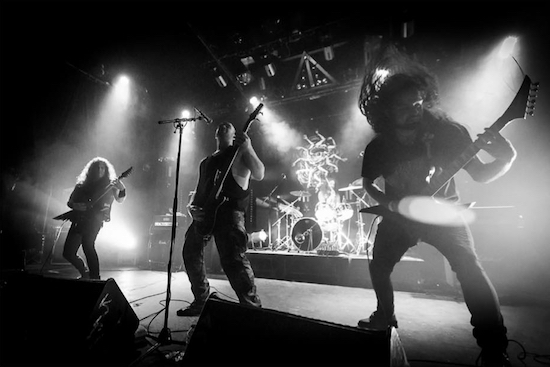
Ritual Necromancy quickly rose to power upon being risen in 2008 after putting into effect their evil practice on their debut demo which was shortly followed up by "Oath of the Abyss". Despite the lacking production the material spoke volumes of the band's potential that soon came to fruition on "Void Manifest". That EP floored the masses and signaled even greater things to follow. "Disinterred Horror" made grave-fall and quickly became the band's most accomplished offering, giving supporters a real treat of terror and ever more reasons to stay clenched to the music. Justin Friday backed by members with massive experience under their belt through involvement with bands the likes of Weregoat and Terror Oath could do no wrong as the march to desecrate and destroy with their demonic death metal continues.
Alex
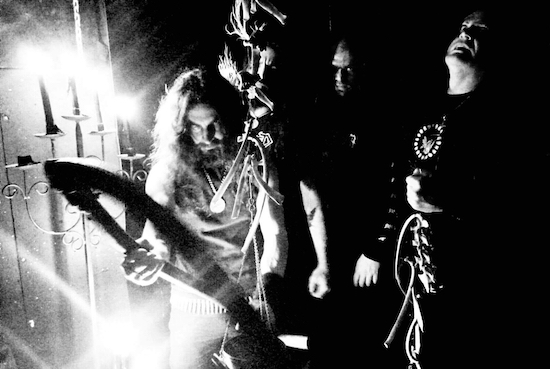
Thanks for doing this interview with MetalBite; how has everything been going with yourself and touring in Ritual Necromancy?
Cheers Alex! All has been well. Our last tour in Europe was pure mayhem, we will certainly be back soon!
What compelled you to form Ritual Necromancy?
Unseen forces... the beyond. The drive to herald the unknown that is impossible to perceive. An addiction to chaos and what we as humans consider death and the perception of finality.
How did you go about contriving the band's name?
I wouldn't say we contrived the name but, it seemed a fitting representation of the point of the band; to communicate with and represent our ideas of death and, all that we perceive it to be.
How did the team behind Ritual Necromancy meet?
Psychedelics in a graveyard and a proper desire to make extreme death metal.
Since being formed in 2008 you have managed to put out 2 full length records an EP and a demo with each showing considerable progression and song writing improvement. Thus, how tough are the members of Ritual Necromancy are on each other when it comes to constructive criticism?
We are very tough on each other. Since the first demo, we knew, collectively, what we expected from one another for each of the next recordings. A vision or idea has to be fulfilled and given that a majority of the music was written by a bass player and a drummer, the interpretation of those ideas by the guitarists had to match or exceed what we wanted and be performed accurately. There is no excuse for settling.
Who writes the lyrical content and where do you draw inspiration from to construct a 'Command the Sigil' or 'Void Manifest'?
I write the lyrics. The themes often come from dreams and/or hallucinations, with or without drug inducement. I try to propel an embodiment of complete control while being entangled in chaos. It's an interpretation of derangement, disembodiment, pure violence and fear, while devoid of the general conscious and relationship humanity tries to rationalize and mold into something inherently acceptable that our collective minds deem capable to process.
What is the compositional process of a song like? Walk us through the steps.
It's very simple. Someone creates a skeleton for a song, and we work it and add and subtract ideas until it satisfies us all.
Is there a particular mood you have to be in before you begin to compose music for the band?
Yes. The music demands a mindset of horrid nature.
How do you deal with creative roadblocks if ever you encounter such?
The roadblocks are inevitable. We just put it aside and try something new until we are ready to go back and revisit an idea with a new mentality.
Your vocals are extremely deep; they sound just as precise and powerful live as they do in the studio. How long have you been doing death metal vocals?
I did vocals in a death metal band a couple years prior to Ritual Necromancy but, that is it. The vocals are catharsis to me and represent an embodiment of something inhuman. No practice, no warmup, only possession.
I enjoyed the promotional video for 'Command of Sigil', I interpret that was about invoking the deceased, or is there more to it?
It is a horror meant to be conquered. One must not fall victim to what they conjure, to conjure is to command. Thus, as a story, the song is about one who fell victim to what they called forth and all its horrors whilst demonstrating to the listener the power they should seek to obtain.
Thus, without being too direct, what do the lyrics on the 'Disinterred Horror' album reflect?
A delving into the psychosis of what one sees, feels, thinks, when summoning the unknown inhabitants of the dimensions of death and devours our idea of life in their wake.
Does 'Disinterred Horror's music transcend what some term as fiction to a space within reality?
One can only try.
Are there any books, figures etc. you borrow content or cite as inspirations for Ritual Necromancy?
No. Nothing borrowed or cited but, there are a lot of ideas out there that coincide.
Is the music at all attached to any personal experience/s?
Yes. All of the music was derivative of experiences and ritualistic practices we sought out.
For me the artwork on Disinterred Horror represents/depicts the manifestation of the logically unreal into the real. From a philosophical perspective what would you say the artwork signifies?
Exactly that. Josh McClear painted an incredible depiction of what I asked of him. To find the unknown and repressed nature of himself and his art. An instinct, not a conscious display.
Is there any new material being constructed for a new album?
We are in the writing process for a new album. We also have an unreleased track from the Disinterred recording scheduled to be released as split very soon.
Can you give any hints about direction or what and where you'd like to see the album progress towards?
All we can say is that it is even more extreme, musically and thematically.
Having been involved in other bands such as Death Fetishist and Noctis, did you at any point find those influences bleeding into Ritual Necromancy?
I only played with those bands as a live musician, and it was only a few gigs each. So, to answer your question, no, nothing bled into the other.
Portland is rich in quality death metal, are there any bands playing the genre you currently admire from the area?
There are so many bands out of that area now and most of them are quality and keeping true and wretched death metal alive for years to come. When we started there was nothing by way of death metal. And now there are dozens of bands. Torture Rack, Witch Vomit, Sempiternal Dusk, Apraxic, Shrine of the Serpent, Nightfell, Diabolic Oath are a few to check out. Again, there are so many now that it is hard to keep track.
Do you see the possibility of a split record somewhere in the future with any of the mentioned bands?
We do have plans for a split with another band from that area but, not from Portland. I won't spoil the announcement here but, we should be announcing it and releasing it within this year.
How has the relationship between Dark Descent records and Ritual Necromancy been as of late?
It's always been great. Matt and Dark Descent remain true to their support and proclamation of underground metal, just as they began.
I always thought Oath of the Abyss could use a production overhaul, the music was really robbed of its effect, yet the album is still sound compositionally. Could you say if there will be any reworking of the album's production in the future?
No, I don't think we will ever rerelease Oath with a new production. I can't deny that those songs deserve a better production but, it is what it is. And while the recording isn't the best, it's still very odd and serves its purpose.
It's been great chatting with you, thanks for even acknowledging MetalBite's interview request. We want another album soon. Any closing words for the masses?
Cheers again Alex and thanks for the support! We will have another slab of insanity for everyone to feast on soon! All the one truth! All hail DEATH!

Discography
Upcoming Releases
- Artillery - Made In Hell - May 15
- Desecresy - The Secret Of Death - May 21
- Blossom Death - Spirit - May 21
- Dark Millennium - Come - May 22
- Piołun - Exolvuntur - May 22
- Downfall Of Nur - And The Firmament Will Burn To Quench The Pain Of This Earth - May 22
- Opera IX - Veneficium - May 22
- Deathstorm - Cascophonies - May 22
- Shewolff - We're All Gonna Fukkin' Die - May 22
- Dimmu Borgir - Grand Serpent Rising - May 22
- Malebeste - Monestherou - May 25
- Godthrymm - Projections - May 29
- Trelldom - ...By The Word... - May 29
- Pharmacist - Vertebrae After Vertebrae - May 29
- Crocell - Swarm Of Insects - May 29
- Seven Metal Sins - Legacy Of Chaos - Jun 05
- Bloody Falls - IV - Jun 05
- Urkraft - Naturens Skrik - Jun 05
- Fleshcrawl - Epitome Of Carnage - Jun 12
- Woewarden - The Roots Of My Neglect - Jun 12